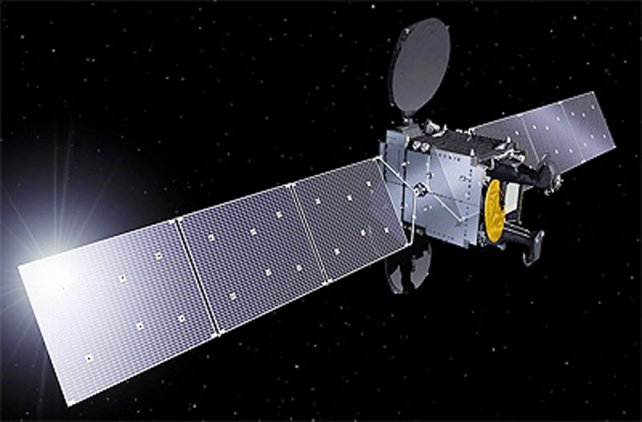
German Media Report Russia Plans Nuclear Satellite Launch This Year
Russia plans to launch a satellite equipped with a nuclear payload into space this year, the website of German broadcaster ARD reported Monday, citing Western intelligence agencies, including Germany’s Federal Intelligence Service (BND).
A joint investigation by the German news organizations WDR, NDR and Süddeutsche Zeitung found that the satellite, probably named Sputnik-S, could be launched as early as December, according to an assessment by the Bundeswehr Space Command.
Information on the matter was recently exchanged among several NATO countries.
Because NATO armies are far more dependent on satellites than Russia is, detonating a nuclear weapon in space could give Russia at least a short-term advantage in the event of war, ARD stressed.
Asked for comment, the Russian embassy categorically rejected “all baseless accusations concerning the activities of the Russian Federation in space.” It said the accusations were “part of a propaganda campaign.” Russian “activities in the exploration and use of outer space” were “carried out in accordance with international obligations” and served “exclusively peaceful purposes,” the broadcaster reported.
Kremlin spokesman Dmitry Peskov, meanwhile, said the German reports contain so many qualifiers such as “allegedly” and “perhaps,” and “references to who knows whom,” that they should probably not be taken seriously.
In October of last year, the U.S. Defense Intelligence Agency (DIA) published a report on the space situation stating that Russia is developing a satellite designed to carry a nuclear weapon.
Experts believe the consequences of a nuclear explosion in space would be severe. U.S. Space Command chief Stephen Whiting said recently that “probably about one-third of all satellites in low Earth orbit would fail immediately.”
In addition to disabling civilian and military satellites, detonating an atomic bomb in outer space would likely create a cloud of debris that would also threaten satellites not directly affected by the blast.
Another challenge would be a very powerful electromagnetic pulse generated by a nuclear explosion in space, which could also lead to widespread failure of technical systems on Earth.
Satellites are essential to daily life, and their widespread failure would adversely affect GPS systems used in navigation, banking, power grids and cellular networks. In the military sphere, some weapons systems would be almost paralyzed, and reconnaissance and communication within armed forces and with allies would be seriously hampered.
Western observers, including U.S. intelligence agencies, have focused in recent years on the Russian satellite Kosmos-2553, which was launched into space in February 2022, shortly before Russia’s full-scale invasion of Ukraine. According to official Russian statements, the satellite was meant to serve scientific research on radiation in space. However, those claims have met with considerable skepticism from Western intelligence agencies.
German security sources told WDR, NDR and Süddeutsche Zeitung that Kosmos-2553 is now believed to have probably been a test of the effects of using nuclear weapons in space. It was meant to serve as a dummy to test the impact of radiation on other satellites and to determine the point at which it would suffer serious damage.
Western intelligence agencies suspect that Russia intended to use Kosmos-2553 to test flight and maneuvering capabilities in conditions of high radiation. (PAP)