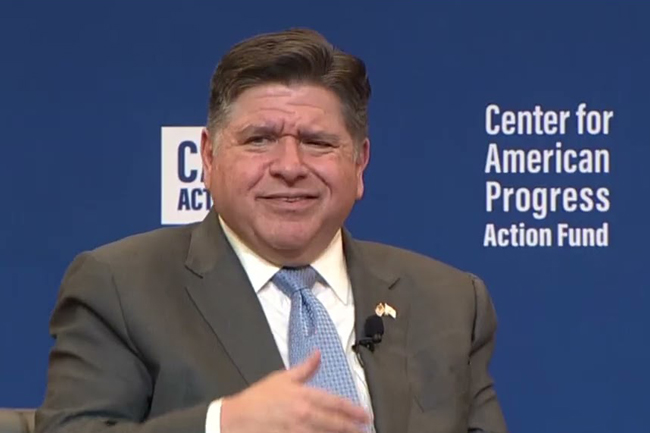


Illinois will not join the federal school voucher program launched by President Donald Trump’s administration, Gov. JB Pritzker announced this week. Shortly after taking office in 2025, Trump signed an executive order that prioritizes federal funding for programs that allow families to choose their schools (school choice).
In October of this year, his administration announced a new federal scholarship program that, starting in 2027, is meant to help pay for private school tuition, homeschooling and other education expenses. The program, called the Federal Scholarship Tax Credit, would create a taxpayer-funded incentive meant to encourage families to choose private schools or homeschooling in states participating in the initiative. On Tuesday, Gov. Pritzker made clear that Illinois will not be among those states.
“At a time when public school education needs investment more than ever, we should not be diverting funds from public schools to private education, especially as the Trump administration’s policies are devastating the education system,” reads a statement issued by the Illinois governor. “We have a duty to look after all of our students. Taxpayer money should not be used to subsidize private schools that may discriminate on the basis of religion, sexual orientation or other characteristics,” he added.
In his statement, Pritzker said the voucher program diverts “critical attention and resources from Illinois students attending public schools, while guaranteeing neither equal access nor oversight of the recipients of these vouchers.” He also noted that President Trump has sought to dismantle the U.S. Department of Education, has previously threatened to withhold federal funding for public education, and has eliminated important protections for students in difficult circumstances. According to the Illinois State Board of Education, the state’s fiscal year 2027 budget earmarks about $10.8 billion for education, 9.2% of which comes from federal funds. “Although Trump presents the voucher program as a success for students, his administration is actively working against their success,” Pritzker wrote.
Under the program, individuals can donate up to $1,700 to scholarship-granting organizations (SGOs) and receive an equivalent federal tax credit in return. The organizations can then pass those funds on to eligible families to cover tuition or other education-related expenses. Donations to any SGO can be made by people in any state, but the money can be distributed only in states that have joined the program.
JB Pritzker said federal rules on SGOs “explicitly prohibit states from setting strict guidelines or standards for scholarship-granting entities.” In the Illinois governor’s view, this means federal funds more often support children attending private schools “without adequate oversight,” while the needs of public education go unmet. Pritzker, like other officials, also voiced concern that governors have no say over which groups can receive funding and cannot stop SGOs from discriminating against eligible families on the basis of religion, sexual orientation or gender identity. There are also no mechanisms to ensure that scholarships go to students from low-income families. The federal voucher program allows families to participate if their income is as much as 300% of the area median. “The voucher program is meant to promote the privatization of education,” the governor wrote in a press release. “Formally joining this program gives the state of Illinois no assurance that resources will be secured for the 1.8 million students attending public schools,” Pritzker stressed.
The Illinois Education Association (IEA), the state’s largest union representing teachers and education workers outside Chicago, welcomed Pritzker’s decision. “Public money should go to public schools, period,” IEA President Karl Goeke said in a statement. “1.6 million public school students in Illinois, their parents and educators across the state were counting on Gov. Pritzker to reject vouchers and stand up for public education, and that is exactly what he did. We are thrilled and grateful,” Goeke said. IEA representatives noted that more than 60% of public schools in Illinois are underfunded, adding that the Trump administration’s voucher plans “will starve schools of funding.”
The Chicago Teachers Union (CTU) has not yet issued a statement on the governor’s decision. The Catholic Conference of Illinois, a public policy organization that, among other things, supports private Catholic schools in the state, issued a statement opposing the decision. It reads in part: “Today, Gov. Pritzker chose to reject approximately $2 billion in federal funds that, starting in 2027, could have supported public and private school students in Illinois. We are deeply disappointed that the governor did not join the more than half of American governors who have chosen to join the Federal Scholarship Tax Credit (FSTC) Program. We are also completely baffled by this decision.”
With Democrats poised to take over, holding what will be a historic majority in the U.S. Congress from January, Gov. Pritzker is pressing them to restore the Department of Education to full functionality, resume federal oversight of and support for special education, and take other steps to “repair the damage to our education system” caused by the budget bill, known as the “One Big Beautiful Bill,” which Republicans pushed through with Trump in 2025. Five other Democrat-led states, Wisconsin, Minnesota, Arizona, Oregon and Virginia, have also decided not to join the program.
Several Democrat-led states, including New York and Colorado, have decided to participate. In Kentucky, North Carolina and Kansas, Republican-dominated state legislatures overrode vetoes by Democratic governors, forcing those states to join the voucher program. In total, 30 states have joined the program.
BK
Source: Polski.FM