Pentagon Deputy Chief Leaves Ukraine Meeting After Criticizing Kyiv’s Strikes Deep Inside Russia
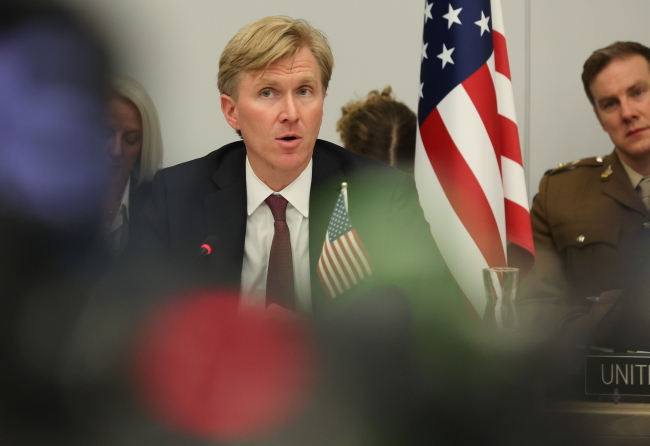
Deputy Pentagon chief Elbridge Colby left Tuesday’s meeting on Ukraine in Brussels after criticizing Kyiv for strikes on targets deep inside Russia. The U.S. official did not stay for the closed-door briefing, the Daily Telegraph has revealed. According to German sources, the move raised concerns about a U.S. shift toward Moscow.
According to the British daily, Colby left the room where the Ukraine Defense Contact Group (UDCG), also known as the Ramstein group, was meeting at NATO headquarters, right after speaking during the public portion of the meeting. The deputy defense secretary said he believes Ukraine’s long-range strikes do not deliver significant military benefits.
The U.S. official did not even stay for the closed presentation by Ukrainian Defense Minister Yevhenii Khmara on the situation at the front. U.S. Ambassador to NATO Matthew Whitaker represented the United States for the rest of the meeting. According to one account, Colby had to catch a flight, but, the newspaper reported, he still held a press conference before heading to the airport.
The behavior of the Donald Trump administration’s representative alarmed European allies, who consider attacks on Russia’s rear areas a key operation for weakening the Kremlin’s war machine. A well-informed source in Berlin told the Daily Telegraph on Wednesday that participants in the meeting were surprised by the American’s position.
“Colby left immediately after his speech. He did not even listen to Minister Khmara’s classified briefing, which made clear that strikes deep inside Russia are an important part of the war effort and have had, and will continue to have, an enormous impact,” the source, who wished to remain anonymous, told the paper.
German sources told the newspaper that the U.S. stance is causing growing concern in Europe because Washington is beginning to echo the Russian narrative.
“In that room, the United States was the only country that sided with Russia’s narrative rather than with Ukraine and the rest of the coalition,” the German source said, adding that limiting Ukraine’s actions to fighting on the front line and medium-range strikes deprives it of a key tool for preventing Russia from achieving success at the operational-strategic level.
The source also pointed to a contradiction in Washington’s position, noting that the United States itself uses long-range strikes in its operations against Iran.
“How can the Americans carry out deep strikes (in Iran) and at the same time criticize a nation defending itself against an illegal invasion for using the same methods?” the official quoted asked.
Colby’s remarks had already drawn a sharp reaction in Europe. German Defense Minister Boris Pistorius called them “stupid,” while British Defense Secretary Wes Streeting defended Ukraine’s operations, arguing that they help weaken the Russian war machine, buy Kyiv time and save the lives of soldiers and civilians. The United Kingdom also announced it would provide Ukraine with 1,000 long-range drones.
On Thursday, Berlin will host a summit of the so-called coalition of the willing, convened by German Chancellor Friedrich Merz, French President Emmanuel Macron and British Prime Minister Andy Burnham. Participants will include Ukrainian President Volodymyr Zelenskyy, Finnish President Alexander Stubb and Czech Prime Minister Andrej Babiš, among others. Prime Minister Donald Tusk will represent Poland. U.S. President Donald Trump’s envoys, Steve Witkoff and Jared Kushner, will also take part in the talks on postwar security guarantees and the reconstruction of Ukraine. (PAP)