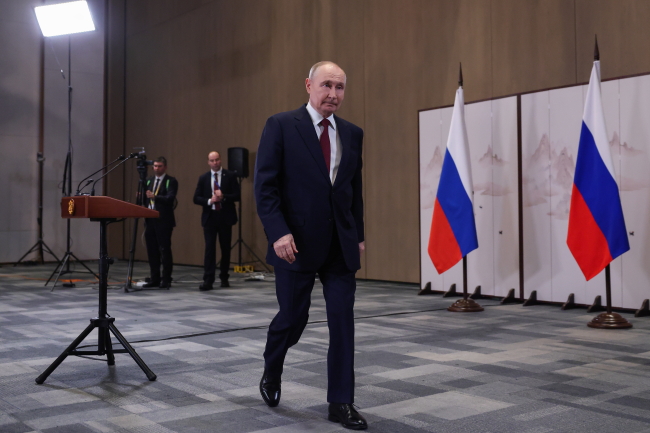


Russian expectations for the summit of the U.S., Chinese and Russian leaders in Shenzhen proved to be decidedly overblown: Moscow failed to achieve any successes, and the effective attack on the Kerch Bridge is a serious blow to Moscow, both practical and to its image, Oleksiy Melnyk of the Razumkov Center in Kyiv told PAP.
The meeting of the U.S., Chinese and Russian leaders at the APEC summit in Shenzhen, China, on Nov. 18-19 was an opportunity for Moscow to build its image as a global superpower. In reality, however, Russia’s current capabilities and potential do not match that image, and analogies with the 1945 Yalta Conference, where the division of spheres of influence after World War II was agreed, do not fit present geopolitical conditions.
“What happened recently is very symbolic: today Putin is unable either to get to Yalta or to invite world leaders there (the city of Yalta is located in occupied Crimea – PAP),” Melnyk, director of the foreign policy and international security program at the Razumkov Center in Kyiv, told PAP. He was referring to the Ukrainian attacks on the bridge across the Kerch Strait, which caused part of the road span to collapse and damaged the rail span.
Russia is currently limited above all by its economic capacity: its GDP is significantly smaller than that of the U.S. or China. This situation is shaped both by the sanctions imposed over its aggression against Ukraine (already after the annexation of Crimea in 2014, and tightened after the full-scale invasion in 2022) and by Ukrainian attacks on the oil sector, which have limited Russia’s ability to refine and export oil. This last factor is crucial for Russian budget revenues, both now and in the longer term, because most European countries have given up Russian supplies or intend to do so soon.
Moscow’s limited ability to project military power is also a problem: the Russian army has been unable to defeat Ukraine, which has far less potential, in nearly five years of war, and nothing suggests that this will change. One of the last attributes of Russia’s status as a major power is its nuclear arsenal, although even here the Russian military has problems. One element of the nuclear triad, the strategic bomber fleet, has suffered significant losses in the war with Ukraine.
The destruction of the road crossing from Russia to Crimea two days before the Shenzhen meeting (on the night of Nov. 16-17) is a serious blow, including to the image of Russian leader Vladimir Putin. Despite this, Moscow is not inclined to change its policy.
“The Russians are not interested in peace; they want the war to continue. They believe that sooner or later they will break Ukraine and it will fall into their hands. Putin is convinced that everything is going well, or at least presents himself that way,” Melnyk said. He noted that at this stage the ongoing war is a war of attrition: it will be won by whoever has the resources and the will to keep fighting longer. At present, however, nothing indicates that either side is inclined to give up the fight.
“The Ukrainian delegation proposed an agreement on a ceasefire, either on energy or in the Black Sea. Russia rejects these proposals, as it does the very logic of the peace process, under which there should first be an agreement on a complete cessation of fire so that there is room for diplomacy,” Melnyk said.
Hostilities are not abating, and the autumn and winter period has additionally brought an intensification of attacks on Ukrainian energy infrastructure.
Moscow is far from success in the war with Ukraine, which does not stop it from consistently putting forward demands on security across the entire European continent. These have not changed since December 2021, when Russian Foreign Minister Sergei Lavrov presented a list of conditions that Ukraine and European countries should meet as part of creating a “new security architecture in Europe.” Under the ultimatum announced at the time, Ukraine should remain outside NATO structures and limit the size of its armed forces, while the countries of the alliance’s eastern flank should withdraw from their territory infrastructure, troops and any installations that appeared there after the organization’s enlargement at the turn of the 20th and 21st centuries.
The question of the prospects for further peace negotiations and the role of European countries remains open. Russian leader Vladimir Putin did declare, after the meeting with the leaders of the U.S. and China, that there would be no further talks after the destruction of the Kerch Bridge. On the other hand, at the same news conference many threads directly related to the prospect of further negotiations emerged. As the Reuters news agency reported on Thursday, Putin once again repeated that the issue of Ukraine must be integrated into a “new security architecture in Europe.”
EU and NATO countries want to have a say in the talks because their outcome will directly affect security on the continent. The problem is that Russia above all does not want this. It would prefer to avoid additional pressure from countries that are unfriendly to it, including Poland, which would represent the interests of NATO’s eastern flank countries within the so-called E5 group, also made up of Germany, the United Kingdom, France and Italy.
“The final word will belong to the administration of U.S. President Donald Trump. One of the points the U.S. is proposing as part of the three-way negotiations is Ukraine’s membership in the EU. But how can this be achieved without the participation of the EU countries themselves?” the expert from the Kyiv think tank wondered.
Russia’s demands are, above all, too exorbitant in relation to the resources it has and its ability to influence the international situation.
“What Russia wants is absurd, so the Kremlin will not receive the benefits it would expect, such as NATO’s return to its 1997 borders. I strongly doubt there would be agreement to that, even from Donald Trump,” Melnyk said.
In the opinion of most analysts, none of the powers whose leaders met in Shenzhen (Russia, the U.S. and China) currently has tools of influence on a global scale, including over European countries, effective enough to impose solutions and the implementation of specific decisions, even if such decisions were made at meetings as high-level as last week’s summit. (PAP)
Dariusz Materniak