
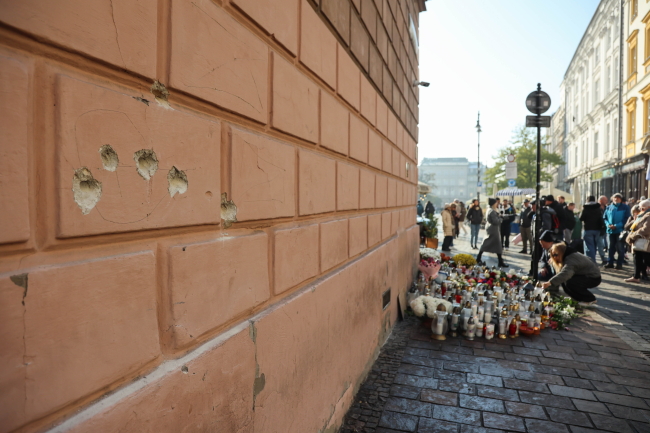


The attack in Kraków is the first major tragedy that did not unite Poles, Prof. Katarzyna Bąkowicz of SWPS University told PAP. Dr. Krzysztof Grzegorzewski pointed to the phenomenon of the political parallelism of media, which can be defined this way: tell me what TV channel you watch, and I will tell you how you will vote.
An attack took place Saturday on the Main Square (Rynek Główny) in Kraków. A 24-year-old man drove a car onto the square and began shooting at random people. After a few minutes, he was neutralized by police officers, who sustained serious injuries during the intervention. The perpetrator died Monday morning of gunshot wounds. Seven people were killed in the Kraków attack. Three other victims were members of the 24-year-old’s family, whom he killed in Ostrowiec Świętokrzyski.
PAP asked media scholars why Saturday’s tragedy so quickly became the subject of political disputes.
Dr. hab. Katarzyna Bąkowicz of SWPS University noted that people have a natural need to quickly explain and understand such events.
“When something happens that departs from social norms, we very quickly need to explain it to ourselves. That is why there is a desire to share even unverified information, to send each other videos or photos,” said Bąkowicz, whose academic work also includes research on disinformation.
She added that the need to assign the perpetrator a specific label emerges just as quickly. “To feel safe, we need to know who this person was, so that, for example, we can avoid meeting someone similar,” she said.
“Our first associations with the behavior of such a person point us toward extremist circles. And depending on which side of the political scene someone is on, they will attribute those traits to radicals from the opposing side,” she added.
On Saturday evening, Marcin Kierwiński, head of the Ministry of Interior and Administration (MSWiA), said at a press conference that, according to findings so far, the perpetrator acted alone and was fascinated by far-right ideologies. On Monday, MSWiA spokeswoman Karolina Gałecka said that the case of an AI-generated image showing Kierwiński allegedly shaking the attacker’s hand would be referred to prosecutors. The fake image was circulated by, among others, a TV Republika journalist.
Bąkowicz stressed that the political calendar also influences how people react to the tragedy, including the upcoming parliamentary elections, which could change the balance of power on the Polish political scene. In her view, politicians use such events for their own purposes, with no regard for moral boundaries. “The more emotional something is, the easier it is to attach politics to it,” she said.
The expert also noted that, unlike earlier tragedies, the events in Kraków did not unite Poles.
“In the face of tragedy, Poles have always come together. They came together, for a longer or shorter time, after the death of the pope or after the Smolensk crash, as well as other disasters. But this time that did not happen; we divided immediately. I see this as a very dangerous signal showing that the world we know is fading into oblivion,” Bąkowicz said.
In her view, while the number of photos and videos posted online after the Kraków attack is not surprising, the behavior of some media outlets, including TV Republika, should provoke outrage. “The media have stopped even pretending that they are not political. It used to be that saying the media were politicized was taken as an insult. Now it no longer impresses anyone,” the expert noted.
“This kind of politicizing and extremizing of everything has led to a normalization of violence. We are becoming less and less sensitive, hence this lack of unity. Since everything is becoming a bargaining chip in politics,” she said.
According to Bąkowicz, the events in Kraków should prompt a discussion about regulating the information space. But as she noted, this would require political courage.
Media scholar Dr. Krzysztof Grzegorzewski of the University of Łódź sees a similar phenomenon. In his view, the tragedy in Kraków showed once again that news media are giving way to identity-based media, and that this trend is visible even in coverage of events that seem remote from politics.
The expert explained that this phenomenon is known as the political parallelism of media. “Political parallelism can be defined this way: tell me what TV channel you watch, and I will tell you how you will vote,” Grzegorzewski said.
In his view, the phenomenon is deepened by social media, which he calls “algorithmic platforms.” Their aim is to hold users’ attention for as long as possible, so they favor stirring up emotions and creating closed information bubbles that reinforce polarization. (PAP)
