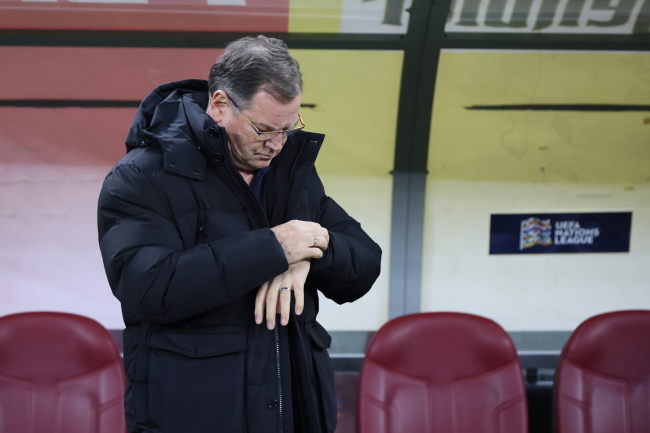


Jan Urban was welcomed with enthusiasm as head coach of Poland’s national football team in July 2025. More than a year later, little of that enthusiasm remains, but despite a disappointing year, the leadership of the Polish Football Association (PZPN) has decided to give him another chance.
– We believe this choice will allow the national team to realize its full potential. Our goal is to qualify for the 2026 World Cup – PZPN president Cezary Kulesza declared on July 16, 2025, the day before the coach’s official presentation.
Urban, now 64, took over a squad shaken by a 2:1 loss to Finland in June 2025 in World Cup qualifying. The poor showing in Helsinki was preceded by then-coach Michał Probierz stripping Robert Lewandowski (who was absent from that camp) of the captain’s armband, and by Lewandowski’s decision to stop playing for the national team under that coach.
Two days after the match in Helsinki, Probierz resigned. Urban was the media’s leading candidate for the job from the start, and PZPN president Kulesza eventually came to the same idea.
The new coach quickly won the trust of the locker room. He gave the armband back to Lewandowski, and in his debut, on September 4, 2025, he drew 1:1 away to favored Netherlands.
When his team beat Finland 3:1 in Chorzów three days later, the praise knew no bounds. Fans chanted Urban’s name, and journalists greeted him with applause at the postgame news conference.
– I’m from this region, I played here, so apparently I left a good impression and the fans appreciate it. But I won’t be fooled by this (applause – PAP). I know how close it is from heaven to hell and the other way around. Let’s enjoy the moment, because the “grill” awaits – the coach remarked.
The fall of 2025 was not yet bad. The team kept winning, and when it did draw, it was – again – 1:1 with the Netherlands, this time in Warsaw.
The real test was to come in March 2026, in the playoffs for a World Cup berth. Poland won its path’s semifinal against Albania 2:1 at PGE Narodowy, but lost the final near Stockholm to Sweden 2:3.
The setback did not shake the coach’s position, and soon afterward the PZPN president announced that his contract had been extended.
On April 10, a heavy blow struck Urban and all of Polish football. His assistant on the coaching staff, Jacek Magiera, died suddenly at age 49 after collapsing during a running workout. The coach had lost an excellent adviser, and the players an authority figure.
It is hard to say exactly how the tragedy affected the national team and the staff, but the fact is that subsequent results and the team’s play kept getting worse. The squad drew criticism for its May-June home friendlies (a 0:2 loss to Ukraine, a 2:2 draw with Nigeria), and in the fall it played poorly in the second division of the Nations League, where it barely avoided relegation, finishing third.
The only win for the white-and-reds came on October 2, when they beat Romania 6:0 in Warsaw while the opponent played a man down for a long stretch. They lost to the same opponent 1:2 in Bucharest in November, failed to score against Bosnia and Herzegovina (0:0 and 0:1), and against Sweden they lost 1:3 and – in their final outing – drew 1:1 in Wrocław.
Even before the November Nations League matches, there was no shortage of opinions that Urban’s fate was practically sealed, regardless of the results in Bucharest and Wrocław.
Supporters of the current coach pointed out, however, that the national team is in the midst of a rejuvenation process. After the last match of the year, Urban himself reminded reporters about the introduction of new players. As he noted, it is a process that must take time.
– The vast majority of these young players are at the stage of gaining European experience, including with their clubs. Despite that, they got a chance with the national team. Now we certainly have more choice, because we’ve gotten to know them and we know what they are capable of. But such adaptation must take time, even two years – he explained.
As it turned out, President Kulesza once again put his trust in the experienced coach. After Tuesday’s meeting between PZPN officials and the national team staff, it was announced that the coach would remain in his post.
Urban was born on May 14, 1962, in Jaworzno. He began his football journey at the local Victoria, then signed with Zagłębie Sosnowiec in 1981. Good performances earned him a transfer to Górnik Zabrze, which then dominated domestic football, although he had earlier come close to moving to Lech Poznań.
With Górnik he won three straight Polish league titles in 1986-1988. Before leaving for Spain, he had played 237 matches in Poland’s top league, the Ekstraklasa, and scored 77 goals. Decades later, in May 2025, he was inducted into the Ekstraklasa Legends Gallery.
In 1989 he joined Osasuna Pamplona. In 1991 he finished fourth in La Liga with the club, which meant a spot in the UEFA Cup. In that historic season he also played one of the best matches of his career – on December 30, 1990, he scored three goals against Real Madrid at Madrid’s Santiago Bernabéu, and his team won 4:0.
After that feat, Urban for a time even topped the scoring standings, and he ultimately finished fifth with 14 goals.
At the peak of his form, in the fall of 1991, he played his 57th and last match for the national team. It was a European Championship qualifier against England (1:1) in Poznań. He scored seven goals for the national team, with which he debuted in 1985. He took part in the 1986 World Cup in Mexico, where the white-and-reds were eliminated in the round of 16 after a 0:4 loss to Brazil.
He spent six years at Osasuna. During that time he played 156 matches and scored 45 goals. In 1995 he briefly moved to Real Valladolid, and after one season went to CD Toledo. He closed the Spanish chapter of his career with 177 top-flight matches and 49 goals.
In the summer of 1996 he joined Germany’s VfB Oldenburg, and at the start of 1998 he returned to Górnik to finish the 1997/98 season – and his rich career – back on familiar ground.
– I was 35, but I still wanted to play. I had an offer from Egypt, but I’d heard about tourists being kidnapped in that country and decided not to go. Then Górnik president Stanisław Płoskoń called. The team had problems in the league, so I agreed to a six-month contract. I wanted to stay longer on similar terms, but we didn’t reach an agreement and parted with no hard feelings. Right away, though, I got an offer to work with youth at Osasuna. For me it was a great thing, a gentle transition to the “other side of the river” – he recalled.
His youth coaching in Pamplona was interrupted for a year by a job at second-division Polideportivo Ejido. In the 2005/06 season, he then coached Osasuna’s reserves. He did not hide, however, that earlier he had not thought about becoming a coach at all.
– Toward the end of my playing days, I coached kids. We took part in a 5-on-5 league with small goals. That’s how it started. At Osasuna I worked as an assistant coach of the second junior team. And I wasn’t at all sure I wanted to be a coach. I think I realized it was great when we won the Spanish championship in the oldest junior group. That was the spark – he admitted.
The breakthrough in his coaching career came on June 4, 2007, when Legia Warsaw unexpectedly announced that Urban would be the team’s new coach. In his first season he won the Polish Cup and finished as league runner-up, and also won the Super Cup (2008). Under his wing, players such as Maciej Rybus and Ariel Borysiuk first emerged and later became leading figures on the team. He stressed, however, that bringing in young players cannot come at the expense of results.
– I put a “kid” in if he deserves it. In a team that functions well, he’ll make use of it and move forward – he claimed.
In 2013 he won the league title and the national cup with Legia.
As a coach he radiated calm and openness. He quickly won the affection of fans and the media, as well as of players, who often stressed that he is fair and cares about the atmosphere in the team.
His two spells at Legia were separated by brief stints at Polonia Bytom and Zagłębie Lubin.
In July 2014, Urban became coach of Osasuna, with which he was to return to the Spanish top flight. Less than eight months later he was fired, with the team in 16th place in the Segunda División.
He worked without major success and fairly briefly at Lech Poznań (Super Cup) and Śląsk Wrocław, before landing at Górnik in mid-2021. He worked there until mid-April 2025, with an eight-month break around the turn of 2022 and 2023.
He regarded his return to Zabrze in the spring of 2023, when the specter of relegation loomed over his favorite team, as the most difficult experience of his club career. But after a great run under his leadership, Górnik finished the season in sixth place.
Urban had also earned his coaching stripes with the national team. In 2008, before the European Championship, he joined Leo Beenhakker’s staff.
– I was at an age where he probably wouldn’t have called me up as a player – he joked. – It came at the expense of my vacation, but I was glad to go and work with a coach like Beenhakker – he recalled.
And the famous Dutchman said boldly that he saw in Urban, or in Adam Nawałka, who was also on the staff at the time, candidates to replace him with the national team.
Nawałka ultimately took the job in the fall of 2013, and Urban had to wait a long time yet…
The current coach has for years divided his time between Poland and Spain, which also affects his approach to life, including to coaching.
– My daughter lives there, my son commutes. We have a base in Spain. I live in the north, where it snows in winter and the Pyrenees are nearby. It was in Spain that I learned to ski. I’m a Pole, but I feel very good there too. I’m appreciated, respected, my kids and wife have their friends, we feel at home. We’ve lived in two countries for years – he recalled.
Plans for a quiet retirement will have to wait, however. The national team coach’s chair is hot, but Urban stays in it. Probably at least until the end of Euro 2028 qualifying…
Maciej Białek (PAP)