
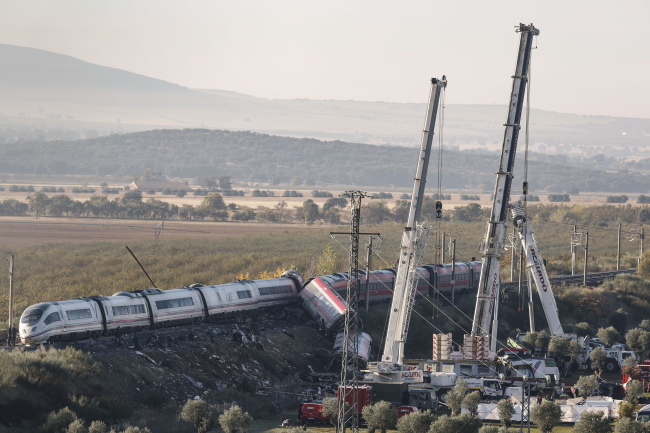


The driver of the Iryo train that was struck from behind by a Renfe train on the Madrid–Seville line on Wednesday twice told the Adif traffic control center that she was not moving and had problems with the train’s continuous speed control system, according to excerpts of recordings of communications between the center and the drivers. The excerpts were released overnight Wednesday into Thursday. Adif is Spain’s rail infrastructure manager.
The collision killed 68 people and injured 122. A total of 544 people were aboard the trains.
Despite the driver’s reports, the control center did not order the Renfe train, which could have reached speeds of up to 200 km/h (about 124 mph), to stop. As public broadcaster RTVE noted, that means Adif allowed the drivers of both trains involved in Wednesday’s crash, Renfe and Iryo, to resume travel, but only the Renfe driver actually set off.
At 8:36 a.m., the control center advised the driver of the Renfe AVE train to resume travel at normal speed, which on that section can reach as high as 200 km/h. Like the Iryo driver, the driver of that train had earlier reported a problem with the operation of the speed control system.
“I will give you authorization. (…) The thing is that the Urda exchange went down, so we are checking it. […] We’re considering disconnecting the system, just a moment. […] We will disconnect it,” a traffic management center employee said. He then added: “Train driver, please disconnect the system. Once you pass Urda, this problem will no longer be there and the system will start working again. This is Atocha to the train driver: please disconnect and reconnect the LZB system and resume travel under the BSL system at normal speed.”
Transport Minister Oscar Puente called this decision “inexplicable” at a press conference on Wednesday.
The recordings show that while the Renfe train was setting off and picking up speed, the Iryo driver told the control center on the same track that she was still stopped.
“I lost transmission and was stopped at the entry signal to Urda,” says one excerpt of the recording. The center replied that it had received the message and soon ordered her to “resume travel in normal mode.” A later excerpt shows that the driver again reported problems with the speed control system and said that this was “why she is still stopped.” The center’s response was: “Fine, when it is possible.”
The daily El Pais stressed that this information gave the control center about five minutes to change its decision and prevent the disaster. “Meanwhile, the AVE was racing along a line built for speeds of 200 km/h. In those minutes it covered about 25 km,” the newspaper wrote.
According to the government, the trains collided at 8:53 a.m. RTVE reported that sources close to Iryo say that the Iryo driver was already in contact with the control center at 8:38 a.m., and that at 8:48 a.m., the moment the operator identifies as the time of the collision, the train had not yet received permission to resume travel.
From Madrid, Justyna Wojteczek (PAP)
