
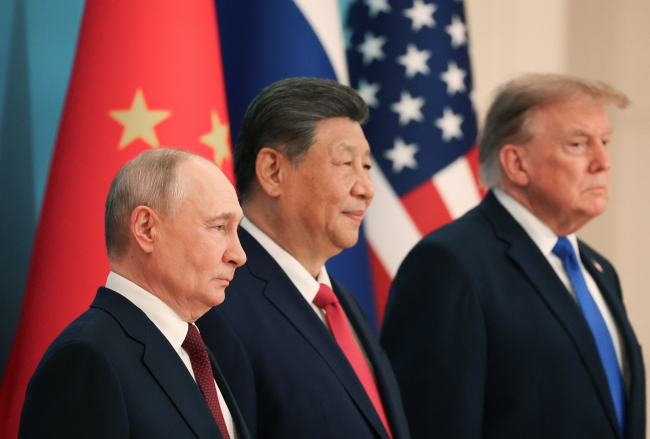


Europe should treat the China-U.S.-Russia summit as a signal that it is essentially on its own, former U.S. Ambassador to Poland Christopher Hill told PAP. He added that Russia and China benefited from the meeting, but it is unclear what interest the United States had in it.
Hill, who oversaw East Asia policy at the State Department, offered his assessment of the high-profile meeting of the leaders of three major powers in China.
In his view, the meeting was mainly about prestige, and the main beneficiaries were its host, China, and Vladimir Putin.
The former diplomat noted that the three-way meeting was the Russian leader’s idea, and that the American president readily took it up.
“I understand what Putin gets out of this trilateral format. I understand what Xi Jinping gets out of it. I don’t understand what good it did for American interests, and frankly, I think it was a mistake,” he said.
The former ambassador also criticized the preparation for the summit. He noted that successful top-level meetings are carefully planned and have specific, previously agreed goals. In his assessment, there was little planning in this case, and Trump treated the summit mainly as an exercise in image-building, as proof that he talks with the world’s most important countries, though, as Hill noted, these are rather “the countries that cause the most problems in the world.” He added that China gained by presenting itself as the world’s leading power, and Russia by presenting itself as America’s equal partner, even though its actual potential does not support that.
Still, according to PAP’s interviewee, the trip was also mainly an attempt by Trump to rebuild his standing after the defeat in the midterm elections.
“But I didn’t get the impression that he has any idea what he wants to achieve,” he said. He added that Secretary of State Marco Rubio, mentioned as a front-runner in the race for the 2028 nomination, did not gain from the summit either. Rubio, he said, “stood there with nothing to say.”
“It wasn’t a good day for American diplomacy. We’ve had many of them in the past few years, and we will have many more before the 2028 election,” he said.
The diplomat said he also does not believe the summit brought anything good in terms of efforts to end the war in Ukraine.
“If I were a European, I would read this whole summit as a sign that Europe has to understand that it is mainly on its own,” Hill said. In his view, it would be a big help to Europeans if they could get the U.S. to speed up production of Patriot missiles and to have Washington “stop tinkering with the Starlink system.”
“I have no confidence that the negotiators, his son-in-law and his golf partner, will pull a rabbit out of a hat. Mainly because rabbits don’t live in hats. You have to shove them in there, and there is no one who has the skills to do that,” he said, summing up the efforts of Trump’s envoys Jared Kushner and Steve Witkoff.
Responding to the view that the summit “could have turned out worse,” because nothing suggests the leaders divided the world into spheres of influence along the lines of the 1944 Yalta meeting, Hill noted that this is “one of the oldest diplomatic sayings in the world,” but in his opinion little could have gone worse.
Hill acknowledged that one positive of the summit was that nuclear weapons came up. He noted that China has so far been very reluctant to discuss its nuclear arsenal. But he added that nothing suggests this opening will lead to anything concrete.
He said Trump picked the topic of nonproliferation “out of thin air,” without consulting the other side, and that his approach lacked consistency. In his view, nonproliferation talks should include all nuclear powers, as well as countries such as North Korea. “Instead, we hear that the president would like to meet with his good friend Kim Jong Un,” he noted.
The former ambassador also addressed the dispute over exports of Nvidia chips to China and the related spy scandal. Hill said Trump was right not to make it a major topic of his meeting with Xi because, as he explained, the two countries spy on each other.
What matters most, in his view, is that Treasury Secretary Scott Bessent and Commerce Secretary Howard Lutnick are waging open war over the issue.
“I’ve never seen a situation where the treasury secretary and the commerce secretary openly and completely disagree with each other, and do so publicly, in front of the press,” he said. In his view, this only underscores the incoherence and chaos of Trump’s policy.
Oskar Gorzyński, Washington (PAP)
