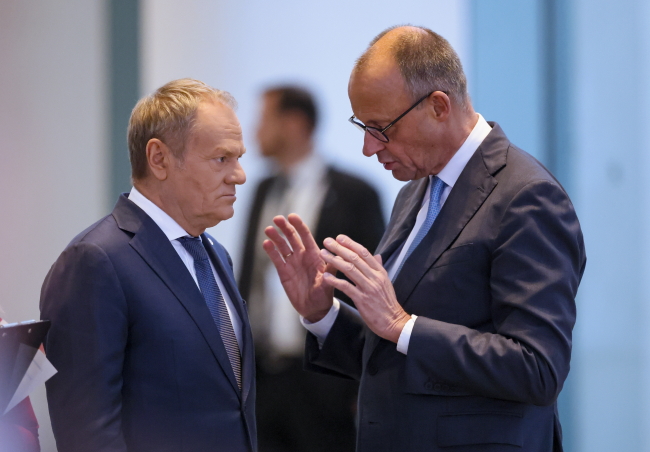


“We are deeply saddened and disappointed that the German budget for 2027 contains no funds for a humanitarian gesture,” Jakub Deka, president of the management board of the Polish-German Reconciliation Foundation, told PAP on Friday. He added that declarations of moral responsibility are not backed by concrete financial decisions.
Deka stressed that, on the issue of payments to surviving Polish victims of the German occupation, “bold political decisions were lacking, probably also out of fear of criticism from the opposition, both in Germany and in Poland.”
The foundation’s board president said Chancellor Friedrich Merz did not dare to decide to set aside funds for this purpose in the budget, and that “the Polish government, it seems, did not put enough pressure on the German side, nor did it sufficiently encourage it to make the gesture.” He added that, in such a situation, the German Finance Ministry showed no goodwill.
“We are deeply saddened and disappointed that the German budget contains no funds for a humanitarian gesture,” Deka said. He noted that the foundation had hoped for a different outcome to the Polish-German talks.
Deka emphasized that “this was not about billions, but about financial support that the German state could afford despite its difficult budget situation.” He cautioned that it is not a matter of compensation, but of a gesture of solidarity and humanitarian aid for the victims who are still alive.
Deka pointed out that the last major payment programs for Polish victims of the Third Reich were carried out from 2001 to 2005, more than 20 years ago, and that those affected received one-time payments for deportation, forced labor and imprisonment.
Deka noted that the surviving Polish victims of Nazism are now much older, in poorer health and increasingly dependent on the help of others. “No more than 50,000 people harmed by the Third Reich are living in Poland, at a very advanced age, struggling with health and financial problems,” he said.
He recalled that the Polish state supports these people with pension supplements granted by the Office for War Veterans and Victims of Repression and paid by the Social Insurance Institution (ZUS), amounting to about PLN 400 a month. “Regular support from the German side at a similar or slightly higher level would be significant help for these people. Unfortunately, for now there is no such gesture of goodwill and solidarity from the German state,” he added.
In early November, organizations representing people harmed by the Third Reich, together with the Polish-German Reconciliation Foundation, appealed to the German government and civil society for financial support for victims living in Poland. Deka said donations had begun to arrive in the foundation’s account from people who want to help those in need. “Since mid-August, a total of about 60,000 euros has been collected. This is very valuable help, although the funds raised this way are out of proportion to the scale of the need,” he said.
A similar appeal is also expected to appear in Germany. Its initiators include German-Polish societies, the German Institute for Polish Affairs and the Copernicus Group, as well as people who have for years been working for reconciliation and better Polish-German relations. “But it is equally important for us to raise awareness among German society, German politicians and decision-makers about the fate of the last living victims of Nazism in Poland,” Deka said.
Iwona Weidmann (PAP)