
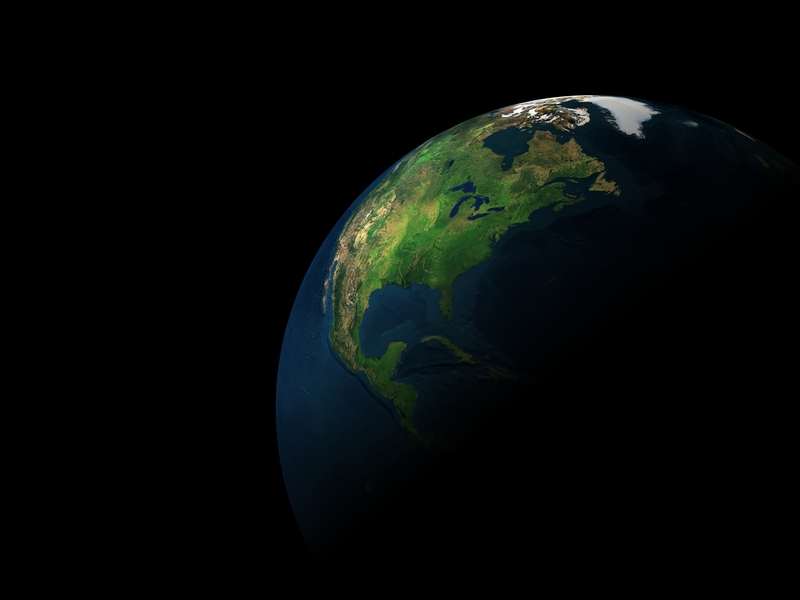


A U.S.-Austrian team of scientists has developed a computer simulation of the entire Earth except for life. It is meant to help in the search for traces of life on other planets.
More than 6,000 planets outside the solar system have been cataloged so far. In the atmospheres of the most promising ones, astronomers are looking for chemical compounds that could be products of life processes.
Experts are especially interested in atmospheres similar to Earth’s, meaning those capable of trapping enough heat for liquid water to exist on a planet’s surface. Liquid water is considered a basic ingredient essential to life.
That is the reminder from scientists at the University of Washington. Together with colleagues from other institutions in the U.S. and Austria, they presented a computer simulation of the entire Earth, minus life, in The Planetary Science Journal.
The simulation is meant to help determine what atmospheric conditions can arise on planets without the involvement of life. That would make it possible to identify atmospheres whose properties can be explained only by the presence of living organisms.
In the simulation, the scientists accounted for geochemical processes occurring on Earth over a span of 5 billion years, from its formation 4.5 billion years ago to about 500 million years into the future.
Among other things, the model accounts for the exchange of chemical substances among the planet’s core, mantle, crust, surface and atmosphere. It can be used to predict the evolution of the atmospheres of rocky planets, which may help in identifying signs of life on planets whose atmospheric properties depart from typical predictions.
Basic information about a given planet can also be entered into the model to check whether it can reproduce the observed properties of that planet’s atmosphere without factoring in the influence of life. A failure to do so may suggest that the observed properties result from the activity of living organisms.
In tests, the model correctly predicted 19 properties of Earth, including the flow of heat through its mantle.
“Our model can help us understand how habitable planets without life might look like planets inhabited by living organisms,” explains Samantha Gilbert-Janizek of the University of Washington, the study’s lead author. “When analyzing the atmosphere of an exoplanet, this tool will help us determine the likelihood that what we are observing indicates the existence of life on its surface.”
The researchers explain that life can affect a planet’s atmosphere in many ways. On Earth, for example, plants and animals continually release oxygen and methane into it. These gases then react with each other, leading to their mutual removal from the atmosphere. It follows, the researchers stress, that a hypothetical astronomer in space analyzing Earth’s atmosphere could suspect that living organisms are constantly replenishing the supplies of both gases.
“Achieving the ambitious goals for a telescope such as the Habitable Worlds Observatory (NASA’s planned space telescope for searching for life on other planets – PAP) requires decades of work by many generations of scientists. I am very grateful that I can become part of this tradition and one day pass the baton to the next generation, so that we can continue, step by step, to get closer to answering the question of whether we are alone in the universe,” Gilbert-Janizek concludes.
Marek Matacz (PAP)
