
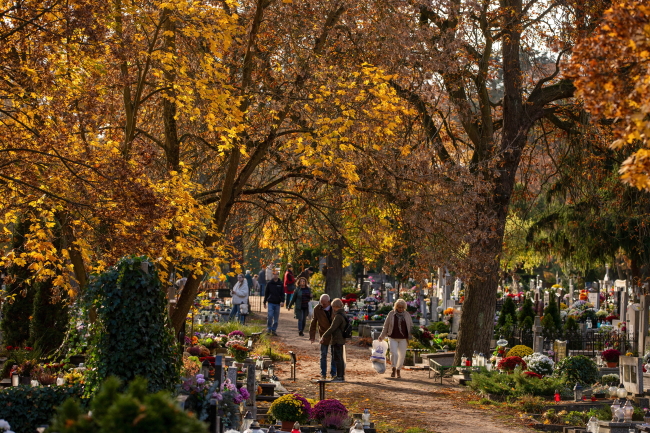


The Catholic Church observes All Souls’ Day on Nov. 2, remembering believers in Christ who are in purgatory after death. Churches hold funeral processions and “zaduszki” commemorations, including maritime, medical, jazz and blues events.
The Council of Trent (1545-1563) confirmed the belief in purgatory in a separate decree stressing two truths: that purgatory exists as a posthumous punishment for sins, and that the living can help souls by shortening it. The Catechism of the Catholic Church explains that “sin has a twofold effect; grave sin deprives us of communion with God and thus closes off our access to eternal life. Every sin, even venial (…), requires purification either on earth or after death, in the state called purgatory.” For that reason, the Catholic Church teaches, one should pray for the dead to ease their suffering.
The tradition of praying for the dead who are waiting to meet God in heaven goes back to biblical times. The first mentions of prayer and an atoning offering for those who have died appear in the Old Testament, including in the Second Book of Maccabees.
The observance of All Souls’ Day was initiated in 998 by St. Odilo (d. 1048), the fourth abbot of the Benedictine monastery in Cluny, France. The practice was first adopted by Benedictine monasteries, but other religious orders and dioceses soon followed their example. In the 13th century, the feast spread throughout the Western Church.
In the 14th century, a procession to the cemetery with four stations began to be held. The fifth station took place in the church, after the procession returned from the cemetery. At the stations, prayers for the dead were said and funeral hymns were sung, in turn for bishops and priests, relatives, benefactors, those buried in the parish and all the dead.
The custom of each priest celebrating three Masses on All Souls’ Day was started in the 15th century by the Dominican order in Spain. In 1748, Pope Benedict XIV approved the practice for Spain, Portugal and their colonies. In 1915, at the request of the abbot primate of the Benedictines, Pope Benedict XV allowed every priest to celebrate three Masses on that day: for an intention requested by the faithful, for all the faithful departed, and for the pope’s intentions.
In Poland, the All Souls’ Day tradition began to take shape in the 12th century and by the end of the 15th century was known throughout the country.
On Nov. 2 in Warsaw, Archbishop Adrian Galbas will lead a funeral procession to the crypts of the Warsaw Archcathedral at 6 p.m. He will pray for the deceased archbishops of Warsaw, presidents, Masovian dukes, and people of culture and the arts, including Gabriel Narutowicz, Ignacy Mościcki, Gen. Kazimierz Sosnkowski, Henryk Sienkiewicz and Ignacy Jan Paderewski. At 7 p.m., he will then celebrate a funeral Mass for the dead.
In Gniezno Cathedral, the Primate of Poland, Archbishop Wojciech Polak, together with bishops and the faithful, will pray at noon on All Souls’ Day for the deceased archbishops of Gniezno, Primates of Poland and bishops. The crypts hold, among others, Archbishop Zbigniew Oleśnicki, Archbishop Jan Łaski, Archbishop Teodor Potocki, Archbishop Ignacy Krasicki and the first Primate of reborn Poland, Archbishop Edmund Dalbor. The cathedral’s underground chambers also hold the heart of Cardinal August Hlond, primate of the Second Polish Republic.
At Oliwa Cathedral in Gdańsk, after a Mass at about 7 p.m., a funeral procession will set out from the cathedral square for the Oliwa Cemetery.
At Poznań Cathedral, a Mass led by Archbishop Zbigniew Zieliński, the metropolitan of Poznań, combined with prayer in the cathedral crypt, will be held at 8 a.m.
A prayer for deceased people of the sea, including sailors, port workers and those who never returned from the sea, known as maritime zaduszki, will be held Nov. 2 at 7 p.m. at the Chapel of Jesus Christ near the beach in Sopot, next to the fishing marina, the Gdańsk Seafarers’ Ministry (Duszpasterstwo Ludzi Morza Gdańsk) announced.
Maritime zaduszki in Rewa will begin at 5 p.m. with a Mass at St. Roch Church in Rewa. Afterward, everyone will walk from the church to Szperk, where a wreath will be symbolically laid on the waters of the Bay of Puck.
Medical zaduszki, organized by the National Health Care Ministry (Krajowe Duszpasterstwo Służby Zdrowia), will be held on Nov. 22 at noon in the Curial Hall at 3 Floriańska St. in Warsaw.
The 9th Reda Jazz Zaduszki is scheduled this year for Nov. 3 at the Church of the Assumption of the Blessed Virgin Mary and St. Catherine of Alexandria. The prayer for deceased musicians will begin at 7 p.m. This year’s performers in Reda include Jacek Siciarek, Tomasz Przyborowicz, Krzysztof Paul Joanna Knitter, Michał Ciesielski, Mikołaj Stańko and Michał Lasota.
The next day, Nov. 4, the 28th Traditional Jazz Zaduszki will take place at the Franciscan Fathers’ church in Gdynia. It will begin at 7:30 p.m.
The Kraków Jazz Zaduszki are scheduled for Nov. 3-7. The program includes Halina Mlynkova, Renata Świerczyńska, Karolina Leszko, Jacek Królik, Marek Stryszowski, the Orkiestra Śląskich Kameralistów and TakSieNieGra under the direction of Piotr Zaufal, Ondřej Havelka and his Melody Makers, and Wielka Rzeka – A Tribute to Stanisław Soyka – with Anna Maria Jopek, Natalia Grosiak, Skubas and Łukasz Lach.
In Łódź, Jazz Zaduszki will be held Nov. 7 in the Performance Hall of the Łódź Event Center (Łódzkie Centrum Wydarzeń). Artists will play the greatest hits of legends of the Polish and world music scenes. The event will be divided into two parts. Audiences will hear songs by Grzegorz Ciechowski, Andrzej Zaucha, Stanisław Soyka, Anna Jantar, Krzysztof Krawczyk, Sinead O’Connor, Janis Joplin, Prince, Chris Cornell, Bonnie Tyler and Dolly Parton.
Blues Zaduszki will take place Nov. 7 at 7 p.m. at the Oliwa Cultural Center (Oliwski Ratusz Kultury) in Gdańsk. The Blues Connections band will provide the musical setting, playing in tribute to the outstanding blues artists and instrumentalists who have died.
From Oct. 29 to Nov. 10, Kraków will host the 23rd International Zaduszki Organowe Festival named for Prof. Jan Jargoń.
Virtuosos representing Spain, Germany, Poland, Portugal and Italy will play historic instruments in Kraków churches: the Carmelite church “Na Piasku,” the Dominican church on Stolarska St., the Jesuit church on Kopernika St., the Benedictine abbey in Tyniec and St. Stephen’s Church on Sienkiewicza St.
The opening concert will be accompanied by Sinfonietta Cracovia. Throughout the festival, audiences will be able to hear works composed from the Renaissance to the present day.
Under the Code of Canon Law, the Church recommends keeping the custom of burying the bodies of the dead. It does not forbid cremation, however, as long as it was not chosen for reasons contrary to Christian teaching, such as a lack of belief in the resurrection of the body or contempt for the human body.
Out of respect for the human body, the Church says, scattering the ashes of the dead in public spaces is not permitted, nor is keeping them at home. Ashes resulting from cremation should be respectfully placed in a holy place, which is a cemetery, in accordance with liturgical rules, and therefore cannot be kept in other places not intended for burial.
From Nov. 1 to 8, a plenary indulgence can be obtained for the dead. The condition is to visit a cemetery or church and fulfill the usual requirements: being in a state of sanctifying grace, meaning without grave sin, receiving Holy Communion, and reciting the Our Father, the Creed and any prayer for the intentions designated by the pope for that day.
Magdalena Gronek (PAP)
