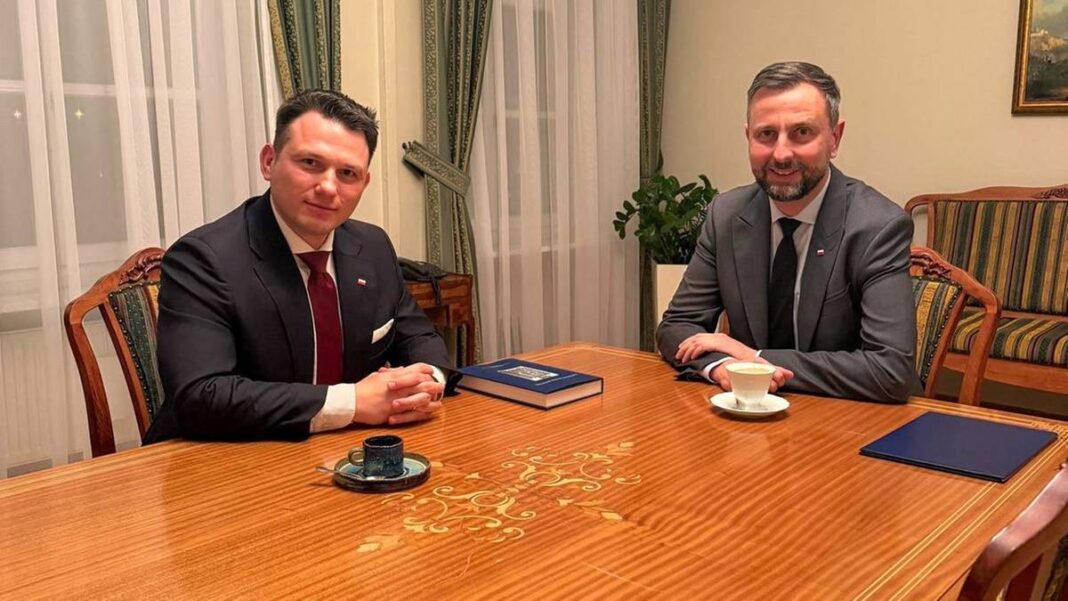
Bosak: PSL Proposal Too Complicated, Would Allow Repeated ‘Resetting’ of Constitutional Tribunal
The proposal by the PSL (Polish People’s Party) to amend the Constitution is too complicated and would allow the makeup of the Constitutional Tribunal to be “reset” repeatedly, Confederation leader and Deputy Speaker of the Sejm Krzysztof Bosak said. In his view, it also requires a political agreement, which is currently out of reach.
The PSL has prepared a bill amending the Polish Constitution which, as Deputy Prime Minister and PSL leader Władysław Kosiniak-Kamysz explained, is meant to “bring about calm, social peace, the rule of law and a restoration of the Constitutional Tribunal’s credibility.”
The PSL proposes adding a provision to the Constitution stating that the National Assembly (the Sejm and Senate sitting together, 560 lawmakers) “may, on a reasoned motion from the National Council of the Judiciary, find that the Constitutional Tribunal is permanently unable to carry out its duties.”
That would require a resolution of the National Assembly adopted by a majority of at least 3/5 of its statutory number of members, or at least 336 lawmakers. Under the PSL proposal, after such a resolution is passed, the National Assembly would elect 15 Constitutional Tribunal judges in a single vote by the same majority, five each for terms of 3, 6 and 9 years.
“I’m glad the PSL has joined the discussion about a constitutional reset, but I criticize the fact that the solution they have presented is excessively complicated,” Bosak said when asked to assess the PSL proposal at a press conference on Saturday in Puławy (Lubelskie Province).
In his view, the mechanism proposed by the PSL is not only about resolving the current crisis surrounding the Tribunal and establishing a panel that would be respected and would function.
“This is a proposal to create a permanent institutional tool for resetting the makeup of the Constitutional Tribunal repeatedly, under loosely defined conditions,” Bosak said.
He argued that the PSL proposal does not help build the stability of state institutions. “Writing a ‘reusable tool’ into the Constitution, on the principle that if the majority doesn’t like some future makeup of the Tribunal, it can zero it out and cut its term short, is contrary to the principle of institutional continuity,” he added.
In his assessment, the grounds for such an “interruption of continuity” are unclear, and the National Council of the Judiciary, which would trigger the changes, is itself in crisis.
“The National Council of the Judiciary has a problem with its legitimacy and with disputes surrounding how it operates. So making one institution that is in crisis the arbiter in the case of another institution that is in crisis seems to me somewhat absurd,” Bosak added.
Bosak stressed that to select a new Tribunal under the PSL proposal, an agreement would have to be reached in the National Assembly, which is deeply divided. “It seems to me that these are completely unattainable conditions, and not only in this term (of Parliament – PAP), but perhaps in the next one as well,” he noted.
The Confederation leader believes that a much simpler solution is needed, one that ends the entire dispute. He pointed to a proposal by Sławomir Mentzen (leader of New Hope) to set the makeup of the panel of judges, then draw lots to determine who would have a shorter and who a longer term, and then, as those terms gradually expire, have the Sejm fill the Tribunal’s seats by an established majority vote. “Perhaps we should follow that proposal,” Bosak added.
He stressed that he was presenting only his own opinion, because there will be further discussion on the subject within Confederation. He himself would support a solution whose design would be “as simple as a flail” and which would end the entire dispute without “complicated hurdles.”
“For us to spend months or even years dealing with the National Council of the Judiciary, the Supreme Court and the Constitutional Tribunal being deadlocked with one another, and with judges and politicians challenging each other, that is a madhouse. This madhouse needs to be closed down as quickly and as simply as possible,” Bosak said.
Under the rules, a bill amending the Constitution is passed by the Sejm, Poland’s lower house of parliament, by a majority of at least 2/3 of votes with at least half of the statutory number of deputies present (307 votes, assuming all 460 deputies take part in the vote), and by the Senate by an absolute majority of votes with at least half of the statutory number of senators present. Submitting a bill amending the Constitution requires collecting signatures from at least 92 deputies. (PAP)