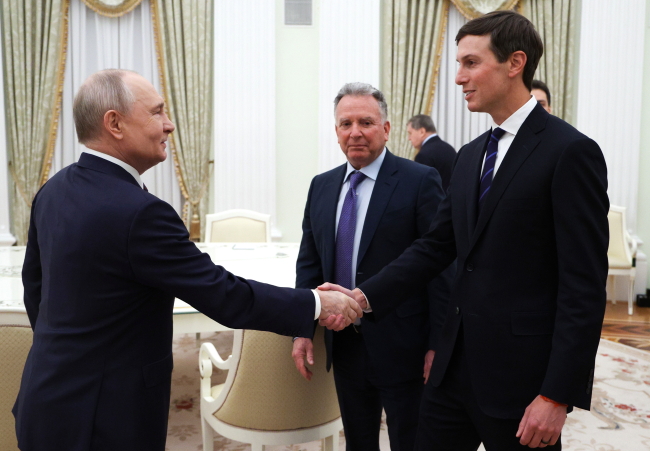


“Deterrence is a byproduct of the will and ability to fight — not a substitute for them,” Eliot A. Cohen wrote Friday in The Atlantic. Cohen argued that presidential envoy Jared Kushner and Pentagon deputy chief Elbridge Colby live in a world of “geopolitical illusions.”
Cohen noted that Kushner, an envoy of President Donald Trump and his son-in-law, recently published a long post on X and gave an extensive interview to Matthias Doepfner, head of the Axel Springer media group. In them he laid out his thinking on talks concerning Russia and Ukraine.
According to Cohen, Kushner’s remarks lead to conclusions he probably did not mean to reveal, and which often put him in an unflattering light.
Cohen argued that in the interview Kushner “grovels” before Vladimir Putin and his henchmen. At the same time, Kushner’s attitude toward America’s allies is markedly cooler. Trump’s son-in-law said the Ukrainians torpedoed an earlier phase of negotiations by attacking one of Putin’s residences — although, according to CIA assessments, no such attack took place at all.
America’s NATO allies also do not fare well in his account, the author noted. “There are many fears in Europe that are unjustified,” Kushner said, overlooking both the attacks carried out and foiled and the potentially deadly acts of sabotage conducted by Russian intelligence services.
Cohen said the key to understanding Kushner’s way of thinking lies in one seemingly offhand sentence: “This is not about justice or about who is right and who is wrong.”
In fact, the author declared, it is exactly the opposite: “This is about a war in which the distinction between aggressor and victim, predator and prey, could not be more obvious.”
“For that reason alone, the ghosts of the victims of Bucha and a thousand other massacres and atrocities committed by Russia should haunt him at night. One may doubt, however, that they do,” the article reads.
The author, who has worked as an adviser at the State Department, among other roles, also pointed out that Kushner’s statements suggest the Trump administration intends to redesign Europe’s “security architecture.”
He noted that one of the leading contenders for the role of chief architect of the new geopolitical order is Elbridge Colby, the undersecretary of defense, who argues that the time has come for a NATO 3.0 model.
Cohen recalled that at a recent meeting of the Ukraine Defense Contact Group in Brussels, Colby condemned Ukrainian attacks on Russian infrastructure and left the meeting before a Ukrainian representative could present classified information on the course of the war.
In the author’s view, Kushner, Colby and other administration officials apparently believe they can reshape the European security system while showing sympathy for Europe’s enemies and condemning America’s allies.
Cohen added that the administration keeps stressing that it “intends to withdraw as far as possible from its commitments to Europe, and in the moments when it is not talking about such a withdrawal, it is actively considering taking over part of European territory.” The author was probably referring to the agreement on the U.S. presence in Greenland.
“To moral blindness, then, one must add political stupidity. But there is something deeper still: a striking lack of seriousness, stemming not only from ignorance of history and indifference to the actual circumstances of the biggest international crime of this century, but also from a belief in miracle-working diplomacy. It is a vision of peace achieved through strategic practices straight out of black magic,” Cohen wrote in The Atlantic.
On Sunday, Kushner said Trump is ready to consider security guarantees for Ukraine modeled on Article 5 of the NATO treaty. He also set out the conditions for approving such guarantees. Under the U.S. proposal, Ukraine would receive security guarantees only after they are approved by the U.S. Congress and Russia, after Trump is satisfied that the likelihood of the guarantees being triggered is low and that they would be consistent with U.S. national interests, and after a broader framework for the postwar security architecture in Europe has been agreed.
“At first glance this sounds like plain fraud: making promises only on the condition that one knows they will never have to be kept. But it is even worse than that,” Cohen warned.
The author said Article 5 “in reality guarantees nothing — an inconvenient truth long masked by American and European rhetoric.” It states that “an armed attack against one or more of them in Europe or North America shall be considered an attack against them all,” but assumes that a country will take such action as it itself “deems necessary,” he noted.
“So if, for example, the United States did not deem it necessary to defend Ukraine against another Russian invasion, it would have no obligation to do so,” he added.
Cohen stressed that “for much of the Cold War, deterrence was a kind of strategic magic dust that was supposed to keep Europe safe,” but that, at least in the early period, its credibility was reinforced by substantial conventional forces on the ground.
He went on: “Guarantees that one has no ability to honor are as worthless as those Britain gave Poland in the summer of 1939.” “They deter no one, because deterrence is a product of the ability and will to fight, not a value in itself,” the author added.
He accused Kushner and Colby of apparently “living in a world of amoral, empty and self-serving geopolitical illusions.”
Natalia Dziurdzińska, Washington (PAP)