
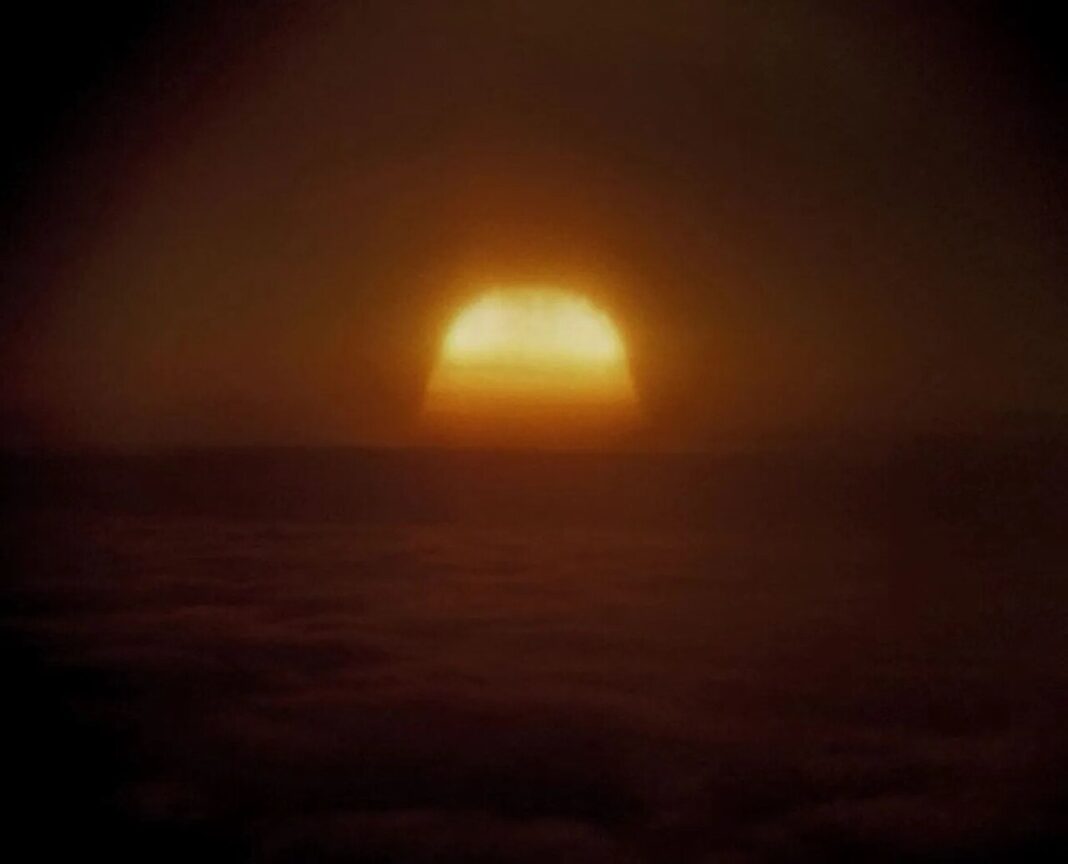


On Oct. 30, 1961, the Soviet Union tested the most powerful nuclear bomb in history on Novaya Zemlya (Nowa Ziemia), a Russian archipelago in the Arctic Ocean. The device, with a yield of about 50 megatons and later dubbed the Tsar Bomba, was more than 3,000 times as powerful as the bomb dropped on Hiroshima.
Fifteen years had passed since the American atomic tests at Bikini Atoll in 1946. In that time, the arms race between the United States and the Soviet Union had gathered pace. “An atomic bomb was not enough; you had to have a hydrogen bomb,” said historian Prof. Paweł Wieczorkiewicz. As he recalled, the first Soviet thermonuclear device was tested after Stalin’s death. By then, both superpowers had mastered the technology needed to build such weapons. Although a moratorium on nuclear tests was declared in 1958, work on improving weapons continued. In 1961, relations between the two powers deteriorated sharply. Construction of the Berlin Wall began in August, and on Oct. 27, American and Soviet tanks faced off at Checkpoint Charlie. The test of nerves ended, fortunately, the following day, but two days after that, thousands of kilometers from Berlin, the USSR demonstrated its most powerful weapon to the world. It had been prepared at the secret Arzamas-16 research center, where a team of physicists was led by Andrei Sakharov, one of the creators of the Soviet hydrogen bomb.
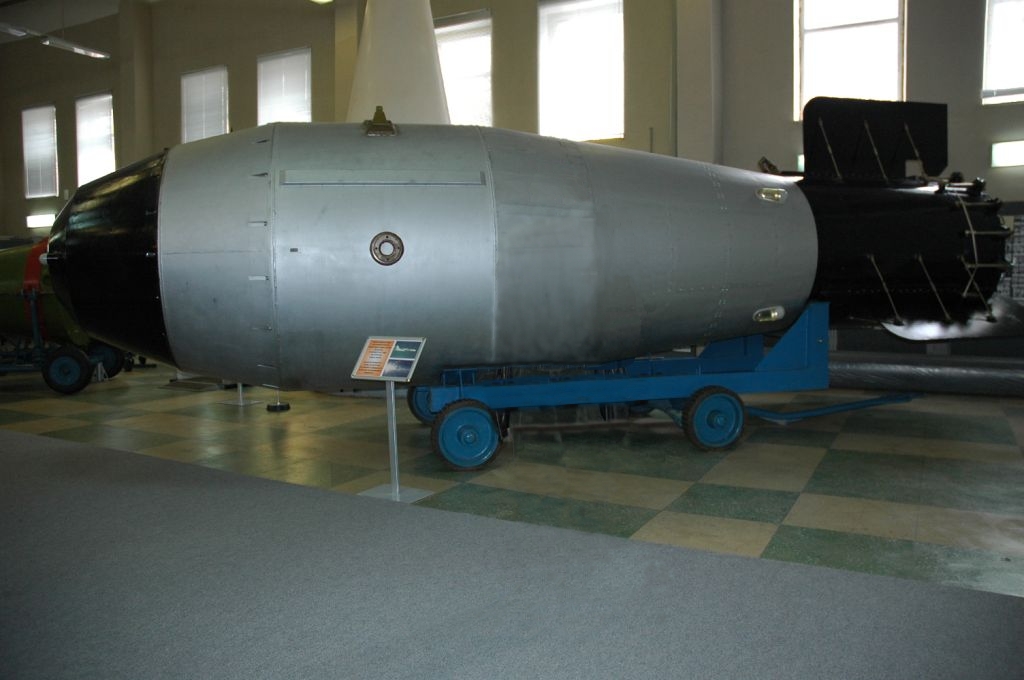
Sakharov joined the Soviet nuclear program in June 1948 through his professor, Igor Tamm. Years later he recalled: “No one asked me whether I wanted to take part in this work. I really had no choice. But the concentration, the complete absorption in the work and the energy I put into it were my own.”
A few months later, the scientist presented the concept of a hydrogen bomb that came to be called the “sloika,” after a popular Russian pastry. The resemblance was no accident: the bomb’s design resembled a layer cake, with uranium and thermonuclear fuel, lithium deuteride, stacked in alternating layers. A device based on this idea was tested in August 1953. But work did not stop at the “sloika.” The next breakthrough came in 1955, when Soviet physicists tested a new design that made it possible to achieve a much greater explosive force. That solution became the basis for further work on thermonuclear weapons, which culminated in the Tsar Bomba. A political decision also contributed to its creation. On July 10, 1961, Nikita Khrushchev met at the Kremlin with scientists from Arzamas-16 and announced the resumption of nuclear tests. Sakharov opposed the decision, considering the new tests unnecessary. The Soviet leader, however, had no intention of backing down. According to an account cited by historian of science Alex Wellerstein, he seized on the idea of a 100-megaton bomb that would hang over the capitalists “like the sword of Damocles.”
The bomb Khrushchev spoke of had many names. In documentation it appeared under the designation AN602, and in scholarly studies also as RDS-220. It was called “Big Ivan,” and in his memoirs Sakharov wrote simply of the “Big Bomb.” The best-known name today, Tsar Bomba, came into common use only after the collapse of the USSR. As Wellerstein notes, it is not known exactly who first used it. According to one account, the physicist Yuri Trutnev proposed the name in the early 1990s while preparing an exhibition on the history of the Soviet nuclear program. The inspiration was said to be two other Russian colossi: the Tsar Cannon, a 16th-century cannon weighing about 40 tons that was never fired, and the Tsar Bell, an 18th-century bell of more than 200 tons that never rang. Both stand in the Moscow Kremlin. Trutnev was also one of the Tsar Bomba’s chief designers. “In retrospect, the pace of its development is hugely impressive,” Wellerstein writes. The team had only four months to design the bomb and prepare it for testing. Much of the design work was done by Trutnev and Yuri Babayev, under Sakharov’s direction.
It was originally assumed that the bomb would reach a yield of 100 megatons. In the end, on Sakharov’s initiative, it was limited to about 50 megatons. Replacing uranium-238 with lead made it possible to greatly reduce radioactive fallout. The physicist was already aware of the dangers of nuclear testing and its long-term effects on people. With the device prepared this way, a specially modified Tu-95V bomber piloted by Andrei Durnovtsev took off on Oct. 30, 1961, from the Olenya airfield on the Kola Peninsula. Under its fuselage was an eight-meter bomb weighing about 27 tons. It was so large that it did not fit in the aircraft’s bomb bay. The plane was accompanied by a Tu-16 equipped with measuring instruments and film cameras.
The bomber crew’s chances of survival were estimated at only 50 percent. To give the airmen time to get away from the blast, the bomb was fitted with a parachute weighing about 800 kilograms. The device was dropped from an altitude of about 10.5 kilometers over a test site near Mityushikha Bay, in the northern part of Novaya Zemlya.
The bomb exploded about four kilometers above the ground. “The explosion was accompanied by a flash of light of extraordinary intensity,” the narrator of a Soviet film documenting the test reported. Despite total cloud cover, the flash and the glow that followed were visible from as far as 1,000 kilometers away. The column grew rapidly, reaching a diameter of about 10 kilometers, and the cloud created by the explosion rose to a height of 60 to 65 kilometers. The shock wave also reached the bomber, which suddenly lost altitude. Durnovtsev, however, managed to regain control of the aircraft and land safely.
The Tsar Bomba remains the most powerful nuclear device ever detonated. Its enormous mass made it difficult to transport, and further increases in yield did not translate proportionally into a larger area of destruction. The bomb was above all a demonstration of the technical capabilities and might of Khrushchev’s state. Wellerstein points out, however, that although U.S. officials publicly downplayed the test as a propaganda spectacle, they took it far more seriously.
Sakharov himself had warned about the effects of nuclear testing since the late 1950s. His concerns did not end with the decision to reduce the Tsar Bomba’s yield. On Aug. 5, 1963, the United States, the Soviet Union and Great Britain signed a treaty in Moscow banning nuclear tests in the atmosphere, in outer space and underwater. It did not cover underground tests. Sakharov, later a human rights defender and a Nobel Peace Prize laureate, considered his part in reaching the agreement an important achievement.
Although the Tsar Bomba explosion was known to the world from the start, for decades the public could see only fragments of its film documentation. It was not until Aug. 20, 2020, that the Russian state corporation Rosatom released extensive archival footage showing the preparations for the test, the bomber’s flight and the blast itself. Nearly 59 years had passed since the events on Novaya Zemlya. The USSR no longer existed, and the film of the greatest display of its atomic might was only then reaching a wide audience.
Marta Panas-Goworska (PAP)