
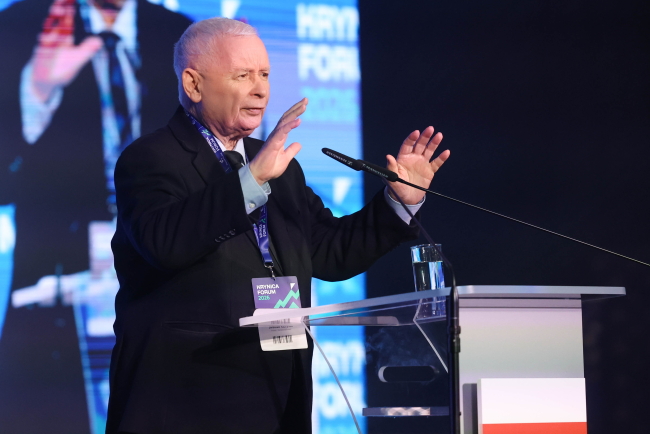


Jarosław Kaczyński’s speech in Krynica was about changes to EU law, and the leader of Law and Justice (PiS) probably did not expect his words about Polexit to cause such a storm, political scientist Prof. Anna Wojciuk told PAP. In her view, however, Kaczyński may have wanted to send a signal to Grzegorz Braun, suggesting the possibility of cooperation.
On Wednesday in Krynica, PiS leader Jarosław Kaczyński listed among possible “methods” of bringing about changes in the EU: influencing public opinion, a new treaty with a delayed entry into force, and a “hard and risky” method. In that context, he added that “in the final provisions of the Treaty on European Union, and later also in those on the functioning of the European Union, there are provisions saying on what terms a country can leave the EU.”
“It all starts with negotiations, and simply starting those negotiations. A hard method, a risky one, but things are truly so bad, so very bad, that it’s worth using such a method too, if the others don’t produce results,” Kaczyński said.
Prime Minister Donald Tusk commented on the words on X, writing that “Jarosław Kaczyński has announced that Poland should start negotiations on the terms of leaving the European Union” and that “this, among other things, is what is at stake in the fight under way in Poland today.”
“Tusk is lying, as usual,” Kaczyński replied later on X. He added that “the European Union is needed, but it requires thorough reform.”
Asked about the political aim of Kaczyński’s remarks on Polexit, Prof. Anna Wojciuk of the University of Warsaw said the PiS leader may not have intended to provoke such a row, because the reference to Polexit was very subtle.
“It was a very technical speech, a detailed discussion of specific EU regulations and the principle of subsidiarity. A long, boring speech, really for nobody,” she noted.
She acknowledged that Kaczyński presented the threat of leaving the EU as one of the negotiating methods, but said the context of his words supports the thesis that he did not intend to make radical political declarations. “He did, of course, say those words about Polexit, but he rightly argues that they were taken out of context. Besides, he is already backing away from it,” she noted.
“It wasn’t a speech about Polexit. It was a speech about how he (Jarosław Kaczyński) will change the European Union once he comes to power, taking advantage of the fact that in other countries, too, the Eurosceptic right will be in power,” the political scientist added.
Wojciuk acknowledged at the same time that Kaczyński may have wanted, in passing, to subtly suggest to Grzegorz Braun’s supporters that the issue of Polexit is not closed, thus opening up room for possible talks. “In my view, though, he didn’t think it would cause such a storm,” she said. (PAP)
Prime Minister: Kaczyński Announced Poland Should Start Negotiations on Leaving the EU; That Is Among the Stakes in Today’s Fight in Poland
Jarosław Kaczyński announced that Poland should start negotiations on the terms of leaving the EU; that, among other things, is what is at stake in the hard fight under way in Poland today, Prime Minister Donald Tusk said Thursday. He added that he does not intend to lose that fight.
The head of government was referring to the words of the PiS leader, who said Wednesday at Krynica Forum 2026 that the European Union must be changed. Among possible “methods” of bringing about changes, he listed influencing public opinion and a new treaty with a delayed entry into force.
If those methods failed to produce results, he said, a “hard and risky” method is possible. He pointed out that EU treaties contain provisions on the terms on which a country can leave the EU, and that “everything starts with negotiations.” “And simply start those negotiations,” the PiS leader said.
“Jarosław Kaczyński has just announced that Poland should start negotiations on the terms of leaving the European Union. That, among other things, is what is at stake in the fight under way in Poland today. A hard fight,” the prime minister wrote on X. Tusk added that he himself “does not intend to lose it, even if not everyone plays along with him.”
Earlier, Deputy Prime Minister and Foreign Minister Radosław Sikorski wrote on X that PiS politicians “do want Polexit after all.” “(They want) a customs border with Germany, the Czech Republic, Slovakia and Lithuania. Passport controls at airports. An end to subsidies for farmers and for investment. An end to KPO (the EU-funded National Recovery Plan) and SAFE. (…) And they swore up and down that never in their lives,” the foreign minister wrote on X.
Kaczyński said Wednesday, among other things, that he has a deep conviction, which is also the conviction of his political party and which, according to him, “very many Poles” share, that “the European Union must be changed.” Speaking about methods of introducing changes in the EU, he listed influencing public opinion and a new treaty with a delayed entry into force.
He also said that if those methods did not produce results, then in his view “one more method can be applied, although he knows it may be controversial.”
He noted that “in the final provisions of the Treaty on European Union, and later also in those on the functioning of the European Union, there are provisions saying on what terms a country can leave the European Union.”
“It all starts with negotiations, and simply starting those negotiations. A hard method, a risky one, but things are truly so bad, so very bad, that it’s worth using such a method too, if the others don’t produce results,” the PiS leader said.
He stressed that this of course requires determination and agreement on positions that “are sometimes distant from one another on various issues, especially when it comes to Eastern policy.” (PAP)
Czarzasty: Kaczyński Is Getting Public Used to Idea of Poland Leaving EU; “They Are Going East, We Are Staying”
Nawrocki is getting people used to the pro-Russian Braun, and Jarosław Kaczyński to the idea of Poland leaving the European Union; they are going East, we are staying, Sejm Marshal Włodzimierz Czarzasty said, responding among other things to Wednesday’s words by the PiS leader, who allows for negotiations on Polexit. (The Sejm is the lower house of Poland’s parliament.)
The words the Sejm Marshal commented on were spoken Wednesday at Krynica Forum 2026. Kaczyński said, among other things, that the European Union must be changed. Among possible “methods” of bringing about changes, he listed influencing public opinion and a new treaty with a delayed entry into force.
If those methods failed to produce results, he said, a “hard and risky” method is possible. He pointed out that EU treaties contain provisions on the terms on which a country can leave the EU, and that “everything starts with negotiations.” “And simply start those negotiations,” the PiS leader said.
In a Thursday post on X, Czarzasty attached a fragment of the PiS leader’s remarks and wrote: “Nawrocki is getting people used to the pro-Russian Braun, and Kaczyński to the idea of Poland leaving the European Union.” “They are going East. We are staying,” he added.
Government spokesman Adam Szłapka also responded to the PiS leader’s words. As he put it on X, “Kaczyński is carrying out Braun’s agenda, and we all know whose agenda Braun is carrying out.”
Tomasz Siemoniak, the minister coordinator of special services, also responded to Kaczyński’s words. In his view, Kaczyński “at such a sensitive moment for our security announces that he allows for negotiations on Poland leaving the European Union.” “Even the dreamers in the Kremlin would not have foreseen that a prominent Polish politician would speak out directly against Poland’s interests,” he wrote on X.
Kaczyński said Wednesday, among other things, that he has a deep conviction, which is also the conviction of his political party and which, according to him, “very many Poles” share, that “the European Union must be changed.” Speaking about methods of introducing changes in the EU, he listed influencing public opinion and a new treaty with a delayed entry into force.
He also said that if those methods did not produce results, then in his view “one more method can be applied, although he knows it may be controversial.”
He noted that “in the final provisions of the Treaty on European Union, and later also in those on the functioning of the European Union, there are provisions saying on what terms a country can leave the European Union.”
“It all starts with negotiations, and simply starting those negotiations. A hard method, a risky one, but things are truly so bad, so very bad, that it’s worth using such a method too, if the others don’t produce results,” the PiS leader said.
He stressed that this of course requires determination and agreement on positions that “are sometimes distant from one another on various issues, especially when it comes to Eastern policy.”
Prime Minister Donald Tusk was among those who commented on Kaczyński’s words. In his view, a “hard fight” is under way in Poland over, among other things, the country’s presence in the European Union. He added that he “does not intend to lose” that fight, even if “not everyone” plays along with him.
Meanwhile, Grzegorz Braun, leader of the Confederation of the Polish Crown, has been back in the spotlight in connection with the upcoming meeting of the National Security Council (RBN). President Karol Nawrocki has convened it for Nov. 3. Politicians of the ruling coalition believe lawmakers from Braun’s camp should not be invited to the RBN, accusing them of being pro-Russian.
In an October interview with the daily “Rzeczpospolita,” President Nawrocki said, among other things, that Braun’s party “has its representation in parliament” and is “a political force that, according to polls, has the support of some Poles, so it should be treated as present in Polish politics.”
In a later statement on Polsat News, Nawrocki said he is the president of all Poles, including those who “cast their vote or are ready to cast their vote for Grzegorz Braun.” He noted that, according to polls, this means about 10% of citizens, and added that “we cannot pretend that there is no Grzegorz Braun and no Grzegorz Braun voters in Poland.” (PAP)
Kosiniak-Kamysz: PiS and Konfederacja Should Say Before Elections Whether They Want Polexit
PiS and Konfederacja, arm in arm with Grzegorz Braun, should say before the parliamentary elections whether they want Polexit and what they intend to do with the benefits membership gives Poland, Deputy Prime Minister and Defense Minister Władysław Kosiniak-Kamysz wrote, referring to Jarosław Kaczyński’s Wednesday words about the EU.
In his post on X, Kosiniak-Kamysz also stressed that the European Union “should be reformed where it needs improvement, not threatened with an exit.”
On Wednesday at Krynica Forum 2026, Law and Justice leader Jarosław Kaczyński said the European Union must be changed. Among possible “methods” of bringing about changes, he listed influencing public opinion and a new treaty with a delayed entry into force.
If those methods failed to produce results, he said, a “hard and risky” method is possible. He pointed out that EU treaties contain provisions on the terms on which a country can leave the EU, and that “everything starts with negotiations.” “And simply start those negotiations,” the PiS leader said.
The deputy prime minister and defense minister responded to that statement on Thursday on X.
“First, opposition to SAFE, European funds for the Polish army and defense industry. Now Kaczyński is talking about negotiations on Polexit,” the deputy prime minister said. He stressed that Poland has received “hundreds of billions of euros” from the Union, and thus “far more than it paid in.” The defense minister pointed out that the money went, among other things, to roads, railways, rural development, investment and access to the single market.
In the deputy prime minister’s view, the European Union “should be reformed where it needs improvement, not threatened with an exit.” “PiS and Konfederacja, arm in arm with Braun, should say clearly before the elections whether they want Polexit and what they intend to do with the benefits membership gives Poland,” he stressed.
The SAFE program is an EU loan fund meant to make up to €150 billion in loans available to member states for investment in the defense industry.
Law and Justice lawmakers raised numerous objections to the act implementing the EU program, which was ultimately vetoed in March by President Karol Nawrocki. Lawmakers pointed in particular to the “conditionality mechanism” governing the release of funds under the program. PiS and Konfederacja voted against the act implementing SAFE, and PiS leader Jarosław Kaczyński said President Karol Nawrocki should veto it. (PAP)
Sikorski to PiS Leader: I Warn You, Once You Step Onto This Path, It Becomes a Bidding War on Nationalism (Updated)
Once you step onto this path, it becomes a bidding war on nationalism and anti-Europeanism, Foreign Minister Radosław Sikorski said, referring to PiS leader Jarosław Kaczyński’s Wednesday statement on the European Union.
“So they do want Polexit after all. A customs border with Germany, the Czech Republic, Slovakia and Lithuania. Passport controls at airports. An end to subsidies for farmers and for investment. An end to KPO and SAFE. And they swore up and down that never in their lives,” Sikorski wrote on X on Thursday.
The foreign minister later addressed the matter at a press conference before leaving for the U.S. “It was clear to me that when someone says the Union is the Fourth Reich, that the Union takes away our sovereignty, it means he is considering leaving. Today we have confirmation of that intuition of mine. With PiS, it’s like this: they never mentally joined the Union; they always spoke of the Union as ‘them,'” he said.
“I thank Jarosław Kaczyński for his candor; I hope Polish entrepreneurs and Polish farmers heard those words,” the foreign minister added. “I hope all Polish voters will draw a conclusion from this, that choosing the far right (…) what it can end in,” he said.
The foreign minister also recalled the case of Britain and Brexit. “Today British farmers complain about increased bureaucracy (…), and they no longer have subsidies. British trade with EU countries has fallen, depending on the sector, by 25% to 39%,” he noted.
“Poland’s border with Germany, with the Czech Republic, Slovakia, Lithuania would be a customs and regulatory border; you would have to not only pay duties but also fill out all the forms for admitting something to the European market. Full border controls would be restored, subsidies would end,” Sikorski said, also recalling programs such as KPO, SAFE and the so-called national envelope for Poland of about €120 billion planned for the next budget period.
Sikorski also recalled that the British authorities, too, when announcing the Brexit referendum, declared that Britain did not want to leave the Union. “Once you step onto this path, it becomes a bidding war on nationalism and anti-Europeanism. I very sincerely warn everyone against these populist nationalists. Britain will cope, because it has the English Channel and an atomic bomb. For us it would be a catastrophe,” Sikorski said.
He stressed that he “will do everything in his power” to protect Poland “from such a misfortune as befell Britain.”
“Our government will not allow this (Polexit – PAP). We have been warning against nationalists for many years. Until now, some of you didn’t believe us. Now you must believe us that they really could do it,” he added.
Sikorski also assessed that Kaczyński’s words about the EU are a “triumph of (Zbigniew) Ziobro’s Europhobia and the takeover of the whole of PiS by the ideology of Solidarity Poland (now Sovereign Poland – PAP).” “True, (Ziobro – PAP) lost politically, but he won ideologically,” the foreign minister quipped. During PiS’s time in power, Ziobro repeatedly criticized the Union’s actions; in 2021, for example, he said the EU treats Poland “like a colony.”
On Wednesday, during his speech at Krynica Forum 2026, Kaczyński said, among other things, that he has a deep conviction, which is also the conviction of his political party and which, according to him, “very many Poles” share, that “the European Union must be changed.”
Speaking about methods of introducing changes in the EU, he listed influencing public opinion and a new treaty with a delayed entry into force.
He noted at the same time that “in the final provisions of the Treaty on European Union, and later also in those on the functioning of the European Union, there are provisions saying on what terms a country can leave the European Union.”
“A hard method, a risky one, but things are truly so bad, so very bad, that it’s worth using such a method too, if the others don’t produce results,” Kaczyński said.
On Thursday, New Left MEP Joanna Scheuring-Wielgus and Infrastructure Minister Dariusz Klimczak, commenting on the PiS leader’s words about methods of pressing for changes in the European Union, said they were very dangerous words and an action against Poland’s national interest. (PAP)
PiS Leader’s Statements on the EU: Sometimes Skeptical, but No Calls for Polexit
Jarosław Kaczyński has spoken about the European Union in different ways in the past, but he has never advocated Polexit. Here are some of the PiS leader’s statements about Poland’s EU membership over the years.
PiS leader Jarosław Kaczyński spoke Wednesday at Krynica Forum 2026 about the need for changes in the European Union. Among possible “methods” of bringing about those changes, he listed influencing public opinion, a new treaty with a delayed entry into force, and a “hard and risky” method. In that context, he added that “in the final provisions of the Treaty on European Union, and later also in those on the functioning of the European Union, there are provisions saying on what terms a country can leave the European Union.”
In the past, the PiS leader has spoken in various ways about Poland’s EU membership. He generally stressed the need to preserve the Union as an association of strong nation-states and was reluctant about Poland’s quick entry into the eurozone.
He also became known, on the one hand, for a remark at a meeting with European Commission President Romano Prodi in 2003 that the European Union has no demos. On the other, as prime minister in 2006, he proposed creating a European army.
In recent years he has repeatedly criticized possible changes to European treaties that would limit the position of nation-states. He has never, however, spoken directly in favor of Polexit.
Below are some of Jarosław Kaczyński’s statements on Poland in the EU over the past years.
On May 19, 2003, at a press conference in Kraków ahead of the European referendum, the PiS leader urged the party’s supporters to take part in the referendum and vote in favor of joining the European Union.
“The conservative voter must realize that Poland has a choice between being in Europe and being outside Europe, that is, remaining in the sphere of Russian influence,” Kaczyński said. “A conservative must be active and know that the Union is an opportunity and a task, and that it doesn’t pay to be on the outside, although one has to fight more than one battle there,” he added.
On March 13, 2017, Jarosław Kaczyński, then leader of the ruling party, assured a press conference that there is no Polexit scenario:
“There is no such scenario. Let me remind you that when we were deciding our stance on the referendum on Poland’s entry into the EU, there was a split in PiS. At the head of the opponents of the Union was today’s MEP Marek Jurek. They got at the party congress (…) probably about 30% of the votes, but 70% had a different opinion, and our party got involved very energetically; I myself traveled around Poland campaigning for Poland’s entry into the EU,” he said.
“We are, however, deeply convinced that the Union really should be reformed, but that is our own concept, not the concept of Ms. Le Pen, who, if I understand her stance correctly, believes the EU should be dissolved. We in no way share that view,” he added.
On Sept. 30, 2018, in Bydgoszcz, the PiS leader said: “Poland of course wants to be in the European Union, Poland wants to have the best possible relations with its neighbors. That is normal, because it is the best, optimal situation for every country.” At the same time, he noted that “this cannot mean readiness to submit.” “Readiness to accept the status of our country as that of an essentially dependent country. One whose sovereignty is really only a pretense, which in various very important matters (…) must accept the reasons and above all the interests of others; interests in the most varied fields, from political interests to economic ones,” he stressed.
On April 27, 2019, at a PiS convention in Poznań ahead of the European Parliament elections, the PiS leader said: “Membership in the EU is a requirement of Polish patriotism, it is beneficial for Poland – we have greater security and a better status.”
On Sept. 15, 2021, in an interview with PAP, Jarosław Kaczyński, PiS leader and deputy prime minister, declared: “There will be no Polexit. It is a propaganda invention that has been used against us many times. We clearly see Poland’s future in the European Union.”
At the same time, he noted that his party wants an end to the crisis visible in the EU. “The treaties are, to no small extent, ceasing to be binding or are being used as a pretext. The principle of the equality of states is also being violated, and in a very drastic way. There is also a visible tendency toward instrumentalization of the EU by the strongest countries, in particular one – Germany. We must oppose this. We are in favor of the EU treaties being appropriately clarified so that various kinds of abuses are made radically more difficult,” he said.
The PiS leader explained that whenever the law is undermined, the situation is such that “the weaker lose and the stronger win.” “Poland must be in the EU, it is a requirement of Polish patriotism to support that presence. We supported it when there was the referendum, we supported it throughout this whole time, and we continue to support it,” he stressed.
On Nov. 19, 2022, at a meeting at the Silesian Museum in Katowice, the PiS leader said: “The road from under one boot – Russian or Soviet – to under another boot – German – is really not a road that Polish patriots can choose.”
“A completely current matter is the question of the shape of the European Union. Whether it is to be a union of sovereign states that have handed over a certain part of their sovereignty to the authorities of the European Union, but in accordance with their own law, their own constitution, or whether it is to be one state – federal, essentially centralist, with Germany in the leading role.”
On Dec. 3, 2022, in Zielona Góra, the PiS leader said: “Poland should be in the European Union, because Polish society demands it, and there is democracy, so this must be taken into account as a basic premise.” “Poland outside the European Union would really be in a difficult situation in many respects,” he assessed.
On Dec. 11, 2023, during the debate on Prime Minister Mateusz Morawiecki’s policy address, Jarosław Kaczyński said that a threat to Poland is “plans that are being formed and adopted by the European Parliament, formed in the European Union.” “We have to say, perhaps even more sharply than the prime minister said it: this is a concept of changing the Polish state into a territory inhabited by Poles and governed from outside, from Brussels, and in fact from Berlin,” the PiS leader stressed.
“This danger must be treated with exceptional seriousness,” he warned. “We must oppose it at all costs – it cannot be a tactic, it cannot be a game in which yesterday we were for, today we are against. It must be a constant, firm, unconditionally stated ‘no.’ We cannot agree to Polish independence once again being a historical incident, like the one from 1918-1939. Poland can develop only as an independent state,” Kaczyński said.
On May 2, 2024, during the campaign ahead of the European Parliament elections, Jarosław Kaczyński said that “Poland must be in the European Union, such are the times.” “But Poland must be in the European Union as a strong, well-developing state catching up with the West, because we can catch up with that West quickly. It would be the first time in our history, and we can achieve that great historic success,” he said.
On Sept. 15, 2025, at a meeting with residents of Kraków, the PiS leader said Poland faces many tasks in the current international situation, including the situation in the European Union. He noted, however, that President Karol Nawrocki “has taken this on energetically.”
Kaczyński drew particular attention to what he described as the need for the president’s involvement at a time when, as the PiS leader put it, “the EU is planning very far-reaching changes in a new treaty.” “At the same time, we feel many ailments connected with our EU membership,” the PiS leader said, stressing that they are not the kind of ailments that would lead to the conclusion that Poland should leave the EU.
In Kaczyński’s view, “the new European treaty will radically limit our sovereignty.” “It is best to refer to what already exists. And something like what, I think, we are thinking of is a certain special status that two countries (Denmark, Ireland) obtained some time ago, and which is provided by an institution called the opt-out – that is, exempting certain states from obligations, preserving their sovereignty in areas where other states hand that sovereignty over to EU authorities,” Kaczyński said.
He was commenting in this way on the European Parliament’s resolution of November 2023 calling for a change to the EU treaties. The main changes in the document are abandoning the unanimity rule in votes in the EU Council in 65 areas and moving competences from the member-state level to the EU level, among other things by creating two new exclusive EU competences – in environmental protection and biodiversity – and significantly expanding shared competences, which would cover seven new areas: foreign policy and security, border protection, public health, civil defense, industry and education. (PAP)
