
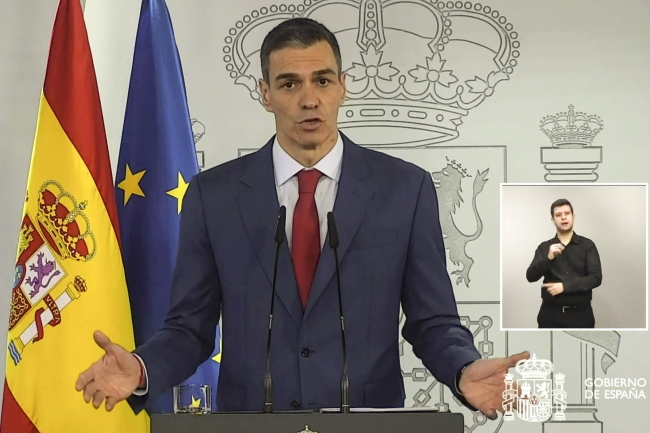


A win by the conservative People’s Party (PP) and the far-right Vox in parliamentary elections would set Spain back 40 to 50 years, Prime Minister Pedro Sánchez, leader of the governing Socialist Party (PSOE), told the newspaper El País.
Early elections to Spain’s parliament will be held Nov. 29, and the campaign is under way.
– [Possible] PP and Vox governments don’t mean a change of power but a real regression. They mean going back 40 or 50 years in the debate [on topics such as] abortion or death with dignity, Sánchez said in an interview published Sunday.
On Friday, PP leader Alberto Núñez Feijóo said in an interview with public radio Cadena SER that he would open a debate on access to abortion for 16- and 17-year-olds, who under current law do not need the consent of legal guardians to terminate a pregnancy. Feijóo noted that although he believes doctors should not be forced to perform the procedure, he does not intend to take this right away from women. He also announced a reform of the law on euthanasia.
Sánchez said that in the autonomous community of Castile and León, governed by a coalition of the PP and Vox, officials have announced they will withdraw subsidies from films deemed “ideological.” – Who decides what is ideological? They do. That means censorship, and that is exactly what Spain dealt with under the dictatorship, the prime minister said.
In his view, the growing strength of the right around the world stems mainly from the algorithms of social media platforms. – Their design favors polarization, spreads messages of hate and helps the far right, he said.
He referred to the ongoing discussion in Spain over PP campaign spots that featured AI-generated likenesses and voices of several PSOE politicians. Among other things, the generated figures admitted to corruption. PSOE is considering legal action.
According to Sánchez, the main issue in the country is access to housing. Polls show this, with more than half of respondents saying so and up to one-third saying the problem affects them personally.
Sánchez stressed that about 1 million homes have been built under his government, 13% of them as social housing. He judged, however, that simply increasing the number of homes on the market is not enough, which is what the PP argues. According to the prime minister, “all levels of government [must] commit to building affordable and protected housing and, where possible, to not selling it to speculative funds.”
He recalled that parliament has rejected government bills containing such regulations several times, most recently a proposal to freeze rents for two years, meaning the payment a renter makes to a property owner. He stressed that communities governed by the PP and Vox are blocking the application of existing regulations on the housing sector.
The prime minister defended his migration policy and argued that, thanks to it, the social security system is setting records for contribution revenue (a year-over-year increase of more than 7% was recorded – PAP).
The social affairs ministry stressed that this results mainly from an increase in the number of people paying contributions, made possible by an influx of migrants. This year, partly thanks to an extraordinary campaign to legalize the residency of migrants who meet certain criteria, the number of employed people from abroad paying contributions rose by more than 420,000.
Sánchez named his biggest mistake as “failing to notice” the corruption of José Luis Ábalos, a former transport minister in his government and one of the most important politicians in the PSOE leadership. Ábalos received a final sentence of more than 24 years in prison for corruption.
From Madrid, Justyna Wojteczek (PAP)
