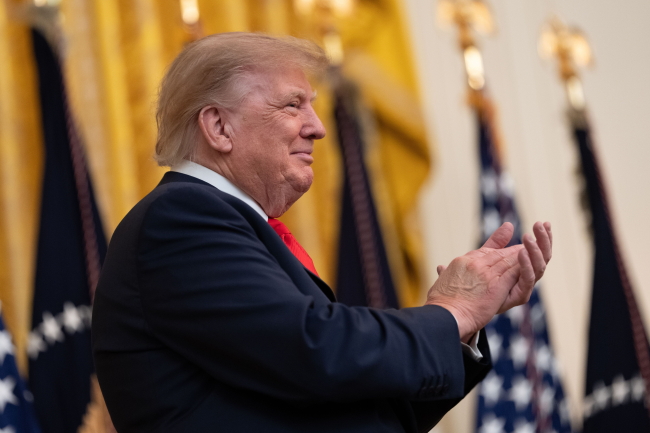


The head of Madrid’s Elcano think tank, Prof. Charles Powell, believes that if the right takes power in Spain, Madrid’s relations with Donald Trump will improve.
In an international climate that is shifting to the right, Spanish Prime Minister Pedro Sánchez is one of the few remaining socialist leaders. Polls ahead of Sunday’s parliamentary elections indicate that he will lose power to the conservative Alberto Núñez Feijóo.
“There is nothing more dangerous than normalizing war,” Sánchez wrote in a November article in „Foreign Affairs.” In his view, militarization increases the risk of war.
To counter it, Sánchez calls for cooperation among many countries, including through development aid. He has come out in favor of strengthening the United Nations by limiting the veto power in the Security Council. He often stresses his commitment to human rights and international law.
During the campaign, he announced that he would enshrine in law a ban on Spain joining “unjust wars.” This is a continuation of his policy: the socialist leader opposed the war with Iran and did not allow the Americans to use Spanish bases to support military operations in the Middle East.
He has also consistently opposed spending 5% of GDP on defense. In response, U.S. President Donald Trump called Spain a “terrible ally.”
Feijóo, for his part, referring to Sánchez’s opposition to raising defense spending, accused him of failing to meet his obligations to allies.
According to the head of the Elcano think tank, Prof. Charles Powell, relations with Trump will improve if the right takes power. He cautioned, however, citing his many conversations with officials of the U.S. administration and the Pentagon, that “there is a lot of turbulence only on the surface.”
– The structural foundations remain very strong, he assured PAP. He noted that the United States is the largest foreign investor in Spain, that a sixth American destroyer recently arrived in Rota, and that the two countries cooperate closely in fighting drug cartels and terrorism.
In his view, the debate over spending 5% of GDP on defense made the Spanish government less popular in Europe than in America. – After the NATO summit in Ankara, the emphasis is no longer on how much is spent but on military capabilities. And in that respect, Spain is doing well, he added.
Spain increased its development aid spending by 13%, devoting about 0.27% of GDP to it in 2025. By comparison, UN data show that Poland spends about 0.16% of GDP on this purpose, and France 0.42% of gross domestic product. The spending is criticized by the leader of the far-right Vox party, Santiago Abascal, who is also a supporter of the policies of Trump and Benjamin Netanyahu.
According to polls, Vox will finish third in the election race, and Feijóo’s conservative People’s Party (PP) does not rule out a coalition with it. Feijóo has announced, however, that as prime minister he would reserve for himself the appointment to posts including the foreign ministry, so Vox is unlikely to get that portfolio.
Experts believe that if power changes hands, Spain will still support Ukraine, though it is hard to gauge the scale of the aid. Abascal has unequivocally condemned the Russian invasion and has repeatedly declared support for Kyiv’s right to defend itself. However, he opposes financial support for Ukraine, arguing that it comes at the expense of Spaniards and results in higher energy and gas bills. Feijóo is a proponent of peace talks involving the EU and believes that peace should not benefit the aggressor.
Although Poland and Spain are both members of the European Union, share a number of episodes in their history, enjoy good cultural cooperation, have seen large-scale migration of Poles to Spain since Poland joined the EU, and now see Poles’ growing share of the housing market, bilateral relations between the two countries are not particularly well developed.
– I have worked on this cause for so many years that I was even decorated by the Polish government, Prof. Powell joked in an interview with PAP. (He received the Knight’s Cross of the Order of Merit of the Republic of Poland – PAP note.)
In his view, the lack of a relationship between Spain and Poland may stem from the fact that Madrid focuses largely on multilateral relations with the European Union. – Spain does not invest as much as it should in traditional bilateral relations. This also applies to other European countries, for example Italy, he added.
In his view, under previous governments in Poland “there was an ideological obstacle.”
– Now it is no longer there. Spaniards feel comfortable only with a Polish government that is pro-European, more or less secular, more or less tolerant and more or less open to the world. Poland has that right now. Since the main political obstacle has been removed, then regardless of who wins the election, this will be an area that is worth working on in the future, Powell said.
From Madrid, Justyna Wojteczek (PAP)