
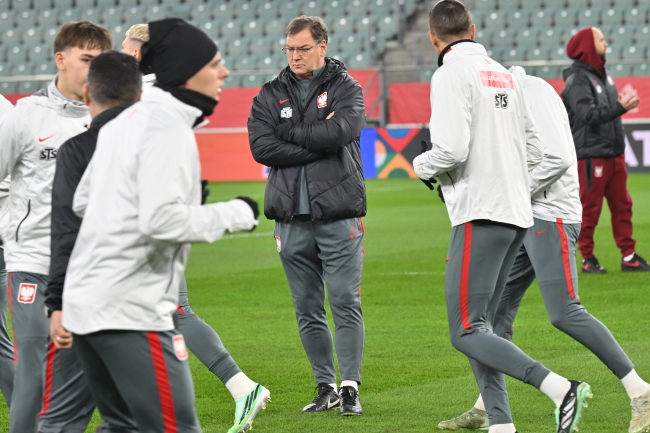


With the Nations League group stage over, the fate of Jan Urban is hanging in the balance. His players drew 1-1 with Sweden on Tuesday. The last Poland national team coach to part ways with the team after a draw was Władysław Stachurski in 1996. Those who followed left after defeats or after “consolation” wins in matches with nothing at stake but pride.
“Whether they fire me or not, it doesn’t depend on me,” Urban said after Saturday’s 2-1 loss to Romania in Bucharest. Three days later, his team drew with the “Three Crowns” of Sweden in Wrocław and finished third in their group in the Nations League’s second tier. They were not promoted to the top tier, but they were not relegated to the third level either.
Cezary Kulesza, president of the Polish Football Association (PZPN), is for now giving himself time to decide on the coach. He plans to meet with Urban and also expects a report on the work of the coaching staff. The future of the 64-year-old coach may be decided by Dec. 6, the day the draw for the Euro 2028 qualifying groups is scheduled in Belfast.
One thing in favor of Urban staying on is, among other things, history. In the 21st century, no Poland national team coach has ended his time with the squad after a drawn match. Most left after defeats, though in varying circumstances, and three left after “consolation” wins at the World Cup.
The last case of a “farewell draw” came in early May 1996. In Stachurski’s fourth match in charge, the team split the points with Belarus, 1-1, in Mielec. A few days later there was a change, and Antoni Piechniczek took the helm for the second time in his career. Officially, Stachurski resigned himself after failing to record a single win, though there was no shortage of voices saying that the then-PZPN chief, Marian Dziurowicz, influenced his decision.
The second stint with the national team for Piechniczek, a highly regarded figure in Polish football who led the White-and-Reds to third place at the 1982 World Cup in Spain, lasted only a year. He last served as coach on May 31, 1997, in a 2-0 loss to England in Chorzów in World Cup qualifying.
His assistant, Krzysztof Pawlak, took over on an interim basis and… beat Georgia 4-1 in Katowice, after which Janusz Wójcik became the coach.
The coach of the Olympic silver medalists from Barcelona led the senior team for more than two years, a period that ended with a 2-0 away loss to Sweden in October 1999.
From the start of 2000, Jerzy Engel was in charge of the national team. He led it to the 2002 World Cup in South Korea and Japan. After losses to South Korea, 2-0, and Portugal, 4-0, the White-and-Reds lost their chance of advancing from the group.
As a consolation, in a match “for honor” and with a heavily changed lineup, they beat the U.S., 3-1, and after returning home the coach stepped down.
Engel was replaced by Zbigniew Boniek, then a vice president of the federation, but he lasted less than six months. He resigned himself in early December 2002, and his last match in the role was a 2-0 loss to Denmark in Copenhagen in November.
Soon afterward, Paweł Janas was entrusted with the job. The national team failed to qualify for Euro 2004 in Portugal, but it did qualify for the 2006 World Cup in Germany. The tournament proved a major disappointment, however. The White-and-Reds lost their first two matches (2-0 to Ecuador, 1-0 to Germany) and were the first team to lose their chance of reaching the round of 16. They finished by beating Costa Rica, 2-1, and went home.
The PZPN president at the time, Michał Listkiewicz, was very diplomatic toward Janas, but journalists and fans were not as understanding.
“We rate Coach Janas’ work very highly,” Listkiewicz said at a news conference, announcing the end of their cooperation and the signing of a contract with Leo Beenhakker.
The Dutchman qualified in fine style for the 2008 European Championship in Austria and Switzerland. The tournament again proved a disappointment for Polish fans. The White-and-Reds lost to Germany, 2-0, drew with Austria, 1-1, and finally fell to a Croatia side fielding its reserves, 1-0.
After the Euro, the experienced coach stayed on, the first Poland coach this century to do so after a major tournament.
In the fall of 2008, however, there was a change in the PZPN presidency: Grzegorz Lato succeeded Listkiewicz. As time went on, relations between the federation’s new leadership and Beenhakker grew increasingly strained. Ultimately, near the end of the unsuccessful 2010 World Cup qualifying campaign, the Dutchman stopped serving in the role. President Lato announced the decision right after a 3-0 loss to Slovenia on Sept. 9, 2009, in Maribor.
In the two remaining qualifiers, losses of 2-0 to the Czech Republic and 1-0 to Slovakia, the team was coached by Stefan Majewski.
The era of Franciszek Smuda followed. Poland did not have to qualify for Euro 2012, because as co-hosts they were guaranteed a place. The performance was again unsuccessful: two points in the group, from 1-1 draws with Greece and Russia in Warsaw and a 1-0 loss to the Czech Republic in Wrocław.
“I spoke with Coach Smuda. His contract ends on Aug. 31. We agreed together that I will pay him all salary and amounts due until the agreement expires. And we are already starting the procedures to choose a new coach,” President Lato said on June 19, 2012.
Less than a month later, Waldemar Fornalik became Smuda’s successor. The coach, known for solid work at clubs, failed to qualify for the World Cup, and after a 2-0 loss to England at Wembley in October 2013, Boniek, by then the PZPN president, handed the coaching duties to Adam Nawałka.
That confirmed an unwritten rule that it is not good for anyone when a PZPN president inherits a coach from his predecessor. Fornalik was appointed by Lato and dismissed by Boniek.
Despite early setbacks in friendlies, Nawałka built a strong team that qualified for Euro 2016 in France. There it reached the quarterfinals, losing to Portugal on penalties.
It was no surprise, then, that Nawałka stayed on. He later led the team to the 2018 World Cup in Russia, but the tournament turned out to be a flop. After losses of 2-1 to Senegal and 3-0 to Colombia, Poland lost their chance of advancing. At the end of the group stage they beat Japan, 1-0, confirming that matches “for honor” are a specialty of the White-and-Reds.
After returning home, Boniek and Nawałka met to discuss future plans. In the end, it was decided that their paths would part.
Jerzy Brzęczek became the successor. He qualified without trouble from a theoretically not very strong group for Euro 2020, but the tournament was postponed by a year because of the pandemic.
In the fall of 2020, Brzęczek kept the team in the top division of the Nations League, but a wave of criticism fell on the national team. Even so, Boniek’s decision to change coaches was unexpected, particularly its timing: January 2021, five months before the delayed Euro. The team’s last appearance under Brzęczek was therefore a 2-1 loss to the Netherlands in Chorzów on Nov. 18, 2020.
Portuguese coach Paulo Sousa got the chance. At the Euro, the White-and-Reds were eliminated after the group stage, but Boniek did not fire the Portuguese coach. Sousa had a valid contract with PZPN, and the federation’s then-head was also finishing his time in office because he could not seek a third consecutive term. Kulesza became president on Aug. 18, 2021.
The end of Sousa’s contract with PZPN depended on Poland’s results in the fight to qualify for the 2022 World Cup. They finished second in their qualifying group and played in the playoffs, so the coach’s contract was automatically extended until then. The Portuguese coach did not see it through, however, as at the end of December 2021 he informed Kulesza that he wanted to terminate the contract. He left for Flamengo in Rio de Janeiro, where he did not last long.
The vacancy with the national team was filled by Czesław Michniewicz, a specialist in putting out “fires.” He achieved the goals set for him. First, in March 2022, he qualified for the World Cup through the playoff final, and he also kept the team in the top division of the Nations League.
In Qatar, the team advanced from the group and lost to France, 3-1, in the round of 16. Its defensive style, however, raised many doubts. Even more damaging to Michniewicz was the so-called bonus scandal and, as media reported, disagreements within the team over how to divide a potential financial reward.
The coach denied the journalists’ reports, but soon afterward Kulesza was already looking for a new coach. He chose Fernando Santos, who won the European Championship (2016) and the Nations League (2019) with Portugal and had previously coached Greece.
“It was a difficult choice, but we chose the best possible coach,” Kulesza said on Jan. 24, 2023, presenting Santos at a news conference.
The end of such a promising story came quickly. Three losses in five matches in a theoretically easy Euro qualifying group meant that in September 2023, after a 2-0 stumble against Albania in Tirana, PZPN’s leadership parted ways with the experienced Portuguese coach.
Later that same month, Kulesza chose Michał Probierz, whom he knew from their time working together at Jagiellonia Białystok and whom he later, during his own tenure at PZPN, appointed coach of the under-21 national team.
Probierz led the team through the playoffs to Euro 2024. His players ended the tournament in Germany in the group stage, and in the fall they were relegated from the top division of the Nations League.
The coach nevertheless stayed on for 2026 World Cup qualifying. And who knows how long he would have continued had it not been for events in early June 2025. The stripping of the captain’s armband from Robert Lewandowski, who was absent from the training camp, the famous striker’s subsequent decision to stop playing for the national team under Probierz, and a 2-1 loss to Finland led the then-coach to resign on June 12, several dozen hours after the match in Helsinki.
In mid-July 2025, Urban became his successor. He had a very successful start, but in 2026 he won only two of 10 matches, lost all of his away games, and ended the year with a draw against Sweden. It will soon become clear whether that was his last act with the national team or, after all, a “winning draw”…
Maciej Białek (PAP)
