
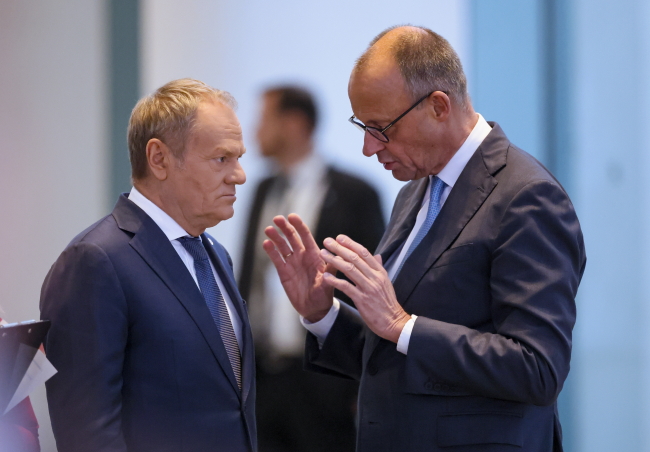


Prime Minister Donald Tusk said that U.S. President Donald Trump, during a call with participants in the meeting of the coalition of the willing, shared his impressions from talks with the leaders of Russia and China. Trump’s words sounded optimistic but were received cautiously, the prime minister said, adding that Russia is unlikely to sit down to negotiations before the end of winter.
Donald Tusk took part on Thursday in a meeting in Berlin of the coalition of the willing, a group of countries supporting Ukraine. At a press conference before returning to Poland, the head of government said that participants in the meeting had connected with the U.S. president, who was just leaving Shenzhen, where earlier that day he had met with Chinese President Xi Jinping and Russian leader Vladimir Putin.
The prime minister said the U.S. president had given representatives of the coalition countries an account of his impressions from those talks. “He said words that sounded fairly optimistic, although I have to say that in the room they were received very cautiously,” Tusk said.
The prime minister explained that the optimism he referred to concerned the intentions of Putin and Moscow regarding peace talks on the war in Ukraine. Tusk added that Trump’s faith in Putin’s good will “is probably unshakable,” although, as he put it, “so far no facts confirm it.”
“It would be nice (…) if sooner or later it really turned out that Russia is ready to start peace talks in earnest,” the head of government said.
Tusk said that the statements by participants in Thursday’s meeting in Berlin “showed very clearly such a consistent approach to the Ukrainian war.” “Everyone declared readiness to help Ukraine, especially in these difficult winter months,” Tusk said.
He noted that Moscow will likely intensify its aggression against Ukraine in the autumn and winter. He added that it is rather unlikely that Russia will sit down to peace talks before the end of winter.
Asked about the possibility of Europe being admitted to talks on ending the war in Ukraine, Tusk stressed that neither he nor anyone at the coalition of the willing meeting “had a signal about this kind of formal initiative.” “I would be very cautious about initiatives of this kind. We certainly also will not want to talk about Ukraine’s future without Ukraine,” the prime minister said.
He said that on Thursday in Berlin, in the context of the future of the negotiations, it was confirmed that Europe will be represented by the E5 countries and European institutions. He said that talks of the European Group of 5 Defense Ministers will continue at the level of security advisers in Berlin on Thursday evening and Friday.
The prime minister added that during the coalition meeting he spoke with U.S. envoys Steve Witkoff and Jared Kushner. “They said that Poland is an absolutely exceptional country, a partner for the United States, and that they are very glad Poland will be in this group of five. But we know very well that this game is sometimes very spontaneous and improvised,” Tusk said.
He stressed that, all the same, the shape of the negotiations will be “set by various actors, and the leading role will certainly still be played by the United States, Ukraine and Russia.”
According to the German news agency dpa, Witkoff and Kushner were to meet in Berlin with the new European negotiating team, established Friday in Dublin. It was agreed then that the team would consist of representatives of the E5 (Poland, France, Germany, the United Kingdom and Italy) and EU institutions. Poland is represented on the team by Deputy Foreign Minister Robert Kupiecki, Tusk’s national security adviser.
U.S. negotiators said last week that Europe would be admitted to talks on ending the war in Ukraine. The Kremlin maintains that the participation of Europeans has not been agreed with it.
The summit of Ukraine’s allies in Berlin took place immediately after the three-way meeting of Donald Trump, Xi Jinping and Vladimir Putin in Shenzhen, China. According to a source in the U.S. administration cited by the news site Axios, among others, the meeting in Berlin and Trump’s visit to China are a coordinated diplomatic effort by the American side. (PAP)
