
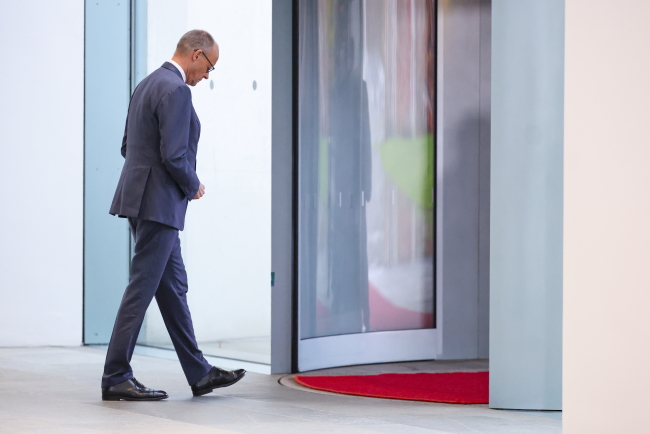


The leadership of France, Germany and the United Kingdom in the coalition of the willing, which is key to Ukraine’s success, is the weakest in years, Politico reported Thursday, citing four officials from European governments.
Russian President Vladimir Putin, who rarely has the chance to attend this kind of event since the invasion of Ukraine, is meeting Thursday with Xi Jinping and Donald Trump in Shenzhen, China. Meanwhile, Ukrainian President Volodymyr Zelensky is meeting in Berlin the same day with the coalition of the willing, a group of medium-sized and small countries led by “two weak leaders and a newcomer without a mandate,” the outlet wrote, referring in turn to German Chancellor Friedrich Merz, French President Emmanuel Macron and British Prime Minister Andy Burnham.
Merz is contending with the rising far-right Alternative for Germany (AfD) party, which threatens his governing coalition. Macron’s approval ratings, meanwhile, are at a record low, and polls show that Marine Le Pen, leader of the far-right National Rally, has the best chance of winning next year’s presidential election in France.
“The leadership of France and Germany is shaking at its foundations,” said one European official who spoke anonymously, quoted by Politico. He added that “in the U.K., Andy Burnham (who became prime minister in July – PAP) seems quite solid on Ukraine, but he is still finding his own way, so we are waiting.”
Politico noted that there had been widespread concern that after the change of prime minister, the United Kingdom would be less active internationally. That has not happened, and in his first weeks in office Burnham held several important meetings with foreign leaders and declared that he wants to pursue closer ties with the European Union.
The coalition of the willing was formed on March 2, 2025, in response to the Trump administration’s policy toward Ukraine. After bold declarations by the coalition’s leaders, Starmer and Macron, that they were ready to send their troops to Ukraine, the momentum of the new format slowed, the outlet said.
One of Politico’s sources said the coalition of the willing became a key element of the Ukrainian president’s defense strategy when it seemed that Trump would at any moment force Ukraine to accept an imposed peace plan, which Kyiv’s European partners judged to be harmful. Efforts to end the war weakened, however, after the U.S. and Israel began a war with Iran in February, Politico stressed, noting that Thursday’s meeting in Berlin is the first coalition of the willing summit since August.
The meeting comes as the first joint exercises by the troops of the countries making up the coalition of the willing are taking place in Poland on Nov. 9-22. Soldiers are rehearsing scenarios meant to prepare them for a peacekeeping mission in Ukraine once peace is negotiated at the political level.
Despite the problems facing the coalition’s leaders, Ukraine still considers them essential. “Burnham is a great guy, making a lot of good moves. We are very happy to be working with him. Merz and Macron are doing everything they can. When it comes to support, Germany is the leader, and France is a strong ally,” a Ukrainian official told Politico. (PAP)
