
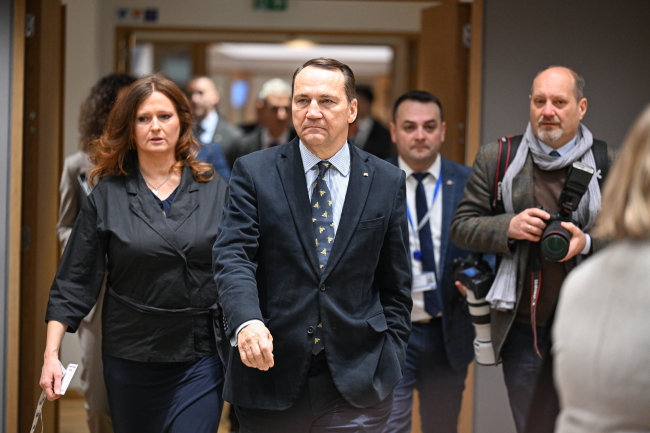


Foreign Minister Radosław Sikorski stressed in Brussels on Monday that the sanctions imposed on Russia so far are limiting its ability to finance the war against Ukraine. Moscow has lost access to Europe, its most lucrative market for hydrocarbons, he noted.
Before a meeting of EU foreign ministers in Brussels, the deputy prime minister and foreign minister said that one of the most painful effects of the sanctions for Russia is the loss of the European market for energy resources.
“The biggest sanction we have imposed on Russia is that it has lost its most lucrative market for hydrocarbons. Every year, Europe imports less Russian oil and gas,” Sikorski said.
He noted that finding alternative markets is logistically difficult for Russia, and that the prices it gets are, as he put it, at least 30 percent lower.
“Russia is selling less oil for less money. That affects its ability to finance the war,” he said.
Sikorski was also asked for his assessment of the three-way meeting of the leaders of China, Russia and the United States — Xi Jinping, Vladimir Putin and Donald Trump — announced for Thursday in Shenzhen.
“I think it is an unnecessary boost for Russia to the position of a global superpower, which Russia has not been for a long time. It should be a meeting in a China–United States–European Union triangle,” he said.
Regarding the 22nd package of EU sanctions against Russia now being prepared, the foreign minister said that “sanctions are something that has to be constantly updated.” He added that “a great many entities and individuals” were placed on the sanctions lists at Poland’s request.
He was also asked about the outcome of Friday’s EU summit in Dublin.
“Two weeks ago I was at the G20 ministerial meeting. Now the prime minister (Donald Tusk) has achieved that, at the level of the prime ministers’ national security advisers, Poland will represent our entire region, the entire eastern flank. That means we are in the game,” Sikorski said.
European Council President Antonio Costa announced on Friday after the Dublin summit that Poland will be one of the countries taking part in negotiations on ending Russia’s war against Ukraine. Besides Poland, they will be France, Germany, the United Kingdom and Italy, along with EU institutions.
Delegations from Germany, France, Italy and the United Kingdom, along with representatives of EU institutions, were already present during negotiations on ending Russian aggression against Ukraine on Nov. 10-11 in Abu Dhabi. However, the main talks were held in a Ukraine-Russia-U.S. format, and EU representatives were not admitted to direct negotiations involving Russia. According to PAP, the next round of talks is expected in Abu Dhabi in about two weeks.
Sikorski was also asked about Poland’s participation in PURL (the Prioritized Ukraine Requirements List), a program aimed at delivering American weapons, purchased by European countries, to Ukraine.
“We contributed (funds) to PURL last year. This year, decisions have not yet been made, but I remind you that Poland is generously supporting Ukraine. (…) We have our own channels for supporting Ukraine,” the foreign minister said. “The fact that Poland pays less or more does not mean the program is dead. Billions of dollars’ worth of ammunition and American weapons are going through it,” he noted.
Prime Minister Tusk said on Friday after the summit that he had told NATO Secretary General Mark Rutte that Poland “will not be putting additional money into this PURL project at the moment (…) because we are spending a great deal on our own armaments.” “We have a high deficit, we are spending a lot on defense, so I said that, in terms of financial capacity, Poland certainly will not be putting in more money, because we have expenses related to our own security, and that is one of the highest in Europe,” the head of government said.
On Monday, Sikorski stressed that the PURL program came into being because “the United States stopped financing support for Ukraine in January of last year, so almost two years ago.” “(Currently) it is Europe that supports Ukraine; the United States does not. But through the PURL program, (the U.S. – PAP) is ready to sell its weapons and ammunition for European money in order to deliver (them) to Ukraine,” he noted.
From Brussels, Łukasz Osiński (PAP)
