
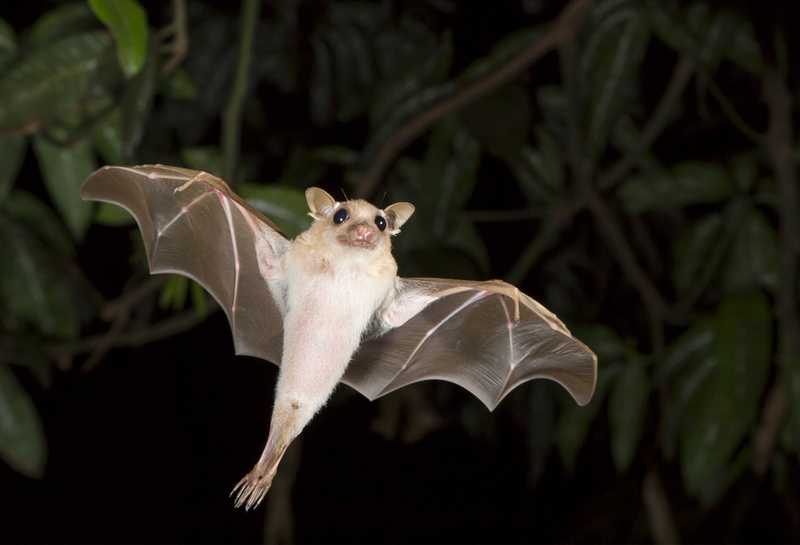


Onshore wind farms in the U.S. may have contributed to the deaths of nearly 19 million bats over four decades, scientists estimate. The scale of the problem is growing along with wind power, but there are ways to limit the losses.
A team of scientists from the United States Geological Survey (USGS) and other American research centers is warning, in the journal Proceedings of the National Academy of Sciences, of a significant threat that wind farms pose to bats. According to the study, onshore wind farms killed 18.7 million of the animals between 1981 and 2024.
Until now, it was assumed that hundreds of thousands of bats die each year from contact with onshore wind farms. The way the threat to individual species varies from region to region was also not taken into account.
The scientists note that wind power in North America has been expanding exponentially since the 1980s.
Cases of bats colliding with wind turbines have also been recorded with increasing frequency. Today, along with white-nose syndrome, a deadly disease that is decimating many populations of these animals, wind farms are considered one of the main causes of bat mortality.
The situation is made worse by the fact that in the United States, monitoring of bat deaths at wind farms is usually carried out separately for individual facilities, mainly to meet legal requirements. As a result, only scattered datasets were created, collected, managed and analyzed in inconsistent ways.
Yet, the researchers stress, bats perform especially important functions in ecosystems, including pollinating plants and keeping pest numbers down.
To address these problems, the authors of the new study developed advanced statistical models. These allowed them to combine data on bat deaths from nearly 500 monitoring reports, compiled after the construction of 277 wind farms across the United States.
Using the combined data, they were able to estimate when, where and how many bats belonging to ten species may have died at those wind farms over the past four decades.
The researchers also analyzed which characteristics of wind farms, such as the size and location of turbines, were associated with higher animal mortality, and how the relative risk to individual species changed depending on location and environment.
According to the new estimates, since 2021 more than 1.5 million bats a year have died at wind farms in the U.S.
Most of the victims belong to four species. During the period studied, about 6.7 million Lasiurus cinereus bats died, 5.8 million Lasiurus borealis and 3.4 million Lasionycteris noctivagans.
All three bat species are migratory and use trees as roosts. The researchers point out that these species are not among the cave-hibernating bats that are most affected by white-nose syndrome.
The analysis also found that bat mortality across different species was associated with a larger area swept by the rotor blades, a smaller distance between the blades and the ground, and proximity to rivers.
According to the scientists, future studies that combine data on bat deaths with information on population sizes and changes over time could help determine whether the growth of wind power is contributing to declines in individual species.
However, the conclusions of the analysis already give policymakers a scientific basis for action to reduce bat mortality. For example, they confirm earlier findings indicating that temporarily shutting down turbines during periods when bats are more likely to appear can reduce mortality in some species.
At the same time, because collision risk varies by region, building wind farms in areas with a lower risk could also limit losses.
In turn, a detailed analysis of monitoring data that takes into account the time of year when bats died can help identify the periods when these mammals are most at risk.
Marek Matacz (PAP)
