Mars Is Not Geologically Dead, Just Dormant, ExoMars Data Suggest
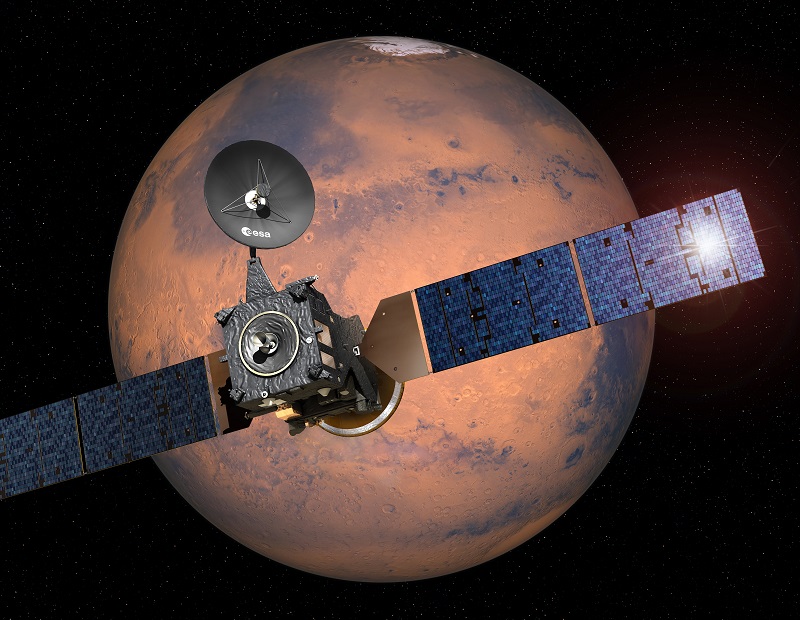
The ExoMars probe has detected hydrogen chloride above fissures on the slopes of a Martian volcano. According to Prof. Daniel Mege of the Space Research Centre (CBK) of the Polish Academy of Sciences (PAN), this suggests the gas may come from volcanic activity, because Mars is not geologically dead, only dormant.
Prof. Mege, of CBK PAN and the University of Bern in Switzerland, is an interdisciplinary scientist on the ExoMars Trace Gas Orbiter (TGO) mission. The researchers analyzed data the probe collected in the lower layers of the Martian atmosphere, and the results were published Nov. 4 in the journal Science Advances.
“The probe recorded the presence of hydrogen chloride (HCl) in the Martian atmosphere. We can assume that this gas most likely comes from a magma chamber beneath the surface, that is, in the Martian crust,” Prof. Mege told PAP, the Polish Press Agency.
He specified that the concentration of HCl in the Martian atmosphere is on the order of 2 ppbv (parts per billion by volume), meaning that for every billion air molecules there are about two hydrogen chloride molecules.
He said that although Mars has the largest volcanoes in our solar system, we do not currently observe any activity on them. “The traces of hydrogen chloride we detected are in a fractured zone associated with one of the largest volcanoes on Mars by area, Alba Mons. Its activity, which began 3.7 billion years ago, was initially very intense and ceased over time,” the researcher said.
In his view, much suggests that volcanoes on Mars are not extinct, but dormant. “That is the case at least in the place where we identified HCl. Our findings also suggest that the interior of Mars is still hot. Earlier, thanks to NASA’s InSight (Interior Exploration using Seismic Investigations, Geodesy and Heat Transport) lander mission, we learned that there are seismic factors in the Martian crust that cause it to deform and crack. Now we also know that there is enough heat there to believe that liquid magma is still present inside the Red Planet,” Prof. Mege said.
He stressed that the HCl content of the Martian atmosphere is a seasonal anomaly. Hydrogen chloride in the northern hemisphere usually peaks in winter (which lasts about 154 Earth days in the northern hemisphere) and almost completely disappears in summer. As the expert explained, this is linked, among other things, to the dust and water cycle on Mars. In early summer, however, there is more hydrogen chloride above the fissures on the slopes of the Alba Mons volcano.
“One possible interpretation is that in winter, when the temperature there drops to about minus 120 degrees Celsius (minus 184 degrees Fahrenheit), ice clogs the openings and fissures in the rocks, so HCl accumulates beneath the surface and is also easily captured by ice particles. When the temperature rises, the permafrost evaporates through sublimation, unblocks the openings in the rocks and releases the gas,” Prof. Mege said.
He added that a second possible explanation for the phenomenon is conditions that favor the probe’s observations. “For spectrometers to detect HCl, a clear atmosphere is needed, and one appears precisely in summer, when the amount of dust falls.”
The temporary concentration of hydrogen chloride was recorded by the TGO’s Atmospheric Chemistry Suite (ACS), a set of infrared spectrometers. The CaSSIS (Colour and Stereo Surface Imaging System) stereo camera, in turn, revealed fresh fissures and surface discoloration in the Alba Mons region.
According to the scientist, further research on hydrogen chloride in the Martian atmosphere may also provide some clues about life that may once have existed there. “An active magnetic system, the heat of liquid magma and some amount of water in the crust mean that a hydrothermal system can form. And hydrothermal vents on the ocean floor are considered one of the most likely places where life on Earth was born. Perhaps it could have looked the same on Mars,” he noted.
He added that the emergence of life requires, among other things, water, suitable pressure and chemical substances, including the “building blocks of life,” that is, the nitrogen bases (of DNA and RNA), which may come, for example, from meteorites. “But that is not enough. Time is also needed to build the molecules necessary for life to arise and to maintain stable, favorable conditions, perhaps for millions of years,” the researcher said.
Prof. Daniel Mege said that at CBK PAN he will lead another project, funded by the National Science Centre (NCN), which will help, among other things, to better understand the seasonality of hydrogen chloride concentrations in the Martian atmosphere. “We want to obtain more data, because the data we published in the paper concern eight detected HCl signals in the atmosphere. All of them are consistent and the measurement error is small, but these are only eight measurements of a local nature. So we need many more years in orbit to supplement this information and check whether the presence of hydrogen chloride is always linked to volcanic phenomena or tectonic deformation,” said the scientist of the ExoMars TGO mission.
He said that further observations, which were not included in the Science Advances paper because the data arrived when the article was already ready for publication, have confirmed this hypothesis.
As part of the new project, the researchers plan to carry out a series of laboratory experiments later this year. Among other things, they will examine how HCl degassed from magmas interacts with ice-rich ground before escaping into the atmosphere. As noted in the project description, this will make it possible to propose a credible mechanism for the seepage of volcanic gases and to determine whether Mars may be the fourth rocky body in the solar system, after Earth, Jupiter’s moon Io and Venus, with ongoing volcanic activity.
“I hope that one day, when we have plenty of experimental data and observations, we will understand what is really happening on Mars,” Prof. Daniel Mege concluded.
Anna Bugajska (PAP)