
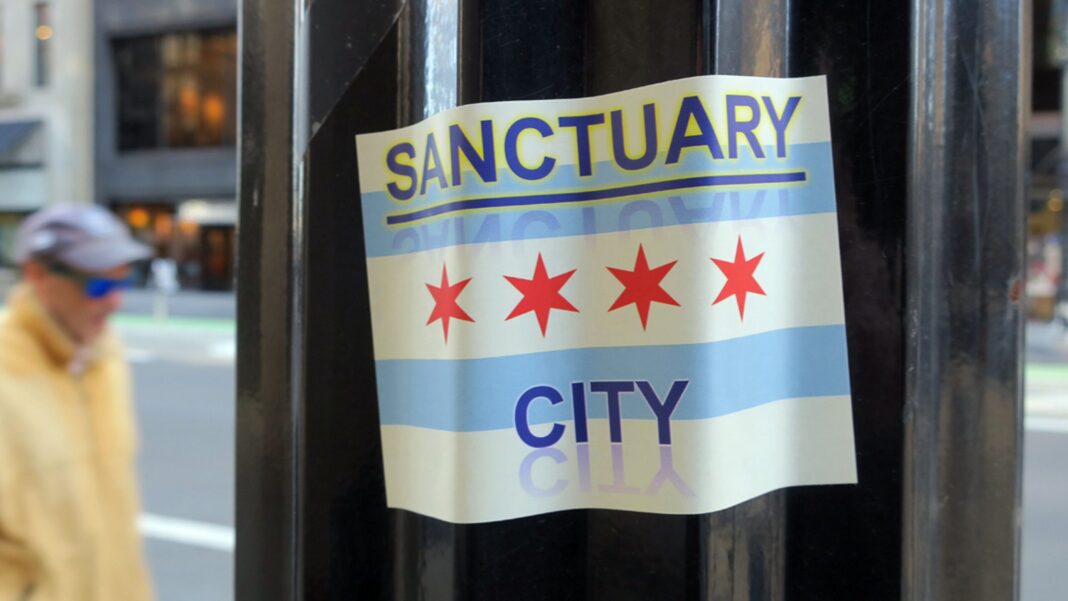


A federal appeals court will decide whether to reinstate a lawsuit filed by President Donald Trump that sought to invalidate state, city and county laws protecting immigrants in the U.S. illegally by barring local law enforcement from cooperating with federal agents.
On Thursday, a three-judge panel of the U.S. Court of Appeals for the Seventh Circuit heard arguments from the parties. The judges asked numerous questions of attorneys representing the U.S. government, Illinois, Cook County and Chicago as they weighed whether to overturn the decision dismissing the lawsuit. After the hourlong hearing, held at the Dirksen Federal Building in downtown Chicago, the court issued no ruling.
The appeal came more than a year after a federal judge dismissed the Trump administration’s lawsuit, declining to invalidate state, city and county laws that protect undocumented immigrants by barring local law enforcement from assisting federal agents, including those of Immigration and Customs Enforcement (ICE). The suit filed by the Trump administration argued that Chicago’s “Welcoming City” ordinance and the state’s “Illinois Trust Act” amount to a “deliberate attempt to obstruct the federal government’s enforcement of federal immigration law, and to disrupt the consultation and communication between federal, state and local law enforcement that is necessary for federal officials to apply immigration law and keep Americans safe.”
Attorneys representing the White House said during the appeal that the regulations in question reject the federal immigration enforcement system “in favor of a system created by the defendants” and are discriminatory because they “specifically target federal immigration officials.” “Sanctuary city policies are an open attack on the full authority of the federal government in matters of immigration,” the filing by attorneys for the U.S. administration reads.
Michael Talent, a Department of Justice attorney, cited on Thursday the example of federal agents being denied entry to correctional facilities in Illinois. As a result, he said, these agents are forced to conduct surveillance from outside in order to detain people without legal immigration status when they are released, all because local law enforcement is barred from giving them any information. Talent argued that this creates a “dangerous and difficult” situation for officers, who must try to detain such people on the street instead of taking them directly into custody to begin deportation proceedings.
The appeals court judges, however, questioned whether Illinois, or any other state, has a legal obligation to cooperate with federal immigration officers. Judge Rebecca Taibleson noted on Thursday that the U.S. Congress has spoken on precisely what states should do regarding the sharing of information and the handing over of individuals in a “somewhat evasive or unclear” way. She added, however, that current immigration law “certainly does not impose” such an obligation. “Given that, expecting us to use the mechanism of federal supremacy, known as conflict preemption, to turn such ambiguity into a binding mandate would be something of a stretch,” she added. The City of Chicago ordinance, known as “Welcoming City,” is intended to ensure that all Chicago residents, regardless of citizenship or immigration status, have access to city services, including police protection and medical care.
In July 2025, U.S. District Judge Lindsay Jenkins dismissed the Trump administration’s suit without a full trial, as requested by Chicago Mayor Brandon Johnson and Illinois Governor JB Pritzker. The decision was a significant win for local and state officials, who sought to keep the federal government from taking billions of dollars in federal funding away from Chicago and Illinois. Judge Jenkins ruled at the time that forcing law enforcement in Chicago and Illinois to assist federal agents in deportation efforts is unconstitutional. She wrote that such an arrangement “would allow the federal government to take control of the states under the guise of intergovernmental immunity, which is exactly the kind of direct regulation of the states that is prohibited by the Tenth Amendment.”
BK
Source: Polski.FM
