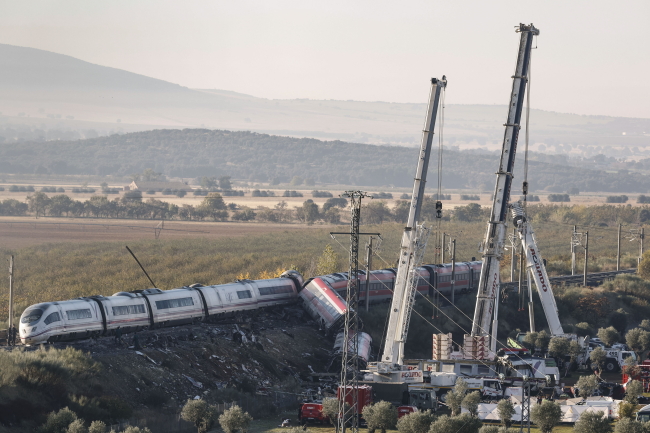
‘Corruption Kills’: Spanish Prime Minister Under Fire After Train Disaster
Spain’s transport ministry on Thursday evening revised earlier information that the death toll from Wednesday’s train crash in Toledo province had risen to 74, clarifying that the toll remains 69.
On Thursday morning, authorities reported the death of one of the injured, who had been in the hospital, raising the death toll from 68 to 69. In the afternoon, the Railway Accident Investigation Commission (CIAF) raised the death toll to 74, and the figure was published on the transport ministry’s website. Soon afterward, however, sources within the ministry explained that the government of the Castilla-La Mancha region is responsible for reporting casualty figures, and the last number it released was 69. CIAF later also corrected its figure to 69.
Local authorities in Castilla-La Mancha said the total number of passengers in hospitals is nearly 200, with 15 of them in serious condition.
The EFE news agency, citing Spain’s Foreign Ministry, reported that the ministry is in contact with the embassies of seven countries from which 42 foreigners traveling on the trains involved in the crash came. According to the data the ministry currently has, one of them died, seven were injured, 10 were uninjured, and the fate of another 24 is unknown. The Europa Press agency confirmed with Argentina’s Foreign Ministry that the fatality was from Argentina. Among those whose fate is unknown are three Italians and one Mexican, while the injured include citizens of South Korea, Mexico and Italy. It is also known that Japanese nationals were aboard the trains.
The royal couple traveled to Toledo on Thursday. They visited the university hospital there, where 15 passengers are being treated in the intensive care unit. King Felipe VI told reporters that the ongoing investigation must establish “how and why” the crash happened. He added that “action must be taken so that something like this never happens again.”
Prime Minister Pedro Sanchez also traveled to Toledo. He has come under fire from the opposition over the disaster, which accuses his government of failing to ensure rail safety. Visiting the rescue center in Toledo, Sanchez said authorities are working “day and night,” not only to support the victims of the crash and their loved ones, but also to explain the tragedy “thoroughly,” so that “something like this never happens again.”
The opposition is also demanding the resignation of Transport Minister Oscar Puente. On Thursday, EFE reported that on his own initiative he will give an explanation about the crash before the Congress of Deputies, the lower house of Spain’s parliament, next Tuesday.
Riots broke out in front of the transport ministry building overnight from Wednesday to Thursday, and on Wednesday evening, during a ceremony honoring the victims in front of Madrid’s city hall, a group of demonstrators held banners reading “Puente, resign” and “Corruption kills.” The authorities of both Madrid and the Community of Madrid are from the conservative People’s Party (PP), which, according to almost all polls, has the best chance of winning the upcoming early parliamentary elections.
Its leader, Albert Nunez Feijoo, visited Urda on Thursday, the town closest to the crash site, where first aid was given to the injured, as well as the operational coordination center in Toledo. “What the transport minister did yesterday was shift the blame onto an employee of the control center at Atocha station,” he said in Toledo. He stressed that “political responsibility cannot be put off until the investigation is over, whether it is administrative or judicial.”
Reuters noted that when Sanchez announced early elections following protests over the housing crisis, he hoped that a wave of public outrage would reverse unfavorable polls and allow him to stay in power. “But Wednesday’s deadly rail crash dealt a serious blow to his campaign,” the agency assessed.
From Madrid, Justyna Wojteczek (PAP)