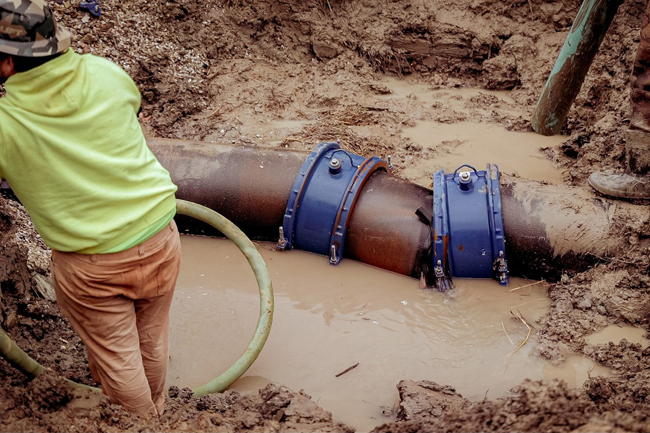


Chicago could lose federal funding if it does not speed up the removal of lead pipes. It has been five years since Congress passed a law providing $15 billion to replace toxic lead water service lines across the country.
But the program is approaching a “funding cliff,” and Chicago remains dangerously behind, according to a report released this week by Sen. Tammy Duckworth, who represents Illinois in Washington. The report shows that Chicago has replaced only 4% of its more than 400,000 lead service lines, the largest number of any city in the U.S.
Meanwhile, the federal money that has supported the work is running out, and it is unclear whether it will be replenished. The $15 billion approved under the bipartisan infrastructure law of 2021 is ceasing to be available, while President Donald Trump’s administration has proposed a 90% cut to support from the drinking water revolving fund. Congress has also trimmed the program’s budget by another $125 million. The deadline coincides with the start of a 10-year period set by the Environmental Protection Agency (EPA) for removing lead water pipes nationwide. Under those requirements, most water systems must complete replacement by 2037.
According to Erik Olson, health director at the Natural Resources Defense Council, Chicago was given until 2047 because of its large number of lead lines. But the city is behind on replacing them. According to data from the Chicago Department of Public Health, 18,000 lead service lines had been replaced by November. Olson said that at the current pace, the city faces a huge challenge in meeting even that extended deadline. And the stakes are high, because residents’ health is at risk. Exposure to lead is especially dangerous for children.
Olson explained that even water systems that meet the EPA’s concentration limit are not necessarily safe. A study conducted in September 2026 found that children who drink water from lead pipes may have elevated blood lead levels, even in cities such as Flint, Michigan, where lead concentrations are below the EPA’s allowable threshold. Duckworth’s report points to a growing gap between nationwide efforts to replace pipes and the resources needed to finish the job.
More than 4 million lead service lines still remain across the United States. According to estimates in the report, meeting Chicago’s 2037 deadline would require replacing more than 400,000 pipes a year. Cities such as Chicago must “step up their efforts” to replace pipes. Illinois received $1.18 billion in federal funds, more than any other state. But as Duckworth notes, money alone does not guarantee progress. “Money alone won’t remove the pipes,” said the Democratic senator, calling for coordinated action by local, state and federal authorities.
Duckworth is urging cities to adopt mandatory pipe replacement programs and to carry out the work in phases, street by street. She points to Newark, New Jersey, as a model, where large-scale city efforts led to the replacement of more than 23,000 service lines in less than three years.
BK
Source: Polski.FM