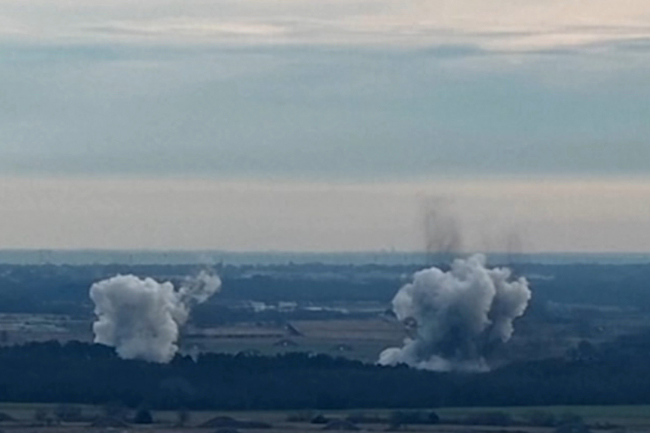


Illinois remains on heightened alert after the U.S. Army’s controlled detonation of lead azide in Iowa on Wednesday morning. Federal agencies say they are continuing to monitor air and soil quality near the site of the detonation.
On Wednesday, two controlled detonations were carried out at the Iowa Army Ammunition Plant in Middletown, Iowa, destroying 68 barrels – about five tons in total – of lead azide. The substance had recrystallized and, because of its instability, posed a risk of accidental explosion. Although wind conditions meant the detonation had “little or no” effect on Illinois, officials said they would remain on alert until the federal government declares the entire operation finished and releases final data.
According to Illinois officials, several communities in the state were covered by a warning issued by FEMA (the Federal Emergency Management Agency) before the detonations. After the blasts, however, no adverse effects were recorded in Illinois. “Our agencies will monitor the situation for unforeseen short- or long-term effects and will take appropriate action if needed,” Gov. JB Pritzker said on social media.
The Environmental Protection Agency (EPA) says it is continuing to monitor for lead in the area surrounding the affected site. According to the latest data released by federal authorities, however, monitoring devices have not detected any traces of lead particles outside that area. A NASA aircraft has also been sent to Iowa, where it is circling the region and collecting air samples to check whether lead particles appeared in the air after the detonations.
The controlled blast of about 5 tons of degraded chemicals raised concerns about potential health and environmental effects, but officials said the countermeasures taken helped limit the negative consequences. “I am deeply confident that we have minimized the risk to the health and safety of the residents of Middletown and surrounding communities across Iowa to a level as close to zero as possible,” Maj. Gen. Eric Shirley said two hours after the explosion. He added that there were no secondary explosions or damage to infrastructure.
Those overseeing the operation said the wind should push the cloud of pollutants southwest, toward Missouri, away from the nearby city of Burlington and the Mississippi River. Even so, hundreds of homes and farms may still lie in the path of the toxic dust cloud containing lead – a metal that is harmful in any amount and especially dangerous to children and pregnant women. Earlier, Iowa authorities had advised residents within 5 miles of the detonation site to evacuate. The U.S. Army said it would continue to monitor air quality and collect soil and water samples near the site of the blast.
BK
Source: Polski.FM