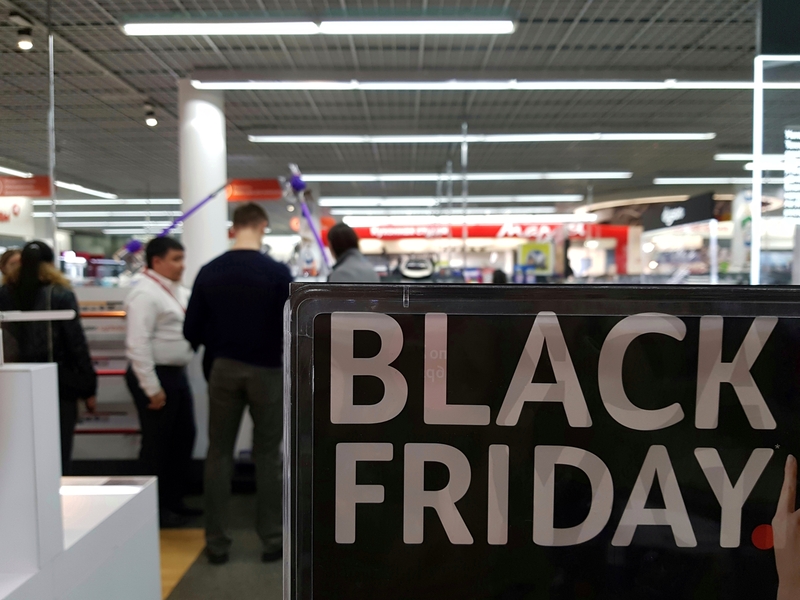


Poles’ interest in Black Friday shopping has been growing in recent years, while their median spending remains between PLN 400 and PLN 600, consumer behavior expert Michał Pajdak told PAP. He noted, however, that price cuts in Poland at this time are smaller than in the U.S.
Nov. 27 is the first Friday after this year’s Thanksgiving in the U.S., known as Black Friday. According to American tradition, many stores cut prices on that day, and consumers go shopping.
Pajdak, a consumer behavior expert at WSB MERITO University in Poznań, told PAP that the custom of Black Friday shopping has clearly taken hold in Poland as well.
Survey research he cited shows that more and more Poles say they are interested in Black Friday shopping. Last year, two-thirds of respondents surveyed by UCE Research were considering taking advantage of the sales; this year, it is three-quarters. The share of those interested also rose in previous years.
Pajdak said that, after adjusting for inflation, Poles’ Black Friday spending remains at a stable level. He estimates that the median stays between PLN 400 and PLN 600.
The average Black Friday shopper in Poland was between 25 and 44 years old and had a secondary or higher education. The shopper worked full time and had a net income of PLN 3,000 to PLN 7,000. Women and men made up a similar share of buyers.
Pajdak pointed out that, since at least 2023, interest in the sales day has been rising among people in cities with 20,000 to 100,000 residents, while it has been falling in cities with more than 500,000 people.
“This event is becoming more pluralistic, because we are shifting from the big cities to medium-sized towns,” the expert said. In his view, this may stem, on the one hand, from the construction of shopping centers and rising wages in smaller localities and, on the other, from the experiences of customers in large cities, who associate the sales day with crowds and traffic jams.
He explained that Black Friday price cuts are possible primarily because stores and manufacturers lower their margins. “It may also be that retail chains offer a certain product as a ‘lure’: the store sells one product at no profit, but only so that the customer buys something else along with it,” he noted.
The expert also said that retailers and manufacturers treat the sales as an opportunity to “clear out warehouses” of old product models sitting in stock. He added that, partly because of this mechanism, Black Friday in Poland is “not quite the same as in the United States.”
Compared with Poland, products such as clothing and footwear turn over far more quickly on the American market, with new models reaching sale much faster. This makes it worthwhile for manufacturers and retailers there to offer bigger discounts to get rid of old stock, the expert said.
In Poland, by contrast, he added, new products appear less frequently, so there is nothing to pull from the market during the sales. He noted that in sectors such as clothing, footwear and electronics, relatively few domestic companies operate in the country, and such companies more often offer these kinds of promotions. “That is why the scale of Black Friday discounts in Poland is much smaller than in the U.S.,” he explained.
Pajdak noted that, despite the EU’s Omnibus directive, which is meant to protect buyers from fake promotions, Polish retail chains use various methods to make discounts look more attractive than they really are.
Among other things, Omnibus introduced a requirement that sellers, alongside information about a price cut, also state the product’s lowest price from the previous 30 days. The expert pointed out that some stores simply raise the price more than 30 days before Black Friday, for example in mid-October, which makes the discount on offer look bigger.
In his view, consumers are driven to buy by psychological mechanisms such as loss aversion linked to missing out on a sale. “We also have the ‘social proof’ effect: two-thirds of Poles are planning to take part in this holiday, and friends brag about buying this here and that there,” he said.
“It is not the case, however, that customers don’t see all of this,” the expert stressed. Citing survey research, he said that 43% of Poles believe Black Friday promotions are not presented honestly. Some 37% of respondents held the opposite view. “Eighty-four percent of respondents say they check every time whether a promotion is real and worthwhile,” Pajdak added.
Referring to the name “Black Friday” itself, he explained that it was popularized in the 1950s and ’60s by police in Philadelphia, who used it to describe the crowds and traffic jams the day after Thanksgiving. The first Friday after Thanksgiving became a “shopping holiday” in the U.S. because the extended weekend and trips to see family offered a good pretext for taking care of pre-holiday shopping, he explained. (PAP)