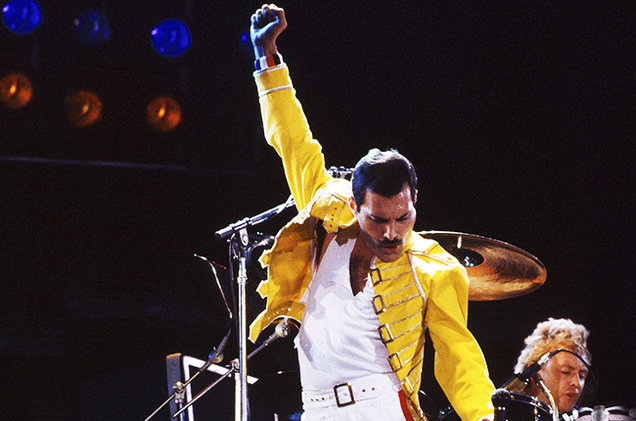


Freddie Mercury, co-founder and lead singer of Queen, is regarded as one of the greatest figures in the history of rock. He is remembered for his expressive stage performances. He died 35 years ago.
– What Queen presented with Mercury was something completely new: a strange mix of heavy rock and theater, with very catchy melodies and Freddie’s stage show. It was extremely innovative, and I think it gave many other artists the impulse to go in a new direction, music journalist Piotr Metz told PAP, the Polish Press Agency.
– Freddie Mercury was an extraordinary and inimitable figure. He had a wonderful voice and incredible ideas for his stage presence. He was born to enchant us. He went down in history as one of the best vocalists, frontmen and composers, as the author of Queen’s hits, music journalist Roman Rogowiecki told PAP.
Freddie Mercury was born Farrokh Bulsara on Sept. 5, 1946, in Zanzibar. It was his mother who got him interested in music and helped him develop that passion, enrolling him, among other things, in piano lessons. In one interview, Mercury recalled: “At first I learned to play because I knew she wanted it, but then I really came to love it.” At age 12, he formed his first band at school, in which he sang and played piano.
When he was 17, his family moved to Great Britain. Three years later, Freddie enrolled in a graphic design program. Although he initially wanted to become a visual artist, he soon came to the conclusion that music was the most important thing in his life. He was confirmed in that belief by meeting Brian May and Roger Taylor, with whom he founded Queen in 1970. Mercury was the group’s lead singer until his death in November 1991. For 21 years, Queen’s work was remarkably diverse, covering rock and nearly all of its varieties. The band’s distinctive and inimitable trait was Mercury’s vocals.
Queen created songs known around the world, among them “Bohemian Rhapsody,” “We Are the Champions,” “The Show Must Go On,” “I Want to Break Free,” “Radio Ga Ga,” “Who Wants to Live Forever,” “Somebody to Love,” “Another One Bites the Dust,” “We Will Rock You” and “Innuendo.” Several dozen other songs could be added to that list. Queen released 14 studio albums. The group’s popularity rivaled that of the legendary Beatles, and many British music critics even argue that Queen with Mercury surpassed the Liverpool Four in popularity.
In 1985, Mercury released the solo album “Mr. Bad Guy.” Three years later, he presented a blend of pop and opera on the album “Barcelona,” recorded together with Spanish opera diva Montserrat Caballé. The title track from that album became the anthem of the Summer Olympic Games in Barcelona in 1992.
“The secret of the extraordinary sound of the Queen singer’s voice lay not only in his range, but above all in his unique technique. A team of scientists, analyzing recordings of his voice, discovered several astonishing facts. One of the most remarkable was that when singing, Freddie Mercury engaged not only the vocal folds, which is standard, but also the vestibular folds, known as ‘false vocal cords.’ Under normal conditions they do not take part in producing sound, but Mercury was able to activate them, generating so-called subharmonics. This gave his voice its characteristic, rich and slightly raspy sound, which scientists described as an ‘extraordinary anomaly,'” the music website skaldowie.pl wrote. “Another element that set his technique apart was his vibrato. In most vocalists it oscillates between 5.4 and 6.9 Hz. In Mercury’s case it was much faster and irregular, reaching 7.04 Hz. This means his vocal folds moved faster than those of the average person, and even of opera masters such as Luciano Pavarotti. This unusual vocal technique allowed him to build enormous tension and drama in his songs, making his performances absolutely unique,” the site continued.
At concerts, Mercury complemented his vocal form with extraordinary stage activity. His performances were a display of vocal artistry and physical expression. This gave the band a colorful, unpredictable and extravagant personality. Freddie also wrote the lyrics to many songs.
In 1987, Mercury was diagnosed with HIV. According to the artist’s biographers, symptoms of the infection had appeared as early as 1982. Despite the diagnosis, Mercury tried to live normally. Queen’s last concert with Freddie Mercury took place on Aug. 9, 1986, at Knebworth Park in Britain and drew more than 120,000 spectators. A year earlier, Queen had played a concert at Wembley Stadium during Live Aid. The television audience of that event was estimated at more than 1.9 billion people worldwide. Years later, that Queen concert was called the greatest rock performance of all time. Mercury recorded his last album with Queen in mid-1990.
– In 1986, at a Queen concert in Budapest, I ran into an acquaintance who was a security guard for the band. He let me into the concert, and later backstage. That was the only time I had the chance to shake Freddie’s hand. It was a great moment for me, Metz recalled.
On Nov. 22, 1991, Mercury summoned Queen’s manager Jim Beach to his home in Kensington to prepare a public statement, which was released the following day: “Following the enormous conjecture in the press, I wish to confirm that I have been tested HIV positive and have AIDS. I felt it correct to keep this information private to date in order to protect the privacy of those around me. However, the time has come now for my friends and fans around the world to know the truth, and I hope that everyone will join with me, my doctors and all those worldwide in the fight against this terrible disease.”
“Mercury was famous for his extravagant and flamboyant way of life, but his biographers agree that it was largely a pose. In reality, the singer was shy and guarded his privacy. He pretended to be loud, but when the curtain fell, when he went home, he was completely alone,” the artist’s biographer David Brett told Polish Radio.
Before his death, Mercury told his manager: “You can do anything you like with my music, but don’t make me boring.” Freddie Mercury died at his home on the night of Nov. 24-25, 1991. He was 45.
– Remembering the anniversary of Mercury’s death, I have to tell a personal story. On the day he died, I was in London, staying with a friend from the BBC in Kensington. From the windows I could see Freddie Mercury’s house. I remember coming back in the evening after a party at a pub and wondering why I could see so many lit candles through the window. Not long afterward, my home radio station called me, asking me to tell them what was happening, Piotr Metz told PAP.
In the 35 years since his death, Mercury has been commemorated in various ways: through films, book biographies, musicals, memorial plaques and monuments. Through his work, he remains present in global culture. In 2011, Rolling Stone magazine ranked him second among the greatest singers of all time. In 2015, Billboard magazine placed the Queen singer second on its list of the “25 Greatest Rock Vocalists of All Time,” and in 2023, third on its list of the “50 Greatest Rock Vocalists of All Time.”
Mercury was posthumously inducted into the Rock & Roll Hall of Fame in 2001 and the Songwriters Hall of Fame in 2003.
Tomasz Szczerbicki (PAP)