

Most Spaniards are on the left in terms of their outlook, but polls show the center-right and the right will win the election next week, Spain expert Prof. Charles Powell Solares told PAP. In his view, a new government will not change much in foreign policy.
The British-Spanish historian, who is director of the prestigious think tank the Elcano Royal Institute in Madrid, stressed that the far-right Vox, which could double its number of seats in parliament and enter a coalition with the conservative People’s Party (PP), is a different kind of party from Germany’s AfD.
“The victory of the center-right and the right will not be crushing,” he noted. In the analyst’s view, it will be helped by the proportional electoral system, which does not favor fragmentation on the left side of the political spectrum.
The expert believes no major changes in foreign policy should be expected after the election: Ukraine will still be able to count on the support of the Spanish authorities, while relations with U.S. President Donald Trump and with Israel could improve.
One week before the parliamentary election, Prof. Powell described Spain, Europe’s fourth-largest economy with almost 50 million people, as “a fully consolidated democracy with a politically polarized society.” He noted that the parliament, which was dissolved in October, “was the most fragmented since 1978.” “More than 10 parties sat in it,” he recalled, adding that the same was true in 1993-96.
“That was also a time of extreme polarization,” he said, referring to the situation in the 1990s. He stressed that the conservative People’s Party (PP) won the 1996 election.
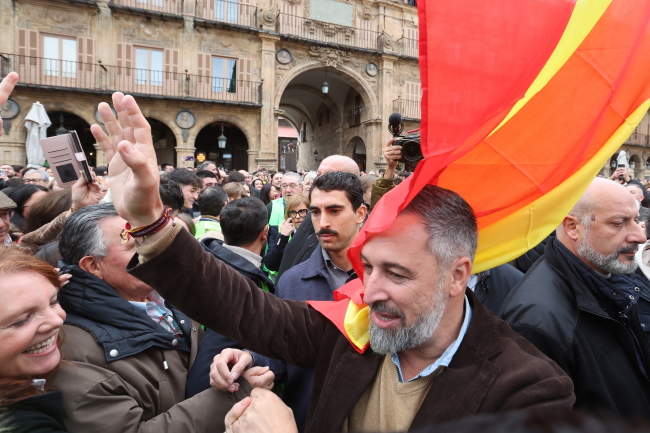
According to polls, the far-right Vox has now become Spain’s third-largest political force and could double its number of seats in Congress, the lower house of parliament. PP leader Alberto Nunez Feijoo has not ruled out a coalition with Vox.
PAP’s interviewee cautioned against comparing Vox, which was founded by disillusioned PP politicians in reaction to separatist movements in Catalonia, with Germany’s AfD. In his view, Vox is closer to Prime Minister Giorgia Meloni’s Brothers of Italy.
“Vox is not the equivalent of the AfD. The AfD wants to destroy the German constitution and German democracy. I don’t think the same can be said of Vox, which would like to change the constitution, but by constitutional means,” Prof. Powell stressed.
He explained that Vox wants, among other things, to limit the powers of the autonomous communities. “That is a legitimate goal, but on the condition that it is pursued through democratic and constitutional procedures,” PAP’s interviewee noted.
In Spain, each of the 17 communities has its own government and parliament, and two autonomous cities also enjoy a high degree of self-rule.
Powell added that Vox already governs with the PP in several communities and “nothing bad has happened.” “Yes, they did things I disagree with, for example so-called culture wars: they did not implement historical memory laws or they withdrew funding for LGBTQ programs, and so on,” he added. In his view, “Vox’s participation in power will moderate them.”
The expert stressed that Spaniards, including most PP supporters, are the greatest enthusiasts for the European Union among residents of the bloc’s member states, and that a new government will continue to cooperate closely with Brussels. He added that the PP will dominate the coalition and set the direction of economic, foreign and defense policy.
Prof. Powell believes that after the election Spain will improve its relations with Trump, although, in his view, in the U.S. administration’s dealings with the Spanish Socialists “there was a lot of turbulence on the surface, but the structural foundations remained very strong.”
Prof. Powell also predicts an improvement in relations with the Israeli government, “especially if at least some Arab-Israeli parties are in it.” Currently, the two countries have no ambassadors in each other’s capitals. “However, Spain will continue to recognize the Palestinian state,” he assured.
One of the main topics of the Spanish election campaign is migration. Powell pointed to what is distinctive about Spain on this issue. “Spaniards do not intuitively see immigration as something bad,” he noted. He explained that people in the country themselves migrated in large numbers to northern Europe and the Americas not long ago, so they realize that the economy needs migrants.
“In 2000, the share of Spain’s residents born abroad was less than 1%. Today it is 17%. That is the largest inflow of migrants into any country in the world. Were there riots? Were there mass demonstrations against it? No. We have no ghettos, there are no no-go zones for the police, and in neighborhoods where many foreigners live, coexistence is peaceful. I know this from my own experience, because that is exactly the kind of neighborhood I live in,” Powell said.
He stressed that the vast majority of migrants arrive in Spain legally and stay on its territory after their visas expire. He also noted that Spain does not struggle, as France or Germany do, with the problems of third- and fourth-generation migrants, but that most newcomers also come from Latin America, with migrants from Central and Eastern Europe only in second place. This kind of background, he argues, helps integration in Spain.
He also pointed out that the campaign by the Socialists to legalize undocumented migrants, for which the government was criticized by most EU countries, was the seventh since the 1980s, and that conservative governments carried them out as well. For that reason, Prof. Powell does not believe a new government would join the initiative of five EU countries that want to deport migrants to a center in Rwanda.
“It is unacceptable to most Spaniards, regardless of their political views. A government formed by the PP would not join something like that,” he said. He admitted, however, that it could be a source of tension between the PP and Vox, because the latter party strongly opposes migration.
One of the latest polls, conducted by the firm 40dB for public radio Cadena SER and the daily El Pais, showed that the currently governing Socialist Party (PSOE), led by Prime Minister Pedro Sanchez, has 30% support. Almost 32% of respondents named the opposition conservative People’s Party (PP), led by Alberto Nunez Feijoo, so the gap between the two main forces narrowed by less than 2 percentage points. The third-largest political force, the right-wing populist Vox led by Santiago Abascal, received 18% of responses in the 40dB survey.
Prof. Powell is a graduate of the University of Oxford who specializes in Spain’s modern history, the history of the monarchy and Spain’s democratic transition after the death of Gen. Francisco Franco. Before becoming director of the Elcano Institute, he headed the Madrid office of the think tank European Council on Foreign Relations (ECFR). He was awarded the Knight’s Cross of the Order of Merit of the Republic of Poland for outstanding contributions to shaping a positive image of Poland in the Kingdom of Spain and to developing bilateral scientific and cultural cooperation.
From Madrid, Justyna Wojteczek (PAP)