An artificial intelligence model has generated a formal proof of the Riemann hypothesis, the holy grail of mathematicians. What now lies ahead is an effort to understand what happened in that proof and whether it contains new mathematics, Dr. Tomasz Miller, a mathematician at Jagiellonian University, told PAP.
On Friday afternoon Polish time (morning U.S. time), Levent Alpöge, an American-Turkish mathematician who works at Anthropic, released a four-page statement in which he wrote: “I believe that, working with (the model) Claude, I have discovered a proof of the Riemann hypothesis.”
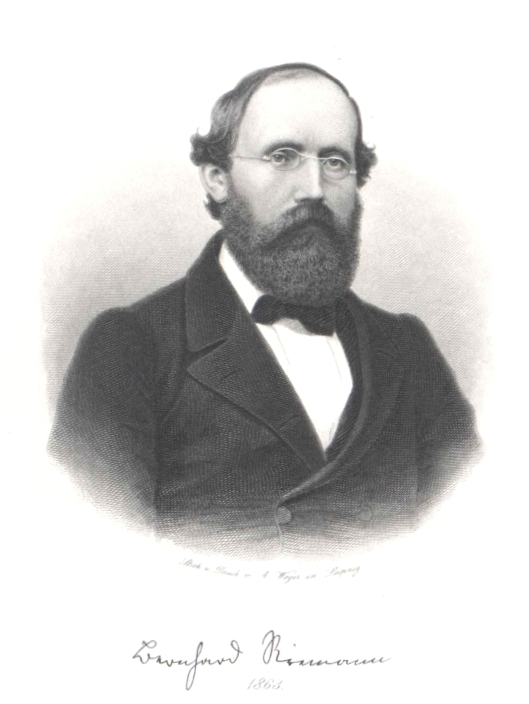
The hypothesis was formulated by the German mathematician Bernhard Riemann in 1859. According to it, the distribution of prime numbers along the number line, which at first glance seems random, is in fact governed by a complex and meaningful order. Over time, the hypothesis became a point of reference for the whole of number theory.
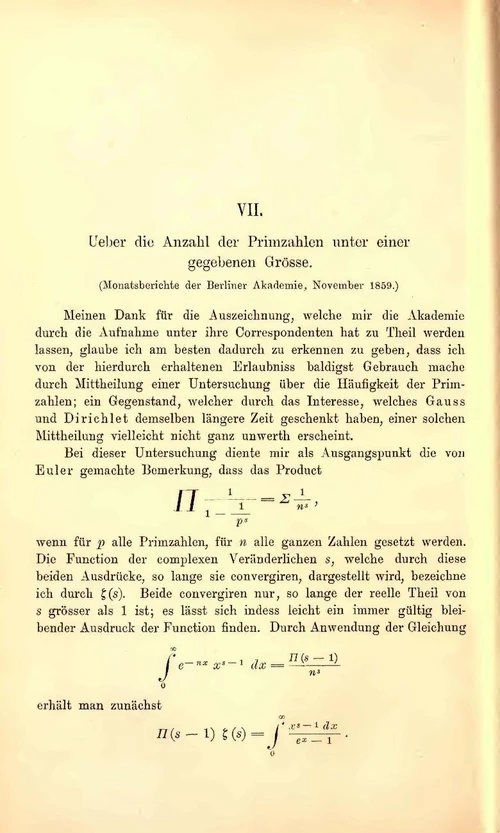
The first page of Riemann’s 1859 paper, in which he formulated the hypothesis
“Levent Alpöge announced that, using Anthropic’s internal, non-public Claude model, he managed to generate a formal proof of the Riemann hypothesis, a kind of holy grail for mathematicians and the most famous open problem, one that has fired scholars’ imaginations for 167 years, since Bernhard Riemann formulated it,” Tomasz Miller told PAP.
He stressed that for now this is what is known as a formal proof.
“This is not a proof written in human language, but in a formal machine language, the Lean programming language, which was created some dozen years ago precisely so that the logical correctness of mathematical proofs written in it could be checked automatically,” he explained.
He clarified that the AI model generated a very long formal proof, whose logical correctness was then confirmed by a compiler. From a logical standpoint, it most likely contains no gaps.
The Riemann hypothesis has excited mathematicians for years. Among those who wrestled with it was Nobel laureate John Nash, whose story is told in the famous film “A Beautiful Mind.”
“It grew out of Riemann’s research on the distribution of prime numbers. They are the foundation of modern cryptography, but they also have many applications in mathematics. If it can be proved that the hypothesis is true, and it seems that this has been done formally, then the truth of hundreds or even thousands of further theorems in number theory and other branches of mathematics follows automatically. It even has implications for theoretical physics,” Dr. Miller said.
He pointed out that mathematicians value the Riemann hypothesis and other great conjectures not only for their own sake, but because studying them allows science to advance.
“In the history of mathematics, it often happens that when you try to prove a hypothesis that holds out for so long, new ideas and new tools emerge along the way, and these later find use in many other places,” he said. The very attempt to prove the greatest conjectures can open new horizons.
That is why the Riemann hypothesis was included on David Hilbert’s list of 23 mathematical problems in 1900, and 100 years later, in 2000, it was among the seven Millennium Prize Problems announced by the Clay Mathematics Institute (U.S.).
As Dr. Miller said, such a rapid growth in the capabilities of artificial intelligence in mathematics means that “human mathematics must, in a sense, reinvent itself a little.”
“It turns out, and Levent Alpöge also wrote this in his statement, that at first he was able to steer this internal model, suggesting ideas about what was worth investigating and which path to pursue. But from a certain point, the AI got away from him, doing things he had not asked for, and it was the one leading him through the proof. And at present nobody understands this proof, starting with Alpöge himself,” the Jagiellonian University mathematician said.
He noted that mathematicians now face a long process of trying to understand what happened in the proof: “whether there are any radically new ideas in it, some new mathematics, or whether it is merely, and entirely, an ingenious use of the mathematics that was already known.”
“We now have a tool that lets us do mathematics in a completely different way, better in some respects but worse in others. Because what matters most to us in mathematics is still understanding what is going on,” he said.
“We don’t want to end up in a situation where a machine proves theorems and we just receive isolated bits of information that this theorem is true and that one is false. That is not all that mathematics is about. It is about understanding the relationships between structures,” he said.
He said some mathematicians fear that these new results will not be accompanied by insight: that we will gain new information, but our knowledge will not deepen.
“Mathematicians and other scientists are driven by a deep need to understand. Artificial intelligence is radically changing the way mathematics is done, but it does not invalidate that need. Fortunately, we still have a lot of work ahead of us,” he concluded.
Tomasz Miller won the 2024 Science Popularizer award in the Scientist category. His 1.5-hour YouTube lecture on the Riemann hypothesis has gained 1.3 million views. (PAP)