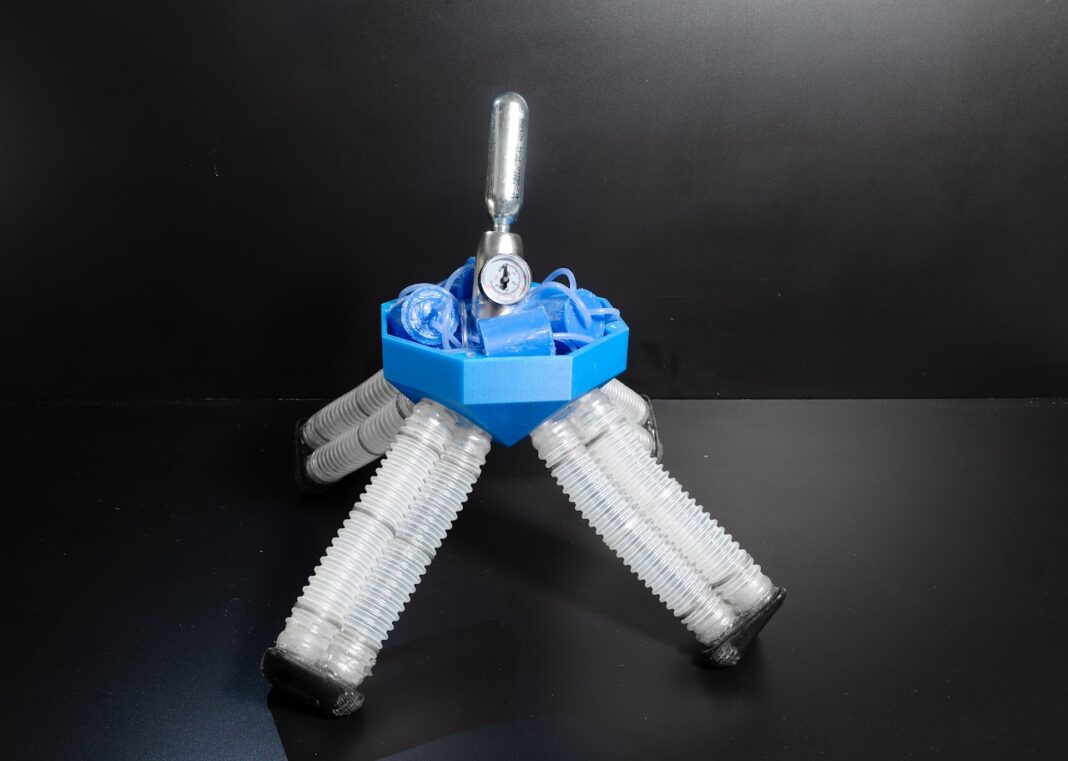
U.S. scientists have developed an air-powered robot that runs at nearly five meters per second. Such machines could operate in areas with high levels of radiation or in strong magnetic fields, during disaster rescue operations or in space.
A team at the University of California, San Diego has developed an unusual robot. The soft machine was 3D-printed from a single material. It is less than 24 cm (about 9.4 inches) long, has six legs and is powered by compressed air.
The researchers say it is the fastest soft robot ever built, capable of moving at 4.7 m/s.
To create it, the scientists drew on experience gained while working on their first soft robot, also 3D-printed and powered by compressed air, which they developed in 2022.
That robot moved at just 4 cm per second. The limit was the air pressure and flow its pneumatic system could withstand.
Inside the device is a system of interconnected chambers, valves and tubes that set its legs in motion when air is delivered under pressure.
By enlarging and reinforcing the robot and its internal structures, the scientists were able to increase the air pressure significantly. At higher pressure, however, the robot can move so fast that its energy efficiency drops sharply, because the device releases high-pressure air that still contains a large amount of energy.
The team turned to a solution used in multistage steam engines, in which steam expands in several chambers in succession. Following that concept, the scientists built a system of chambers and valves inside the robot that lets the compressed air expand twice: first in smaller high-pressure chambers, where it drives the valves, and then in larger low-pressure chambers, where it moves the robot’s legs.
As a result, the robot can move more than 100 times faster than the earlier version while also saving energy.
“Our first walking robot showed what could be achieved, but it was too slow. We hoped to overcome that limitation, and fortunately we found a solution that makes the new robot 100 times faster,” says Dr. Yichen Zhai of the University of California, San Diego, one of the authors of the study published in the journal Science Robotics.
The scientists successfully tested the robot on a range of surfaces, including concrete, gravel, lawn, garden mulch and sand. The robot can also run down stairs, swim and move underwater.
“The biggest challenge was taking a proven solution, the multistage steam engine, and using it in a soft, running robot that can be printed as a single piece from a single material. We see this as a step toward creating complex and efficient robots that can be printed on desktop 3D printers from inexpensive materials,” Dr. Zhai stresses.
For now, the robot works only when connected to a source of compressed air, such as a conventional compressor. The scientists, however, want to develop designs that use less compressed air, so the machine could move using, for example, a compressed-air cartridge.
They also plan to create robots capable of more complex movements, allowing them to change direction and manipulate various objects.
According to the inventors, similar robots could one day be used in places where electronic devices cannot function. Examples include reconnaissance in areas with high levels of radiation or strong magnetic fields, rescue operations after disasters and space.
Marek Matacz (PAP)