
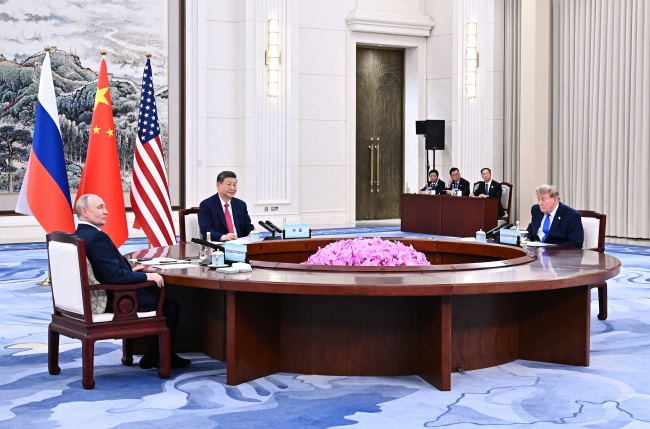


Vladimir Putin has clearly expressed a desire to end the war between Russia and Ukraine through diplomatic means, U.S. President Donald Trump said on Friday. He confirmed that he considers Putin a friend and revealed that the Russian leader told him he would not have invaded Ukraine if Trump had been president at the time.
Trump largely repeated claims he has made many times before during a news conference of about 1.5 hours on his trip to the Philippines and China, which ended Thursday.
Describing his meeting with Putin, Trump said the Russian leader “clearly expressed a desire to end the war between Russia and Ukraine.”
He said the problem is the hatred between Ukrainian President Volodymyr Zelensky and Putin. Even so, he said there is a good chance of reaching an agreement.
According to Trump’s account, Putin told him he would never have invaded Ukraine if Trump had been president at the time.
“I asked him about it. I said: ‘Would you have gone in there (to Ukraine) if I had been president?’ He answered: ‘No, that would never have happened.’ Our country played it so badly. It played it very badly,” he lamented.
Asked whether he considers Putin a friend of America, Trump said he would not rule on whether Putin is a friend of America, but stressed that the two have a “fantastic” personal relationship. He said he has dealt with Putin for a long time and that Putin was “very nice” during the scandal over alleged ties between his circle and Russia.
“I see him as someone with whom I have a very good relationship, and a really very good one. He has a lot of nuclear weapons. He is second only to us in nuclear arsenal,” he said. “He is going through a difficult period now, because he is fighting a war that should have lasted one day, and it has now lasted five years and many people are dying,” he added. He also criticized “stupid people” who criticize his good relationship with the Russian leader.
Confronted with the fact that Russia launched another massive attack on Ukraine right after their meeting, Trump said Putin would very much like to end the war, but that it is difficult, above all because of the hatred between him and the Ukrainian president.
He did not address the incursion of Russian drones and missiles into Polish territory. But once again, in answer to a question unrelated to Poland, he recalled that he had endorsed Poland’s President Karol Nawrocki in the election. He said Nawrocki’s victory was a surprise because, as Trump claimed contrary to the facts, Nawrocki was polling in 11th place when Trump endorsed him.
Trump also brushed aside Russia’s position on Friday. Russia denied that it was open, as Trump’s envoys had claimed, to the U.S. giving Ukraine security guarantees modeled on those of NATO. Trump said such statements from Russia could only be a negotiating tactic.
He stressed, however, that he does not want to talk about guarantees for Ukraine because “first you have to make a deal.” That position contradicts the approach of his negotiators Steve Witkoff and Jared Kushner, who want those guarantees and a broader security arrangement to be part of a peace agreement.
The U.S. president acknowledged that the war in Ukraine was given considerable time during the three-way meeting with Putin and Chinese leader Xi Jinping. He described the meeting as “one of the most momentous international summits in many years.”
“On the way there, I wasn’t thinking about Yalta, about Winston Churchill, Stalin and FDR (Franklin Delano Roosevelt – PAP), although that was a great event. I went with the thought that I get along great with those two men and that we would sort out our differences,” he said.
Trump said that in his meeting with Xi he agreed on “certain shared security mechanisms” for the development of artificial intelligence (AI), though he did not elaborate.
Trump also announced – though he admitted he had not yet discussed it with his advisers – that he would ban American companies from building data centers outside the United States.
He suggested that exports of advanced chips had been “destructive” for the country and had allowed other countries to catch up with America in AI. At the same time, Trump defended Nvidia’s former chief Jensen Huang – who advocated loosening restrictions on AI chip exports – and called for his return to the company after a prior “big apology.”
Asked about chip export controls, the president suggested that they are part of a comprehensive deal being negotiated with China. He opposed, however, exporting the most advanced chips.
He also mentioned that at the meeting with the leaders of the Quad (China’s rivals Japan, Australia and India), a “new Quad superintelligence accelerator” was launched, but added that this cooperation will be limited.
“I’ll tell you, we will do it on a limited basis. We have a big advantage and we want to keep it (the AI industry) in this country,” he stressed.
From Washington, Oskar Górzyński (PAP)
