
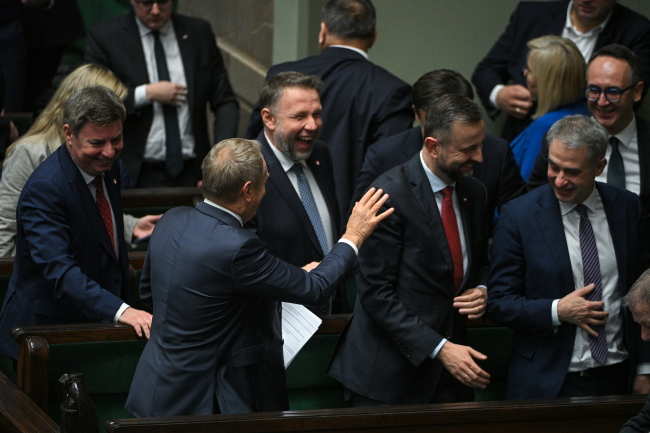


The Sejm, the lower house of Poland’s parliament, on Tuesday rejected a motion by the Rozwój Plus caucus for a constructive vote of no confidence in the government and the election of Marek Jurek as prime minister. According to Mateusz Morawiecki, the government broke “all rules of the rule of law” in the conflict over the Constitutional Tribunal (TK). “A rather pathetic farce,” Prime Minister Donald Tusk said of the motion.
A total of 442 lawmakers took part in the vote. In favor of the no-confidence motion were 200 lawmakers, including all those present from the PiS, Rozwój Plus and Konfederacja caucuses and the Direct Democracy and Confederation of the Polish Crown groups. Against the motion were 242 lawmakers: all those present from the governing coalition, as well as from the Razem group. No one abstained.
Passing a no-confidence motion requires an absolute majority of the statutory number of deputies (at least 231 votes).
Rozwój Plus caucus leader Mateusz Morawiecki, presenting the motion of no confidence in Donald Tusk’s government, stressed that it was filed to prevent “the threats posed by the current government” in connection with the situation at the Constitutional Tribunal.
In his assessment, the government broke “all rules of the rule of law” in the conflict over the Tribunal. Among the “threats from the government,” Morawiecki listed “announcements of attacks on the independent central bank” and “attacks on the president’s institutions.”
“What happened at the Tribunal, that coup d’état, is something that will lead to a spiral of conflict. A spiral that, if we do not stop it, may result in very troubling things for our homeland,” the former prime minister said.
Morawiecki said that to repair the situation surrounding the Tribunal, there must be a “reset of the government,” followed by the creation of a Sejm investigative committee on the “coup against the TK,” and ultimately a so-called constitutional reset.
According to the former prime minister, the dispute over the Tribunal is meant to “cover up gigantic economic and social problems.” Among them he listed “unemployment raging in Poland,” the high budget deficit and energy prices.
Morawiecki appealed for votes in favor of the motion especially to lawmakers from PSL (the Polish People’s Party) and Polska 2050 (Poland 2050). He called both groupings a “coalition being devoured by Tusk.” “Enough of this duopoly we are dealing with, because Poland is not the property of any political party. Poles are not waiting to see whether in the next round of the fight PiS will beat Civic Platform or Civic Platform will beat PiS. Poles expect concrete solutions,” he stressed.
He added that Marek Jurek, the candidate for the new prime minister, is “a man of compromise who can calm the situation in Poland.”
Prime Minister Donald Tusk, who spoke at the close of the debate, stressed that the motion’s initiator, Mateusz Morawiecki, had “outdone himself” by presenting theses on inflation, the rule of law and honesty in politics. He added that he could comment on Morawiecki’s speech with words he once used about him: “Mateusz, what a little Bambi you are.”
He also asked “what stage name the former head of government has earned for himself over the years,” to which a reply could be heard from the Sejm chamber: “Pinocchio.”
“You said that besides the Constitutional Tribunal there is also a ‘tribunal of history.’ But besides tribunals there are also the prosecutor’s office and the court. I know very well why there is such nervousness on the benches of the right, of the opposition. (…) There is hardly a day when Poland does not learn why you are so desperate to return to power,” Tusk said.
He also recalled controversial statements by prime ministerial candidate Marek Jurek on homosexuals and in vitro fertilization.
“Mr. Marek Jurek became the candidate for prime minister not only because probably no one else wanted to. Also because Marek Jurek’s views are, to a greater or lesser extent, acceptable to everyone who will vote for his potential premiership,” Tusk said.
He cited quotes from Marek Jurek, including on violence against children. “Children who don’t get a hiding are less compassionate and more hysterical,” Tusk quoted. “When we were discussing how to prevent domestic violence and the beating of women, Marek Jurek firmly stated that the Istanbul Convention, which was meant to protect women from violence, is a convention that threatens the sovereignty of the Republic,” the prime minister noted.
He also quoted Jurek’s statements that “homosexuality as an inclination is a disease” and that “persecution of homosexuals is a healthy reflex of self-defense by society.” “Today another statistic of the happiness of Polish families was presented: more than 18,000 children have been born in Poland thanks to in vitro. Mr. Marek Jurek said of in vitro that it was a ‘law on the selection of children to be born,'” Tusk quoted.
He also called on the motion’s sponsors to say whether they share Jurek’s views. “This is something that unites both Konfederacjas, PiS and Mr. Mateusz Morawiecki,” the head of government said.
“There is nothing to laugh about in what threatens Poland if this united right wing, gathered around such ideas, comes to power. You will lose this vote today and, I am deeply convinced, you will lose the election in a year. Do you know why? Because in Poland no one will allow the hell you created for Polish women and children, the defenseless and the weaker, to return. That hell will not return,” Tusk declared, addressing right-wing politicians.
He also referred to comparisons involving the date of December 13, associated with the introduction of martial law in 1981 and the swearing-in of Tusk’s government in 2026, which had been made by, among others, PiS caucus leader Mariusz Błaszczak. Tusk recalled that on that day in 1981 he was at the Gdańsk Shipyard, where he “did not see exactly anyone from among those who sit on this side (occupied in the Sejm by the opposition – PAP).”
During the debate, KO (Civic Coalition) caucus leader Zbigniew Konwiński cited a leaked email from the PiS years, written by then-head of the Chancellery of the Prime Minister Michał Dworczyk to Prime Minister Morawiecki, about a meeting with then-TK president Julia Przyłębska and arrangements concerning how cases at the Tribunal would be decided.
According to Konwiński, this correspondence is the quintessence of Morawiecki’s attitude toward the TK. “You are the last person who can talk about the politicization of the Constitutional Tribunal,” the KO lawmaker declared.
He said that the no-confidence motion was signed “in large part by those who either have problems with the justice system, or are the subject of the justice system’s interest, or are being checked by various services.” He cited the so-called envelope elections case and abuses at the Government Strategic Reserves Agency.
“This is not a motion to dismiss Prime Minister Tusk. This is a motion for amnesty. And there will be no amnesty,” Konwiński declared.
PSL caucus leader Krzysztof Paszyk said that Morawiecki’s motion was “pure commentary.” He added that the motion “does not fit the trend” of constructive actions aimed at solving concrete problems.
Paszyk pointed to the government’s successes, above all those of the ministries led by PSL politicians: record defense spending, the building of drone forces, lower fuel and energy prices, as well as infrastructure investments in roads, railways and ports.
Tomasz Trela (Lewica, the Left) said that Morawiecki, as a former prime minister under PiS rule, “will convince no one.” In his view, the motion and the debate on the no-confidence vote show the cooperation of all right-wing groupings, from Rozwój Plus to Grzegorz Braun’s Confederation of the Polish Crown.
Trela described Marek Jurek himself as a “rather frail and poor” candidate. He pointed to Jurek’s controversial statements on homosexuality and on the European Union.
Centrum caucus leader Mirosław Suchoń said that voting for the motion by what he called a hysterical opposition would also mean handing power to “lobbyists linked to Konfederacja.” “And also into the hands of Braun’s people, who get their instructions from civilians in Cyrillic, and into the hands of Jarosław Kaczyński, who destroyed the institution of a democratic state under the rule of law,” he stressed.
Polska 2050 deputy caucus leader Paweł Śliz said the motion of no confidence in the government “is a mockery.”
Adrian Zandberg (Razem) admitted that Tusk’s government is “poor” and that it “has failed people,” but called the motion unserious. The lawmaker described Marek Jurek as a candidate “who didn’t fit in PiS because he was too far right.”
Other opposition groupings defended the motion. Łukasz Schreiber (Rozwój Plus) said the prime minister “decided to remove all the safeguards” and concluded that since he has a majority in the Sejm, he “can do anything.”
He accused Tusk of having a chance to go down in history as a person “who limited democracy to the act of voting alone.” As he stressed, prime ministerial candidate Marek Jurek “is the antidote to the total war that Donald Tusk has declared on Poles.”
PiS caucus leader Mariusz Błaszczak said the Council of Ministers had lost the “moral right to govern.” Referring to the situation surrounding the TK, he said that “the dispute is about whether the Polish Constitution will stand above EU law, or the other way around.”
Konfederacja lawmaker Witold Tumanowicz spoke in favor of the motion. In his view, the government’s biggest problem is “the gulf between what the prime minister says and what he does.” He said the government had subordinated the TK “as if it were a political spoil.” At the same time, he warned against “the return of the harmful rule of PiS and Mateusz Morawiecki.”
Włodzimierz Skalik of the Confederation of the Polish Crown group said the government “is carrying out an anti-Polish agenda under the Euro-Soviet dictate of Brussels” and should be removed “as soon as possible.” He did, however, voice reservations about Marek Jurek’s candidacy and appealed: “Let’s look for a better candidate for prime minister.”
Jarosław Sachajko (Direct Democracy) said Tusk’s rule is a repeat of 2007–2015 and “typical recidivism, only on steroids.”
After the vote in which the Sejm rejected the no-confidence motion, the prime minister told reporters that “everyone knew it was a farce, that it is rather pathetic.”
“For the first time in Polish history I saw a former prime minister speaking, submitting a no-confidence motion, justifying it, and the chamber completely empty, including on the opposition benches. That is very strange. In his place I would be very sad today,” Tusk said.
The prime minister said that Rozwój Plus politicians are “flailing about.” “Mateusz Morawiecki would very much like to break out on his own, but that is probably still out of his league, it seems to me,” the head of government added.
The motion to dismiss the government was signed, besides Rozwój Plus lawmakers, by members of the Konfederacja caucus, Direct Democracy group lawmaker Paweł Kukiz and independent lawmaker Paulina Matysiak.
The motion gave a negative assessment of the work of the Council of Ministers led by Donald Tusk. Its authors deemed it necessary to appoint a new government. As the main reason they cited “the coup against a constitutional organ of the state and the government’s political responsibility for the events at the Constitutional Tribunal.”
The motion to dismiss the government also cited other arguments: a sharp rise in state debt, a crisis in health care, the “failure of migration policy and ineffectiveness regarding the migration pact,” as well as keeping public media in a state of liquidation. (PAP)
