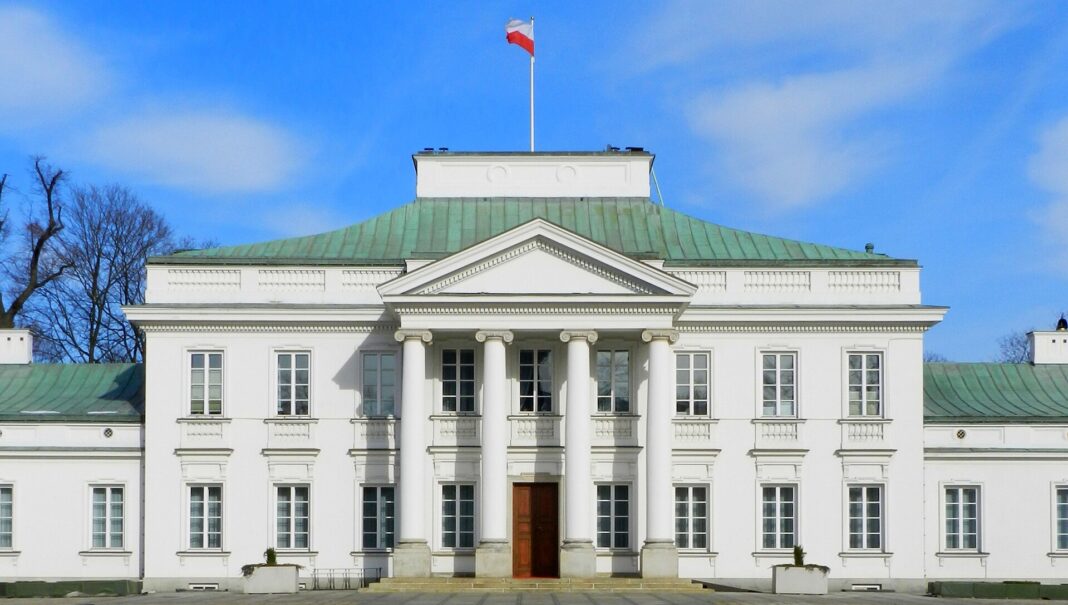
Kosiniak-Kamysz: KO and Left Skipping Belweder Meeting on Constitutional Tribunal Is a Mistake
The failure of representatives of KO (the Civic Coalition) and the Left to take part in a meeting with political groups on the situation at the Constitutional Tribunal is a mistake on their part, Deputy Prime Minister, Defense Minister and Polish People’s Party (PSL) leader Władysław Kosiniak-Kamysz said. PSL will press for a “constitutional reset,” because it is the only chance to fix the situation, he added.
The meeting between Zbigniew Bogucki, head of the Chancellery of the President (KPRP), and representatives of political groups on repairing the situation at the Constitutional Tribunal is scheduled for 2 p.m. Monday at the Belweder Palace in Warsaw.
At a Monday briefing in Kraków, Kosiniak-Kamysz said PSL would be represented at the meeting by caucus chair Krzysztof Paszyk and deputy chair Magdalena Sroka.
“We always respond positively, just as with the meeting two weeks ago at the president’s,” the leader of the PSL said.
He recalled that PSL had put forward the idea of a constitutional reset. “In our view, it is the only chance to fix the situation, and not only in our view, because current polls indicate that for the majority of the public it is the only chance to fix this situation,” Kosiniak-Kamysz said.
Asked about the declarations by KO and Left politicians that they would not attend Monday’s meeting, he replied: “I consider the absence of the Civic Coalition and the Left a mistake on their part. In their place, I would take part, but everyone is the architect of his own fate, everyone decides for his own party,” the deputy prime minister added.
He stressed that PSL will “strive for a constitutional reset” because it considers it “the only chance to fix the situation.” Moreover, he noted, today’s decisions by the National Bank of Poland (NBP) “probably show that best of all.”
On Monday, the NBP announced that it had halted all payment orders involving funds held in the Constitutional Tribunal’s accounts. A spokesman for the central bank told PAP that this means payment orders are not being carried out regardless of who issues them. The central bank cited “doubts as to the proper representation of the Constitutional Tribunal in its dealings with the NBP.”
The PSL leader was also asked about talks with coalition partners on their participation in a parliamentary working group on the “constitutional reset” of the Tribunal, a plan drawn up by his party.
“I have informed our coalition partners. Either the principle we are proposing is adopted, or there will be no lasting solution. Soon there will be another change after one election, then another, then a third. And what, will we reverse things again, and every time the situation will be reversed and nothing will be lasting?” Kosiniak-Kamysz asked.
In his view, “the constitutional system must be lasting, so the safeguards in the constitution must be lasting.” “I believe this is possible. I believe such a role in politics makes sense,” he stressed.
As announced, Monday’s meeting at the Belweder is to be an opportunity to talk about “what is happening around and within the Constitutional Tribunal itself.” The presidential side said it would not “put forward its own proposal” on the Tribunal.
PAP has learned that KO and Left politicians do not intend to attend Monday’s meeting on the Tribunal. Politicians from PSL, Polska 2050, Razem, Konfederacja (Confederation), Konfederacja Korony Polskiej (Confederation of the Polish Crown), Law and Justice (PiS), Rozwój Plus and the Senate caucus Nowa Polska-Centrum are expected to attend.
On Oct. 30, representatives of the group of judges elected to the Tribunal by the current term of the Sejm, the lower house of parliament, announced that Anna Korwin-Piotrowska, as the longest-serving judge, had become the head of the Constitutional Tribunal and had issued an order for a break in the official duties of Tribunal President Bogdan Święczkowski and Vice President Bartłomiej Sochański.
Święczkowski called this a usurpation. President Nawrocki also stated at the time, among other things, that “the constitutional order of the Republic of Poland had been violated and a constitutional organ of the state had been taken over by force.”
Prime Minister Donald Tusk, in turn, declared, among other things, that the current Sejm had elected new Tribunal judges, but the president had not taken the oath from some of them, President Święczkowski had prevented them from starting work, and when after many weeks of waiting they decided to take up their duties, “they were attacked.”
On Thursday, the prime minister stressed that “the matter is settled as far as the Tribunal is concerned.” “It is settled in the sense that we have a Tribunal, it will issue rulings, I hope so. Very many citizens are waiting for rulings and interpretations from the Tribunal,” he noted.
The constitutional amendment proposed by PSL would end the terms of the current Tribunal judges. A motion with candidates for judges would be submitted with the president’s consent, and a new 15-member Tribunal would then be chosen in a single round by the National Assembly by a 3/5 majority, with five judges elected for terms of 3, 6 and 9 years. Submitting a bill to amend the constitution requires the signatures of at least 92 lawmakers.
PSL proposes adding to the constitution a provision under which the National Assembly (the Sejm and Senate sitting jointly, 560 parliamentarians in all) “may, on a reasoned motion of the National Council of the Judiciary, find a permanent inability of the Constitutional Tribunal to perform its tasks.”
This would require a resolution of the National Assembly adopted by a majority of at least 3/5 of its statutory number of members, that is, the votes of at least 336 parliamentarians. Under the PSL proposal, after such a resolution is adopted, the National Assembly would elect 15 Tribunal judges in a single vote, by the same majority, five each for terms of 3, 6 and 9 years.
The motion containing candidates for Tribunal judges, chosen from among people “distinguished by legal knowledge,” would be submitted by the Sejm speaker after consulting, among others, the first presidents of the Supreme Court and the Supreme Administrative Court, and after obtaining the prior consent of the president of Poland.
Amending the constitution is difficult, because it requires a majority of at least 2/3 of votes in the Sejm and an absolute majority in the Senate. The president, the Senate or at least 1/5 of the statutory number of deputies may initiate an amendment to the constitution. The Senate has 60 days to consider an amendment passed by the Sejm and cannot make changes to it. (PAP)