Poland’s Central Bank Halts Constitutional Tribunal Payments; Justice Minister Żurek Decries ‘Anarchization’
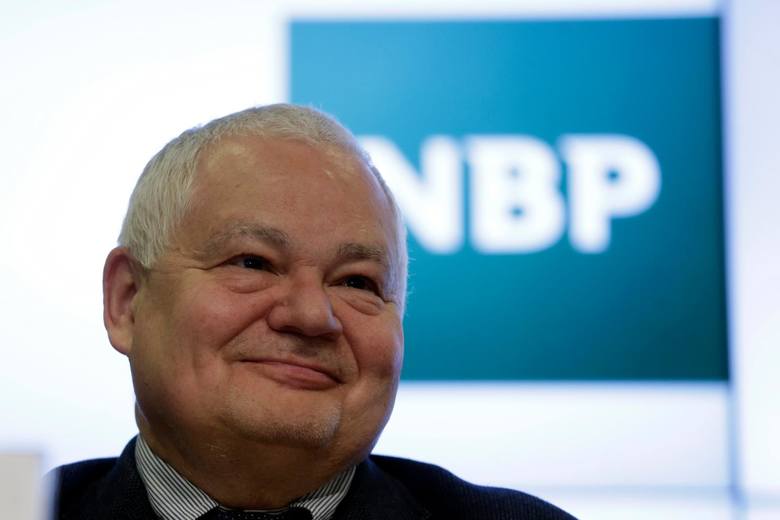
The National Bank of Poland (NBP) has decided to halt all payment orders involving funds held in the accounts of the Constitutional Tribunal, the central bank’s spokesman, Maciej Antes, told PAP.
“This means that payment orders are not being carried out, regardless of who places them,” the NBP spokesman said. “Once again, it must be stressed that the NBP is not competent to resolve the dispute over the leadership of the Constitutional Tribunal,” Maciej Antes added.
PAP has obtained a letter that the NBP sent to Constitutional Tribunal (TK) President Bogdan Święczkowski. In it, the NBP says that the “suspension of the ability to carry out payment orders” involving TK funds “followed an analysis of the situation of the National Bank of Poland as the bank holding the Tribunal’s accounts, in the context of the current situation surrounding the functioning of the Constitutional Tribunal.”
“In the situation that has arisen, the analysis of the National Bank of Poland’s position took as its starting point the provisions of the Rules for Maintaining Bank Accounts at the National Bank of Poland (…), as well as the bank account agreement concluded with the Tribunal. The authority of persons entitled to issue instructions on behalf of the Constitutional Tribunal (…) should derive from documents identifying the person or persons authorized to make declarations of intent on behalf of the account holder concerning property rights and obligations, and authorized to grant further powers of attorney. (…) Changes to the specimen signature card that enable the disposal of funds in the account holder’s account require a declaration by the account holder signed by (…) authorized persons,” the NBP letter to the TK president says.
In its analysis, the central bank concluded that “in light of the provisions of the cited Rules, doubts about the proper representation of the Constitutional Tribunal in its dealings with the NBP were deemed justified.” The NBP cited provisions of the Payment Services Act, which says that “a payment transaction is considered authorized if the payer has consented to its execution in the manner provided for in the agreement between the payer and its provider.”
“In the situation at hand, there is no doubt that the NBP has no authority to determine whether consent to carry out payment transactions on behalf of the Constitutional Tribunal will be given by the authorized person or persons,” the NBP letter says. “There is therefore a need to apply Article 50, Paragraph 1 of the Payment Services Act, which allows for the possibility of refusing to execute an unauthorized payment order,” it also says.
The central bank also referred to provisions of the “Rules for Maintaining Bank Accounts at the National Bank of Poland.”
“(…) under which the NBP reserves the right to suspend or refuse to execute a payment order, or to block funds in an account, on the basis of generally applicable law and restrictions arising from sanctions lists. In view of these circumstances, from the perspective of the National Bank of Poland, suspending the ability to carry out payment orders involving funds held in the Constitutional Tribunal’s bank accounts is fully justified,” the NBP letter states.
On Oct. 30, representatives of the group of judges elected to the TK by the current term of the Sejm, Poland’s lower house of parliament, announced that Anna Korwin-Piotrowska, as the longest-serving judge, had become the acting head of the Constitutional Tribunal and had issued an order for a break in the duties of TK President Bogdan Święczkowski and Vice President Bartłomiej Sochański.
Święczkowski called this a usurpation. President Nawrocki also stated at the time, among other things, that “the constitutional order of the Republic of Poland was violated and a constitutional organ of the state was seized by force.”
Prime Minister Donald Tusk, for his part, stated, among other things, that the Sejm of the current term had elected new TK judges, but the president did not administer the oath of office to some of them, President Święczkowski prevented them from starting work, and when after many weeks of waiting they decided to take up their duties, they “were attacked.”
On Nov. 10, the Supreme Court overturned the order for an immediate break in the duties of Bogdan Święczkowski and Bartłomiej Sochański. Judge Anna Korwin-Piotrowska then stated that Supreme Court rulings have no bearing on the suspensions, which are reviewed “only by the TK disciplinary court.” (PAP)
Żurek: We Will Consider How to Counter the ‘Anarchization’ of the Constitutional Tribunal Through the NBP
Justice Minister and Prosecutor General Waldemar Żurek described the actions of the National Bank of Poland as the “anarchization of the Constitutional Tribunal.” “We will be considering how to counter a kind of anarchization of the Tribunal’s operations through the NBP,” Żurek said.
On Monday, the NBP announced that it had halted all payment orders involving funds held in the Constitutional Tribunal’s accounts. As the central bank’s spokesman, Maciej Antes, told PAP, this means that payment orders are not being carried out regardless of who places them, the NBP spokesman said. As its reason, the central bank cited “doubts about the proper representation of the Constitutional Tribunal in its dealings with the NBP.”
In an interview with Polsat News, Żurek noted that in its Monday statement on the Tribunal, the NBP mentions a Supreme Court decision of Nov. 10 that Święczkowski had attached. In that decision, the Supreme Court overturned the orders issued by Anna Korwin-Piotrowska for a break in the duties of TK President Bogdan Święczkowski and Vice President Bartłomiej Sochański.
According to the justice minister, the Supreme Court decision changed form, from a resolution to an order and back to a resolution. “The question of which version is genuine is the first question,” Żurek said.
Żurek also said that Maria Szczepaniec and Marek Dobrowolski, named in last week’s Supreme Court ruling, “are so-called neo-judges on the Supreme Court.” Both judges sit in the Supreme Court’s Chamber of Extraordinary Control and Public Affairs.
In this context, Żurek referred to a 2020 resolution of three combined chambers of the Supreme Court, which held that a court is “improperly constituted” if its panel includes a person selected as a judge by the so-called “neo-KRS” (the National Council of the Judiciary as reconstituted in 2018).
He also pointed to a resolution of the Supreme Court’s Labor Chamber issued last year, under which a ruling of the Chamber of Extraordinary Control and Public Affairs with judges appointed since 2018 is deemed “non-existent.”
In Żurek’s view, from the prosecutor general’s standpoint, this means a “non-existent ruling” is at issue, regardless of whether a resolution or an order was issued on Nov. 10.
He added that the NBP in its statement “refers directly to this supposed ruling” of the Supreme Court, which, in his view, “is not a ruling in light of Polish law, legitimate judges and European courts.” “We will not respect it,” he said.
“We will be considering how to counter a kind of anarchization of the Tribunal’s operations through the National Bank of Poland,” Żurek announced. “We have to find an answer on how to respond, whether prosecutors should open proceedings over unlawful conduct, over relying on such ‘supposed rulings,’ and whether these people are in fact breaking the law by refusing to give the Tribunal funds,” he added.
On Oct. 30, representatives of the group of judges elected to the TK by the current term of the Sejm announced that Anna Korwin-Piotrowska, as the longest-serving judge, had become the acting head of the Constitutional Tribunal and had issued an order for a break in the duties of TK President Bogdan Święczkowski and Vice President Bartłomiej Sochański.
Święczkowski called this a usurpation. President Nawrocki also stated at the time, among other things, that “the constitutional order of the Republic of Poland was violated and a constitutional organ of the state was seized by force.”
Prime Minister Donald Tusk, for his part, stated, among other things, that the Sejm of the current term had elected new TK judges, but the president did not administer the oath of office to some of them, President Święczkowski prevented them from starting work, and when after many weeks of waiting they decided to take up their duties, they “were attacked.”
Święczkowski and Sochański appealed the orders to the Supreme Court. Initially, the Supreme Court deemed itself not competent to hear the petitions and referred the matter to the Tribunal “as a separate organ of the judiciary.” Judge Zbigniew Korzeniowski issued the order in the case on Nov. 6. Both TK judges appealed that decision.
On Nov. 10, the Supreme Court announced that the Nov. 6 order had been overturned and that the Supreme Court had “decided to overturn both orders” issued by Korwin-Piotrowska regarding the ordered break.
In response, Korwin-Piotrowska stressed that Supreme Court rulings have no bearing on the suspensions, which are reviewed “only by the TK disciplinary court.”
Monday’s NBP decision drew numerous reactions from politicians of the ruling coalition.
In an interview with TVN24, Finance and Economy Minister Andrzej Domański said the government “will take action so that the TK can perform its functions.” (PAP)
nl/ mro/