
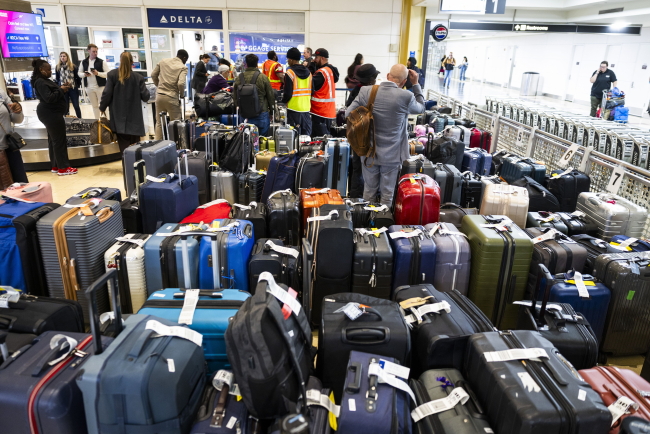


More than 15,000 flights were canceled or delayed in the U.S. on Friday, and another 3,000 could be affected Saturday, even though the nationwide ban on takeoffs has been lifted, according to FlightAware data cited by CNN. The shutdown caused chaos at U.S. airports and also affected Europe to a limited extent.
Air traffic to and from the U.S. is gradually returning to normal in Europe after operational problems, the EU agency Eurocontrol said Saturday in response to a question from PAP, the Polish Press Agency.
At London’s Heathrow, the largest airport in the United Kingdom, some flights to the U.S. were canceled or delayed, the BBC reported. They include flights operated by British Airways, American Airlines and United Airlines.
Three PLL LOT flights from the U.S. to Warsaw also departed late, LOT spokesman Krzysztof Moczulski told PAP on Saturday. He added that the delays range from a few minutes to more than four hours. He warned that they could also affect flights from Warsaw to Los Angeles (LO65) and from Warsaw to Bangkok (LO23).
The effects of the disruption to U.S. air traffic were relatively minor for passengers at many airports in Europe, including in Germany, the dpa news agency reported.
At Germany’s largest airport, in Frankfurt am Main, four flights to the U.S. scheduled for Saturday were canceled because the aircraft that were supposed to operate them could not leave the U.S. on Friday, an airport spokeswoman said. Three planes that had already taken off from Frankfurt were turned back to Germany. By Saturday morning, only isolated delays were being reported. At Munich airport, four of the 20 flights to the U.S. scheduled for Saturday were canceled.
In Spain, the disruption to U.S. air traffic led to the cancellation of four flights, including an Iberia flight from Madrid to Chicago and a Delta flight from Madrid to Atlanta, the daily El País reported. In addition, a United Airlines plane from Chicago did not reach Barcelona; after a two-hour layover, it was supposed to fly back to the U.S. Delays were also recorded on flights between major airports in the two countries.
The Spanish airport operator, quoted by the newspaper, said that flights to the U.S. were gradually returning to their normal schedule on Saturday before noon, although some delays persisted.
At Rome’s Fiumicino airport, a small number of flights were delayed on Saturday before noon, the Ansa news agency reported. Flights to Chicago were delayed by more than two hours, to Atlanta by an hour and a half, and to Detroit by 30 minutes. Delays of three to four hours are expected for flights to Los Angeles, Houston and Atlanta scheduled for Saturday afternoon.
The air traffic chaos followed a move by the U.S. Federal Aviation Administration (FAA) on Friday to impose a so-called ground stop, a complete ban on takeoffs for all aircraft in the U.S.
According to CNN, 3,500 planes were in the air when the decision was announced on Friday afternoon local time. The restrictions were lifted after 4.5 hours, at 2:16 a.m. Polish time on Saturday.
After flights resumed, U.S. Transportation Secretary Sean Duffy said at a press conference that the outage was caused by the failure of an outdated, analog communications system, including communications equipment, switches and routers, which were overloaded with data.
He assured reporters that the new AI system that helps with air traffic control was not, and could not have been, to blame. Microsoft, for its part, ruled out any connection between the incident and its earlier global outage.
U.S. carriers United Airlines, Delta and American Airlines warned that a return to normal flight schedules would take all weekend.
Duffy said at the press conference that further disruptions could occur. He added that U.S. President Donald Trump had declared a state of emergency to speed up the modernization of the communications system. He also appealed to Congress for additional funding for that purpose; in his estimate, building a new system will require a total of $50 billion, while Congress has so far allocated $12.5 billion.