
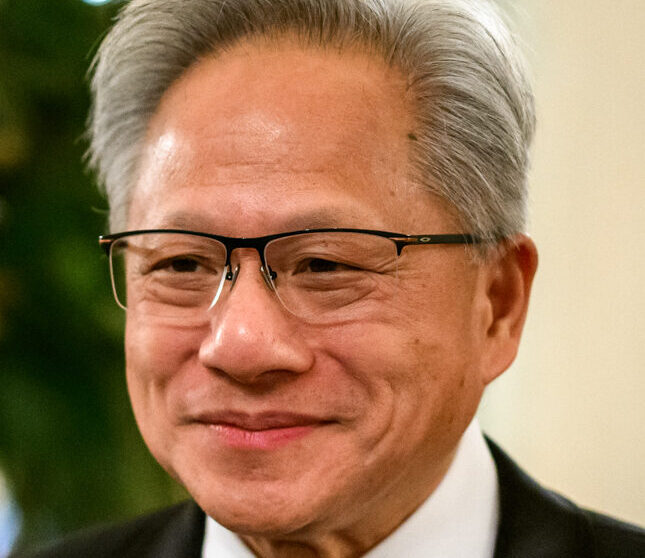


Over the past several years, the company founded by Jensen Huang has evolved from a firm known to computer-game enthusiasts into one of the most important companies in the world. Today, Nvidia is the foundation on which the entire AI industry is being built, and the fate of a large part of the U.S. economy depends on it.
“When America sneezes, the world catches a cold,” goes a saying popular among economists. Today, investors and economists increasingly say “Nvidia” instead of “America.” That is why the spy scandal and the departure of the company’s chief and founder, Jensen Huang, are being followed around the world.
Last year, the maker of advanced electronic chips became the first publicly traded company valued at $5 trillion. Although it has since lost the top spot to Apple, the company’s real importance goes beyond its stock market value. A large part of the AI industry rests on the company’s products and investments, and according to politicians in Washington, access to the most advanced chips may decide the outcome of the race between the world’s powers.
The company’s importance to the American and global economy has many aspects. According to the Stanford AI Index 2026 report, Nvidia accounts for more than 60% of the world’s AI computing power. According to a report by the firm Presenc AI, Nvidia’s share of the data center segment, meaning the infrastructure that supports artificial intelligence systems, is estimated at 80% to 85%. The company’s position is gradually declining, in part because other giants, including Google and Amazon, are producing cheaper AI chips, but it remains dominant.
Beyond its market share, the company’s significance lies in the fact that it sits at the center of what the industry calls circular financing. This is an arrangement in which a product supplier invests in its customers or guarantees their debts while also lending them money to buy its products.
Nvidia is an investor in OpenAI, as well as in the cloud company CoreWeave, which rents out computing power based on Nvidia chips to OpenAI and other companies. But the company has also invested in OpenAI’s main rival, Anthropic, and has ties to Elon Musk’s SpaceX.
These arrangements, along with the huge investments in AI infrastructure and chips, have long worried some investors that if the enormous demand for the company’s chips turns out to be smaller than expected, a “bubble” will burst, sending shockwaves through the rest of the economy.
Investment in AI infrastructure is currently the main driver of U.S. economic growth. Shares of Nvidia and other companies in the sector already make up nearly half of the value of the S&P 500 index, which is the basis for investments by a huge share of funds around the world.
As the maker of the world’s most advanced AI chips, Nvidia is also central to the rivalry between the U.S. and China. Access to the company’s best chips, meaning those with the greatest computing power, is the main advantage the United States holds in this race. Although Chinese companies such as Huawei are competing in chip production, they are estimated to be about three years behind Nvidia in the performance of the chips they make.
The role of Huang, the Taiwan-born chief, founder and symbol of the company, was ambiguous here. The businessman has long argued for loosening restrictions and for greater entry into the Chinese market. In January 2026, thanks to Huang’s efforts, President Donald Trump announced that he would grant a license to export H200 chips, which are advanced but not the newest, to China in exchange for 25% of sales revenue being paid to the U.S. budget. Trump later also signaled approval for exporting a scaled-down version of the latest chips in the Blackwell series.
In practice, these chips have not been exported to China, at least through direct channels, partly because of the stance of Beijing, which officially favors its own semiconductor industry. But as the spy scandal involving Huang has shown, Chinese technology companies are smuggling Nvidia products on a massive scale through shell companies in Southeast Asia. One such company is Singapore-based Megaspeed, headed by Alice Huang (Huang Le), with whom Nvidia’s chief reportedly had an affair and who, according to U.S. agencies, worked for Chinese intelligence. According to the news site The Information, companies linked to Alice Huang and her husband (who was reportedly aware of the affair) brought chips worth more than $7.5 billion into China.
Huang’s departure could have major consequences for Nvidia, because the businessman, as the company’s founder, was identified with it and did not draw up a succession plan.
But the scandal also has broader significance for the company, because Southeast Asia has until now been an important market for its products. According to the Wall Street Journal (WSJ), exports to Singapore were said to account for 22% of the company’s revenue in the second quarter of 2025. In light of the spy scandal, a chorus of voices in Congress has called for tighter export controls.
Nvidia’s current position as one of the most important companies in the world is a direct result of the past four years and the development of artificial intelligence. Huang founded the company in 1993 with Chris Malachowsky and Curtis Priem, and for most of its existence it focused on making graphics chips used mainly for computer games. The breakthrough came in 2006, when the company introduced the CUDA platform, which allows graphics cards to be programmed for arbitrary computations.
Only later did it turn out that they could be useful for training the neural networks that underpin artificial intelligence models. The company released its first products designed specifically for AI in 2017, but the real explosion in demand began when OpenAI released ChatGPT, which kicked off the ongoing AI revolution.
Since then, the company’s stock has risen from about $15 to $239 this October. Since that peak, the share price has fallen by more than 30%. Besides the Huang scandal, this reflects concerns about the long-term profitability of the massive AI investments, as well as concerns about regulation of the industry in light of the Democrats’ victory in the congressional elections.
From Washington, Oskar Górzyński (PAP)
