
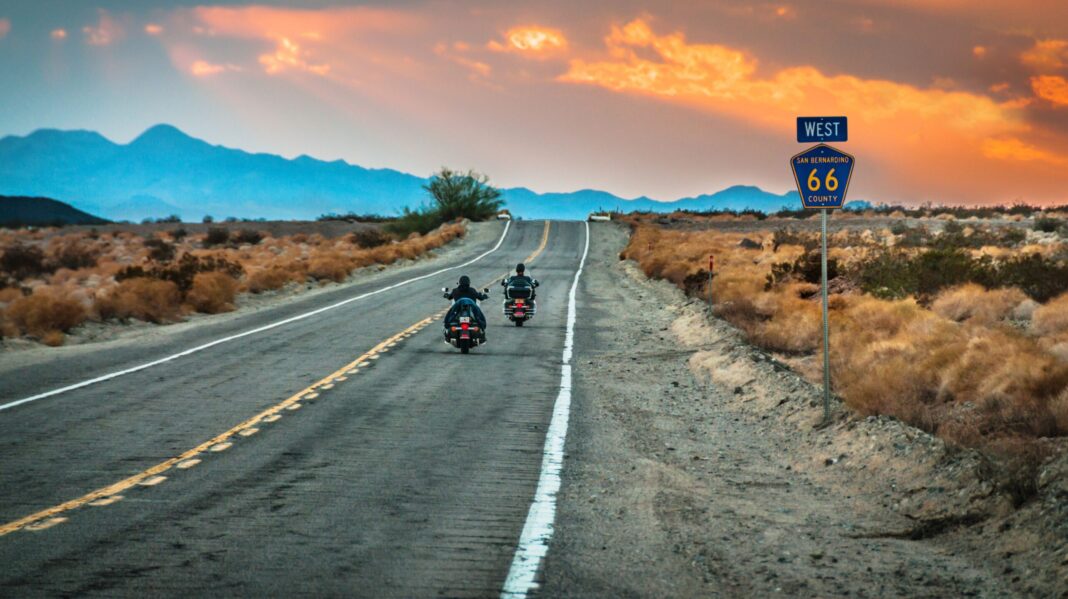


Route 66, which was created 100 years ago, is considered the most famous road in the world. Alongside the American flag, Coca-Cola, Elvis Presley and McDonald’s, it is one of the most recognizable symbols of the United States.
John Steinbeck called it the “Mother Road,” and Nat King Cole sang about it. It shaped American identity and culture, promised the fulfillment of the “American dream,” freedom, mobility and adventure, and gave artists inspiration.
Route 66 opened on Nov. 11, 1926, but it carries echoes of the earlier conquest of the Wild West and the slogan “Go west, young man.” Cowboys and settlers headed west in horse-drawn wagons across trackless country in search of a better life. When Route 66 was built, their descendants, with the same dreams, headed west in cars. Though born of pragmatism, the road became a romantic symbol in American culture.
For immigrants from Europe, it was a road to a better life. During the Great Depression, thousands of Americans traveled it across the country, from east to west and back again, looking for work that would let them survive hard times. After World War II, American veterans returning from Europe covered hundreds of kilometers on it in search of meaning in life. They became the seed of several subcultures of the time, including the Beats and the Hells Angels. Hippies, too, had a similar goal, though with a different ideological backdrop. Between those groups were millions of ordinary Americans for whom the “Mother Road” was part of everyday life.
In American literature, the symbolism of Route 66 is best captured by canonical works such as John Steinbeck’s “The Grapes of Wrath” (1939), Jack Kerouac’s “On the Road” (written in 1951, published in 1957) and Robert Pirsig’s “Zen and the Art of Motorcycle Maintenance” (1974), considered the best-selling philosophy book of all time. On the Polish book market, the iconic account of a journey along the route became “Asfaltowy saloon” (“Asphalt Saloon”) by Waldemar Łysiak (1980).
– Route 66 gave rise to the road genre in country music. This road is more than just a strip of asphalt; it is the myth, legend and nostalgia of America, Michał “Lonstar” Łuszczyński, for more than 45 years one of the biggest country music stars in Poland, told PAP, the Polish Press Agency. – The road in country music is often identified with the road of life. It is a metaphor for freedom. It invites you to escape somewhere, or to use it to return from a place you didn’t want to be. The road combines two seemingly extreme concepts, romanticism and realism, “Lonstar” explained.
The photograph shown here, taken in 2011, shows a historic stretch of Route 66 in Arizona.
The photograph can be seen here: https://skroc.pl/RaoQHxD and on dzieje.pl: https://dzieje.pl/wiadomosci/historia-jednej-fotografii-z-bazy-zdjec-pap-route-66-droga-symbol-ameryki-ma-100-lat
Subscribers to the PAP service can download this photograph free of charge to illustrate this text.
For hundreds of years, the main road story was Homer’s “Odyssey.” In the 20th century, stories inspired by Route 66 became the modern foundation of road narratives. The road, traveled by car or motorcycle, has always been a metaphor for, among other things, life, the search for meaning and identity, escape, and a journey into the unknown. For 100 years, this highway has inspired writers, filmmakers and musicians. A significant part of American literature, music and film has been built on its myth.
It laid the groundwork for the American road movie, represented by cult films such as “The Grapes of Wrath” (the film adaptation of the novel, 1940), “Easy Rider” (1969), “Vanishing Point” (1971), “Duel” (1971), “Smokey and the Bandit” (1977), “Convoy” (1978), “The Hitcher” (1984) and “Thelma & Louise” (1991). In the 1960s, a television series called “Route 66” was made, telling the story of two young men traveling across the United States.
The song that became almost an anthem of the highway was “(Get Your Kicks On) Route 66” from 1946, composed by Bobby Troup and first sung by Nat King Cole. The song also appeared on The Rolling Stones’ debut album. Many other artists have also taken it up, including Chuck Berry. Themes of Route 66 could also be found in country songs about the lives and work of big-rig truck drivers.
Route 66 also had a significant influence on prosaic areas of life. The growing volume of car travel along the route contributed to the rise of fast-food restaurants that served drivers.
It ran from Chicago, Illinois, through Missouri, Kansas, Oklahoma, Texas, New Mexico and Arizona to Los Angeles, California. Its length was 2,448 miles (3,940 km). It was built on a network of local roads. In the early years, some sections still had dirt surfaces; the road was fully paved in 1938.
As the interstate highway system was built, Route 66 was gradually replaced by new roads. In 1979, U.S. road authorities recommended removing the Route 66 designation, and the last sections of the road were removed from the highway system in 1985. To this day, many stretches of the old route have been preserved as historic sites and are tourist attractions.
What remained eventually became a national landmark. In 1999, President Bill Clinton signed a law to preserve Route 66, which provided federal support for restoring historic sites along the route. The step revived local initiatives commemorating Route 66 and its historical and cultural significance. Surviving buildings tied to road infrastructure, including gas stations, motels and roadside restaurants, were restored, and several local museums related to the road were opened. The animated film “Cars” (2006) became a cinematic monument to Route 66. Its creators managed to make a film that is both engaging for young viewers and faithful to the history of the place it portrays.
In 2018, the U.S. Bicycle Route 66 was designated, running along parts of the “Mother Road.” In 2026, the U.S. Postal Service issued a commemorative stamp marking the route’s centennial.
The photo archive of the Polish Press Agency (PAP) holds about 20 million photographs and continues to grow with new collections. Its holdings reach back to the 1920s and are an important part of the national heritage. The images, frozen in frames, record every aspect of social, political, economic, cultural and religious life over the past 100 years.
Professional digitization of PAP’s photographic holdings makes them widely accessible through the PAP website (https://fotobaza.pap.pl/). A team of specialists works on correctly identifying and describing the photographs in detail, reviewing source materials in reading rooms and archives. Customers are kept up to date on new photographs in the PAP Photo Database.
Tomasz Szczerbicki (PAP)
