
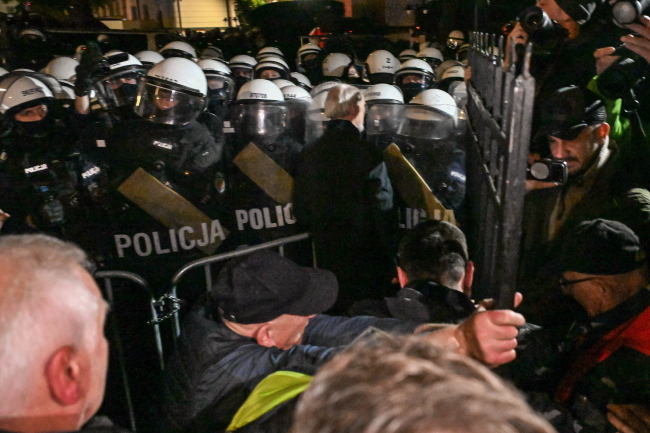


The fight over the Constitutional Tribunal (TK) is a kind of rigged match between Poland’s two main political forces, the Civic Coalition (KO) and Law and Justice (PiS), which allows them to eliminate an independent tribunal, reinforce a polarization that benefits them and weaken their competitors, says Prof. Antoni Dudek of Cardinal Stefan Wyszyński University in Warsaw (UKSW). In his view, the key day will be Nov. 11, because those gathered for the Independence March may head for the Chancellery of the Prime Minister (KPRM) in an attempt to topple Donald Tusk.
PAP: How do you assess the war over the Constitutional Tribunal that began Friday evening? Is it a rigged match?
Prof. Antoni Dudek: I think it is a kind of political rigged match. Of course, it is not being arranged on an ongoing basis, but it follows from the logic of the conflict that has taken shape over the last 11 years. As a result, the two largest political forces in the country have gotten rid of the Constitutional Tribunal, and at the same time they can accuse each other of the Tribunal not functioning. The upshot is that there is no Tribunal, and it is clear that this process will deepen, because neither side is interested in a compromise.
PAP: So the second goal of this rigged match is to strengthen the polarization from which KO and PiS benefit at the expense of smaller parties? Does that mean alliances outside these two camps, for example the PSL with Rozwój Plus, will become impossible?
A.D.: Everything is aimed at maintaining the dominance of the two main politicians, Donald Tusk and Jarosław Kaczyński. Although on the right the situation is somewhat more complicated, because there is the question of the role of Karol Nawrocki. I can find no other explanation for Tusk staging this kind of spectacle than the desire to strengthen polarization. After all, those eight judges could have met outside the TK building on Al. Szucha and made there the decisions that are due to be made on Nov. 3. Later the building could have been taken over gradually, once it ran out of electricity, heating and so on. President Bogdan Święczkowski would probably have left it in time. Tusk, however, evidently wanted a spectacle, and he has one.
PAP: What can we expect on Tuesday? Who will take part in the General Assembly, and what should we expect from it?
A.D.: Those eight judges elected in the current term will decide that they have the quorum needed to lift Bogdan Święczkowski’s immunity, because, as Anna Korwin-Piotrowska claims, two judges, Bogdan Święczkowski and Bartłomiej Sochański, are inactive, since they have a break in their service. So the quorum is counted not from 15 judges but from 13, and in that case eight people make it up.
PAP: None of the judges elected before 2023 will take part in the General Assembly?
A.D.: That is where this is heading. From what I know, none of those seven is planning to attend the General Assembly. That surprised me, by the way, because I thought that over all these weeks they would have managed to win over at least one person. But we will see on Tuesday. I think that is how it will look, because otherwise what would be the point of the meeting? To state that there is no quorum? So they will decide that they have a quorum, adopt the draft budget for next year, and also lift Święczkowski’s immunity. The question is whether Tusk will go further and, for example, decide to arrest Święczkowski. If he wants further escalation, he will do so.
PAP: Are the opposition’s fears justified that a Tribunal taken over in this way will help the current government win the 2027 election? Could it, for example, make decisions aimed at outlawing PiS or other parties, or try to remove President Karol Nawrocki from office?
A.D.: I don’t think Tusk intends to remove Karol Nawrocki from office or to outlaw PiS. It will more likely head in the direction in which the Tribunal finally begins to hear cases and its rulings are published, and so on. So that one can say the constitutional court has been fixed. That will last if Tusk stays in power after the 2027 election. If there is a change of government, of course such a TK will be challenged.
In my view, Poland has had for some time now a system of “sejmocracy,” which works this way: whoever has a majority in the Sejm, the lower house of parliament, forms the government, and that government rules, including in all public institutions. And if someone doesn’t like it, they may end up like President Święczkowski, or like National Prosecutor Dariusz Barski earlier, or the leadership of the public media. It is a mechanism for forcing through one’s political will, which I would not call a dictatorship, but rather a departure from the rule of law. This process is advancing and resembles the unraveling of fabric. As it began to unravel in 2015, so it unravels more and more.
We will see what happens if, for example, on Nov. 11 a crowd heads for the prime minister’s chancellery to remove Tusk from office. Some right-wing politicians certainly intend exactly such a scenario. Listening to their speeches at the rally overnight from Friday to Saturday, it was clear that they wanted huge crowds to come to Warsaw under the pretext of defending the Tribunal. And because the prime minister’s chancellery is right next door, they wanted them then to move against Tusk and overthrow him. As we know, the crowds did not come. The right-wing leaders’ ability to mobilize is, so far, rather meager.
PAP: But on Nov. 11 there will be far more people at the Independence March…
A.D.: Yes, which is why I can imagine that this enormous crowd will set off from Dmowski Roundabout not, as usual, along Jerozolimskie Avenue toward Praga, but toward Szucha and the KPRM. I expect there could be some brawls, which were avoided overnight from Friday to Saturday. I don’t think, however, that they would lead to the fall of the government and the overthrow of Tusk. That would already be a real coup d’état.
PAP: Is there any chance of a constitutional reset on the Tribunal, which is demanded not only by some opposition parties but also by KO’s coalition partners, the PSL and Polska 2050? Representatives of both parties also took part in Saturday’s consultations with the president.
A.D.: They took part to show what role they play. Of course, the coalition partners will declare that the TK needs to be fixed, that a constitutional reset is needed, but in reality nothing of the kind will happen. They have only one tool they could use: not supporting the budget, which would open the way for Karol Nawrocki to dissolve the Sejm and call early elections. But for both Hołownia’s movement and the PSL that would be a risky game, because it could mean they would not find themselves in the next Sejm.
Undoubtedly, from the standpoint of the political atmosphere in Poland and the current paralysis, early elections would be beneficial. Otherwise we face a year of permanent war between the president and the government, vetoing of further bills and so on. After any elections nothing will change if the current coalition keeps power. If it loses it, we will have the rule of some right-wing coalition compatible with President Nawrocki.
In my view, however, it is politicians who want some kind of crisis point, not ordinary people. If people wanted it, we would probably have had tens of thousands of people on Szucha over the weekend and a new Maidan. Instead there is a small group of elderly people singing religious songs. It resembles the situation at the cross on Krakowskie Przedmieście in 2010. So what happens on Nov. 11 is key.
PAP: Is no positive breakthrough around the TK possible? I understand that agreeing to a reset is a kind of test of intentions. If someone is for a reset, it means they care about genuinely repairing the Tribunal. Opposition suggests that it is mainly about the conflict? Because if either KO or PiS agreed to a reset, it could be carried out, since there would be a constitutional majority?
A.D.: As we said at the start, they don’t want it, because it would restore a constitutional court that limits power. If compromise candidates were elected to the TK, that is, most likely people who can’t be controlled, they could behave in various ways. It is better to have Berko-like or Święczkowski-like people on the Tribunal. Besides, a great polarizing instrument that both parties badly need would be lost. I don’t see in Kaczyński or Tusk even a shadow of willingness to reach any compromise. They believe they are in the right and that the other side is breaking the law.
Interviewed by Piotr Śmiłowicz (PAP)
